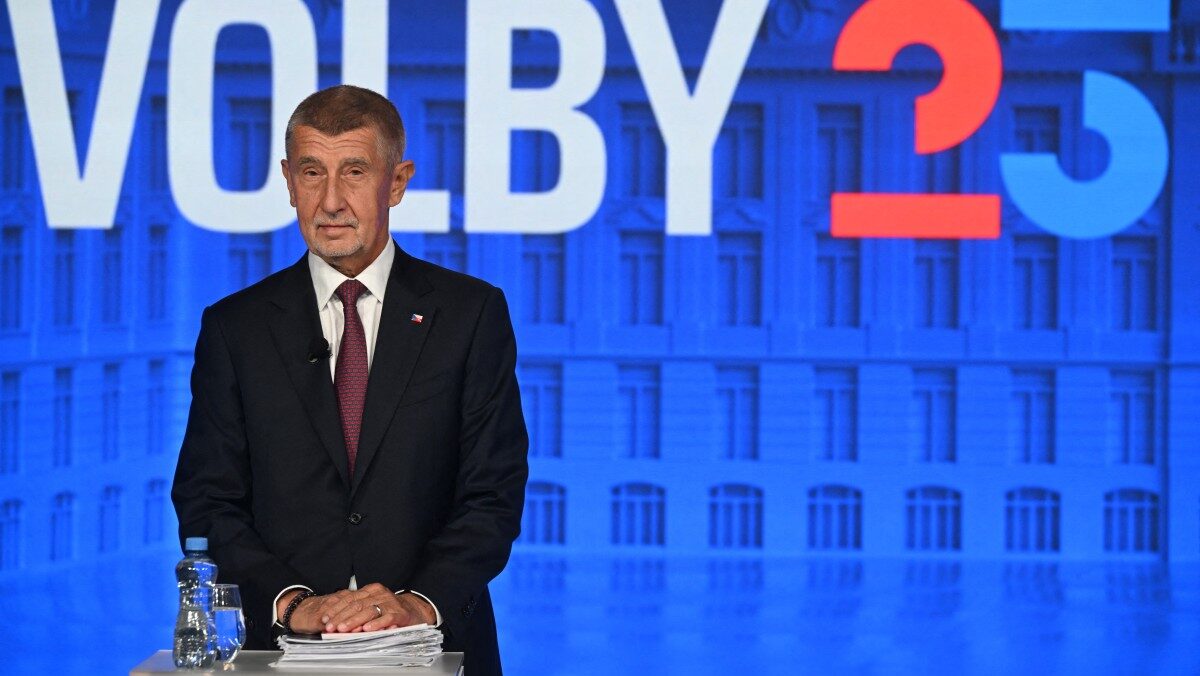
Leader of Czech Republic’s ANO party Andrej Babis looks on at the TV studio of CNN Prima tv prior to his election TV debate with Czech Prime Minster and Leader of Czech Republic’s Civic Party (ODS) and Together (SPOLU) coalition, on October 1, 2025, in Prague, Czech Republic.
Michal Cizek / AFP
The Czech Republic heads to the polls on October 3–4 with billionaire former prime minister Andrej Babiš poised for a return to power, as his sovereignist-Eurosceptic ANO movement commands a double-digit lead over the governing coalition of Petr Fiala.
Opinion polls place ANO at 31% support, comfortably ahead of Fiala’s Europhile centre-right Spolu coalition with 21%. The right-wing, anti-immigration Freedom and Direct Democracy (SPD) is in third place at 13%.
Czechia, Median poll:
— Europe Elects (@EuropeElects) September 29, 2025
ANO-PfE: 31%
SPOLU-ECR|EPP: 21% (+1)
SPD-ESN: 13% (-1)
Piráti-G/EFA: 10% (+3)
STAN-EPP: 10% (-1)
Stačilo!-NI|S&D: 7% (-2)
Auto-PfE: 5%
Přísaha-PfE: 2%
+/- vs. 01-31 August 2025
Fieldwork: 01-25 September 2025
Sample size: 1,019
➤ https://t.co/EvT7FIWCzK pic.twitter.com/NbMDA5evpf
Babiš, who previously led the country between 2017 and 2021, has built his campaign around promises of cheaper energy, lower taxes, and stronger pensions.
Central to his platform is a defence of Czech sovereignty against Brussels’ overreach on migration and climate policy.
At a recent rally in the central town of Kralupy, he denounced “the green madmen, people’s party and socialists who do all they can to destroy Europe,” pledging instead to “win against regulations and snooping, green taxes that the EU comes up with.”
His criticism resonates with many voters who feel that the current government has been more preoccupied with Ukraine than with its own citizens.
Fiala’s coalition, which has sent weapons, coordinated an EU-backed ammunition supply scheme, and championed the Green Deal, is increasingly viewed as out of touch.
A poll in June showed that 49% of Czechs believe the country is giving too much to Kyiv, compared to 29% who said it was about right, and just 6% who said aid was insufficient.
Babiš has vowed to end what he calls the “rotten” shell-supply initiative, arguing that funds should be spent at home. The Czech Republic needs the money for its own people, not for arms traders, he said last month.
While critics accuse him of being soft on Russia, Babiš insists he is a “peacemonger” who seeks a truce in Ukraine rather than endless escalation. He has made clear that the Czech Republic will remain both in the EU and NATO, but on pragmatic, interest-based terms.
If ANO falls short of a majority, it could turn to potential allies such as the SPD or Stačilo!, both of which oppose military aid to Ukraine and want referenda on EU and NATO membership. Such a coalition would pull Prague closer to the sovereignist governments of Viktor Orbán in Hungary and Robert Fico in Slovakia, reinforcing the Visegrád bloc as a counterweight to Brussels.
Fiala, a former political science professor, has warned against “losing our country’s destiny to Russia’s collaborators.” But his words ring hollow against a backdrop of declining living standards, tax hikes, and cuts to public services. Teachers, pensioners, and young families alike have felt let down by a government that promised reforms but delivered austerity.
Meanwhile, Babiš’s message is simple: defend Czech interests, prioritise ordinary citizens over foreign wars, and resist policies that undermine national prosperity.