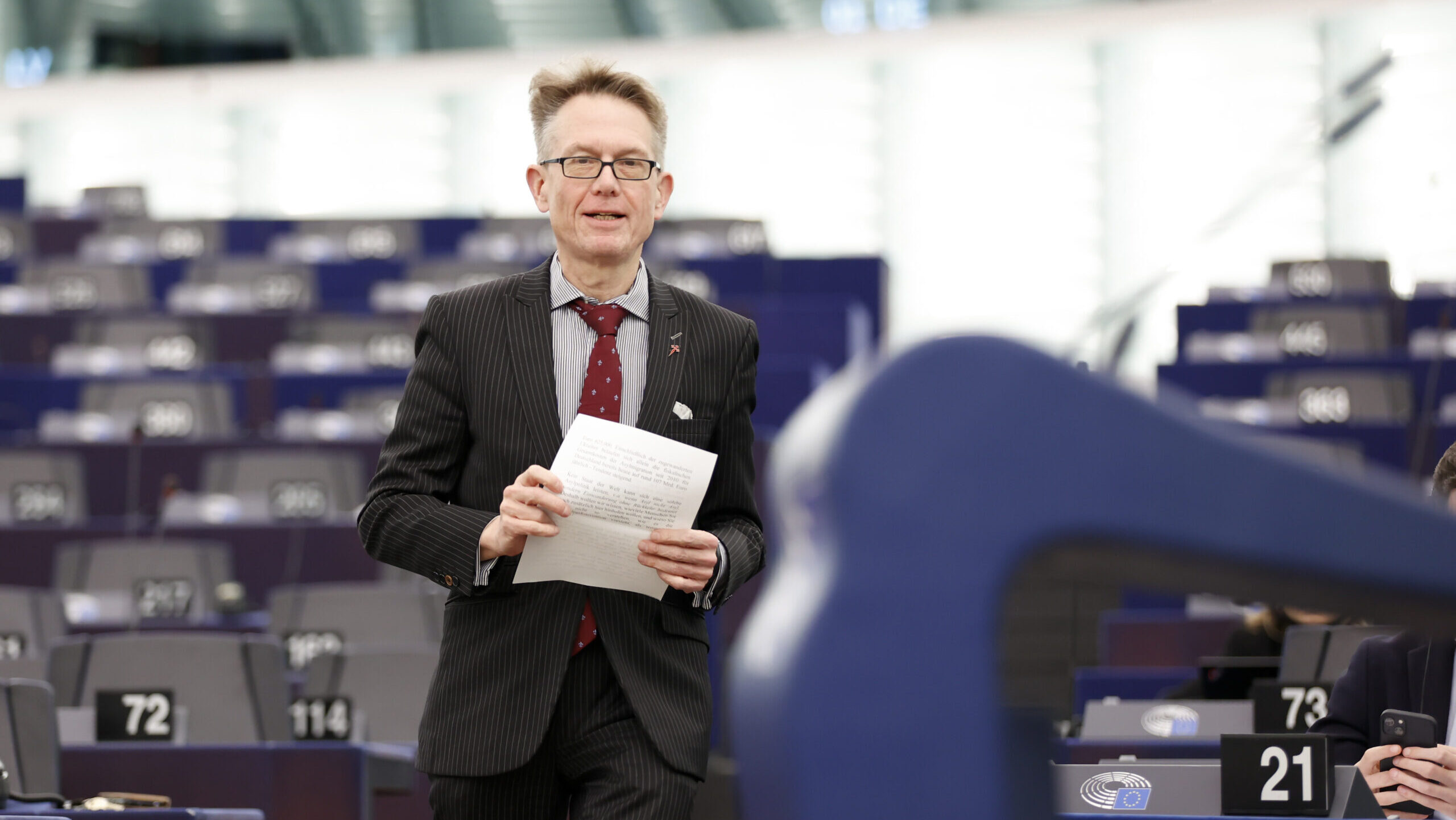
Gunnar Beck
Mathieu CUGNOT © European Union 2024 – Source: EP
A long-running criminal case against former Member of the European Parliament for the Alternative for Germany (AfD), Gunnar Beck, has collapsed before a local district court (Amtsgericht) in Neuss, North Rhine-Westphalia. After more than three years of a much-publicised criminal investigation, the Public Prosecutor’s Office in the regional capital of Düsseldorf suddenly threw in the towel and dropped the unfounded allegations a few days before the final hearing and scheduled pronouncement of judgement. Beck has consistently rejected the accusations, describing them as “grotesque and fabricated”.
Beck, a university academic, practising lawyer and MEP until 2024, had been under investigation since 2022—initially on charges of robbery and theft of a scarf from a Neuss department store and violent assaults on employees and police officers. A conviction for robbery could have carried a custodial sentence of up to fifteen years. Although the investigation was rapidly discontinued in November 2022, it was reopened in 2023 by another public prosecutor. The charges were then conspicuously altered in scope. In 2023, the allegation of robbery was reduced to alleged theft of drugstore items found in Beck’s luggage, valued at approximately EUR 350. In 2024, the allegation of aggravated theft was further downgraded to petty theft of cosmetic test samples valued between €1 and €20.
During a hearing in late September 2025, witnesses testified that the defendant had been “really aggressive,” yet they were unable to recall the alleged events or the specifics of his aggressive conduct; nor were they able to identify any stolen items, describe the injuries allegedly inflicted by Beck and recorded on police instruction, or identify who amongst them had been the victim of the aggressive conduct and injured by him.
Crucially, at the trial, the prosecution conceded that at no point during the proceedings or the hearing had they identified a single item which they had sufficient reason to believe Beck had allegedly taken from the store, nor was there any evidence to suggest he had taken anything at all. In fact, the court found that none of the items seized from Beck had ever been sold at the Neuss branch of Galeria Kaufhof. The scarf alleged to have been stolen was shown to have been lawfully purchased abroad by Beck years earlier.
The court, accordingly, dismissed the allegations of theft, assault and bodily harm and, by order dated 21 November, imposed a penalty order against Beck for alleged “verbal resistance” to police officers. Beck also disputes this allegation. In a video statement released earlier this year, he argued that a few sharp words were understandable, given that he had been “confronted by four strong men who were all twice as broad and half as young” as he was.
Critically, Beck further asserts that the proceedings were predicated upon misrepresentations and fabricated evidence. According to him, photographs of items taken from store shelves were presented as goods supposedly seized from his luggage and as ‘stolen goods’ in a criminal complaint drawn up and signed by the manager of the department store. In a statement to The Burkean, Beck characterised the case as politically motivated and referred to the same senior prosecutor in Düsseldorf, who had previously investigated him for unauthorised use of an academic title—a matter that concluded with a mere warning and no fine. In a press release published on X.com, Beck wrote:
The charges go back to an incident in the Kaufhof department store in Neuss, near which I had spent the day lawfully distributing political leaflets with party colleagues. When I visited the store later I was accosted by store employees and the Neuss police accused me of robbery (!) of a scarf purchased in England and of violent assault. A later criminal complaint by the Kaufhof department store in Neuss for theft of goods worth over EUR 350 was demonstrably ‘rigged,’ i.e., entirely invented, while I could demonstrate that I had lawfully bought the scarf years ago in England. Importantly, not a single one of the items found on my person or seized from my luggage had ever been offered for sale at the department—neither at the relevant time nor at any time before or after.
On social media Beck added:
Left, some right-wing and liberal and centrist German politicos are calling for sanctions and military action to spread the benedictions of democracy and the rule of the law. The Germans love to lecture other nations. All the same, their own legal system is far from perfect. In my case, the judge finally did the right thing because there was not a shred of evidence. However, the prosecution should have never been brought in the first place. How was it even possible for it to be initiated in the absence of any, even minimal evidence. The reason is simple. Public prosecutors are not independent, but act on the instructions of regional ministers of justice. Even the European Court of Justice has criticised this deficiency. Germany’s justice system can be relatively lenient, but it is highly politicised, and it is certainly not the envy of the world. Instead of making others’ concern their own, German politicos had, as Voltaire once advised them to do, cultivate their own garden first.
The widely reported waiver of Beck’s parliamentary immunity shortly before the 2024 European elections marked the beginning of a judicial and media campaign that AfD representatives frequently describe as the illegitimate use of legal mechanisms for political purposes (“lawfare”). During the hot phase of the election campaign, the allegations against Beck receded into the background in light of espionage and corruption allegations against AfD lead candidates Maximilian Krah and Petr Bystron. Even before the 2024 European elections, the AfD Bundestag staffer Marie-Therèse Kaiser and Thuringian AfD leader Björn Höcke were convicted of incitement to hatred. Even the left-leaning daily TAZ remarked, in relation to Höcke’s case, that the conviction lacked a clear evidentiary basis and did little to strengthen confidence in the judiciary: “An acquittal would therefore have been more appropriate.” Prior to the Thuringian state election, Höcke received a second conviction for incitement to hatred on essentially identical allegations, with several further proceedings based on similar accusations still pending.
Despite continuing legal pressure, the AfD secured just under 16% in the 2024 European elections and nearly 21% in the Bundestag elections one year later. Current polls place the party at approximately 26–27%. Lawfare—the instrumentalisation of the German justice system—may intensify further.