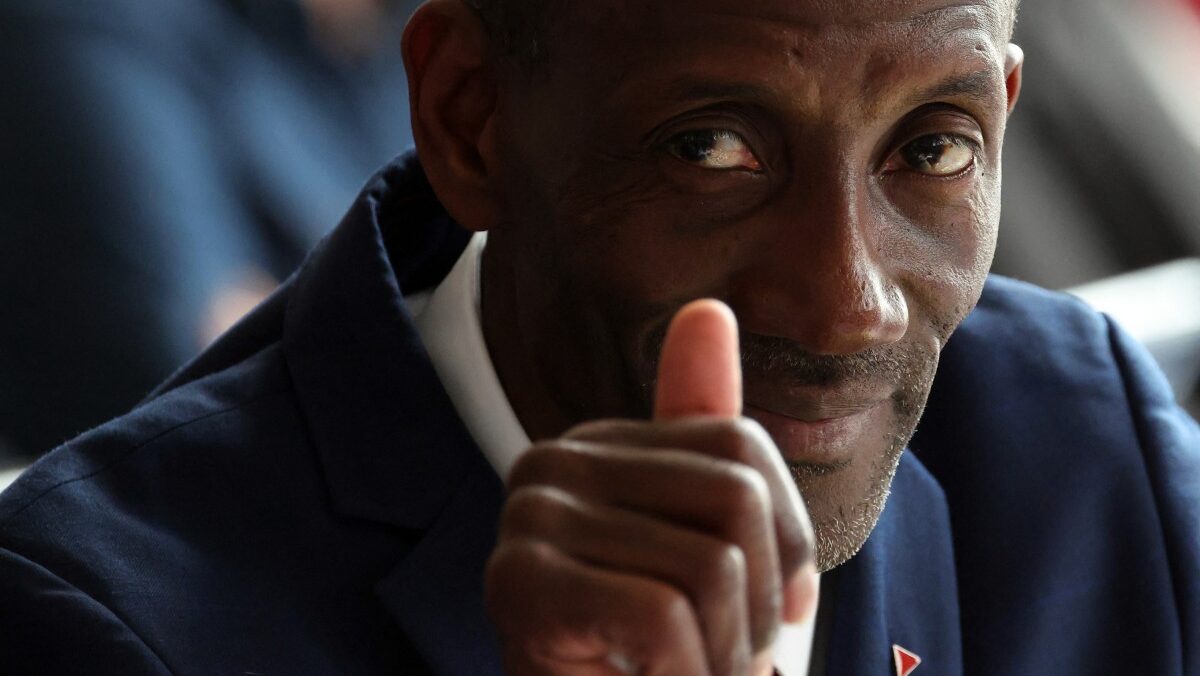
Saint-Denis’ mayor Bally Bagayoko chairs the first session of the newly-elected city council in Saint-Denis, suburb of Paris on March 21, 2026.
LUDOVIC MARIN / AFP
In the areas where they have just been elected, the mayors from La France Insoumise (LFI) are already making a name for themselves for all the wrong reasons. Recourse to violence, communalism, and sectarianism—they paint a worrying picture of France in the hands of the far left.
Although Jean-Luc Mélenchon’s party is far from having secured the resounding victory it claims in the press following its results in the March 2026 French municipal elections, it has won a few symbolic strongholds that allow it to assert that a “new France” is emerging.
In Saint-Denis, Mayor Bally Bagayoko, of Malian origin, elected in the first round, now finds himself at the helm of a city with over 150,000 inhabitants. Others have joined him.
The handover of power to the new teams did not go smoothly. In the hours following the victory of the LFI mayors and their allies, images circulated showing violence, insults and shoving directed at the outgoing mayors, sparking outrage.
In some cases, the outgoing mayors even had to be escorted by the police: having lost by 104 votes to LFI’s Abdelkader Lahmar in Vaulx-en-Velin near Lyon, the Socialist Hélène Geoffroy was humiliated by residents present when the results were announced. Defeated by Omar Yaqoob in Creil, in the Oise department, Sophie Dhoury-Lehner also denounced the “insults and threats” suffered by her team. “My running mates and I were forced to remain in the town hall, surrounded by individuals hurling insults and threats. The intervention of the national police was necessary to ensure our safety,” she explained to the press.
After Saint-Denis and Creil, Mantes-La-Jolie and Le Blanc-Mesnil: the list is long of these towns where the outgoing mayors had to be escorted out amidst threats and jeers in a toxic atmosphere, giving the impression that the new mayors were celebrating a territorial conquest rather than an electoral victory. The scenes were filmed and widely shared on social media, revealing an atmosphere of unrest foreshadowing a form of civil war.
The climate of violence that is taking hold is worrying local elected representatives. In Saint-Denis, a socialist councillor, Oriane Filhol, was attacked a few months ago by a certain Mouloud Bezzouh, who was found guilty a few days ago by the Paris Court of Appeal of having sent three young men in December 2023, in return for a promise of payment, to beat up the young woman, then a deputy mayor. She has just resigned, having witnessed, the day after her election, the new mayor engaged in a lengthy and clearly cordial discussion with her attacker. The mayor of Saint-Denis, for the time being, maintains that he has only “public relations” dealings with the attacker and describes the deputy mayor’s resignation as a “serious political error.”
Aurore Bergé, minister for gender equality and the fight against discrimination, spoke out on X against these disgraceful scenes. “These images are unbearable. No elected representative of the Republic should need to be protected by the police. Whether they were re-elected or defeated, they have served the French people,” she wrote.
Beyond their tumultuous arrival in office, the first announcements made by the LFI mayors are causing concern locally. In Saint-Denis, Bagayoko announced his intention to gradually disarm the local police, which is worrying the police force. According to police sources cited by Europe 1, of the 140 police officers in the town, nearly half are already considering requesting a transfer. The head of the municipal police, who is close to the outgoing Socialist mayor Mathieu Hanotin, is reportedly a particular target and is facing pressure to speed up his departure. For his part, the head of the video surveillance unit is applying for posts in other municipalities. Europe 1 notes a veritable “transfer market” for municipal police officers currently underway in the Île-de-France region, driven by municipalities seeking to retain an armed police force.
Faced with the ongoing exodus, the minister for public action and accounts, David Amiel, has written to the newly elected mayor of Saint-Denis to call him to order, emphasising that “no municipal authority can legally suggest that the situation of municipal officers, their posting or their continued employment could depend on their adherence, real or supposed, to the political orientations of the municipal executive.” The minister is also concerned about the risk of psychological harassment of staff should they not be in line with the political orientations of the new local authorities.
On X, Marine Le Pen of the Rassemblement National (RN) was quick to comment ironically on these waves of resignations within the police force: “Our new local authorities will be delighted to look into their cases!” she posted on March 24th, rejoicing at the wave of new RN elected mayors.
Nos nouvelles municipalités seront ravies d’étudier leurs dossiers ! https://t.co/IT3A6zksnh
— Marine Le Pen (@MLP_officiel) March 24, 2026