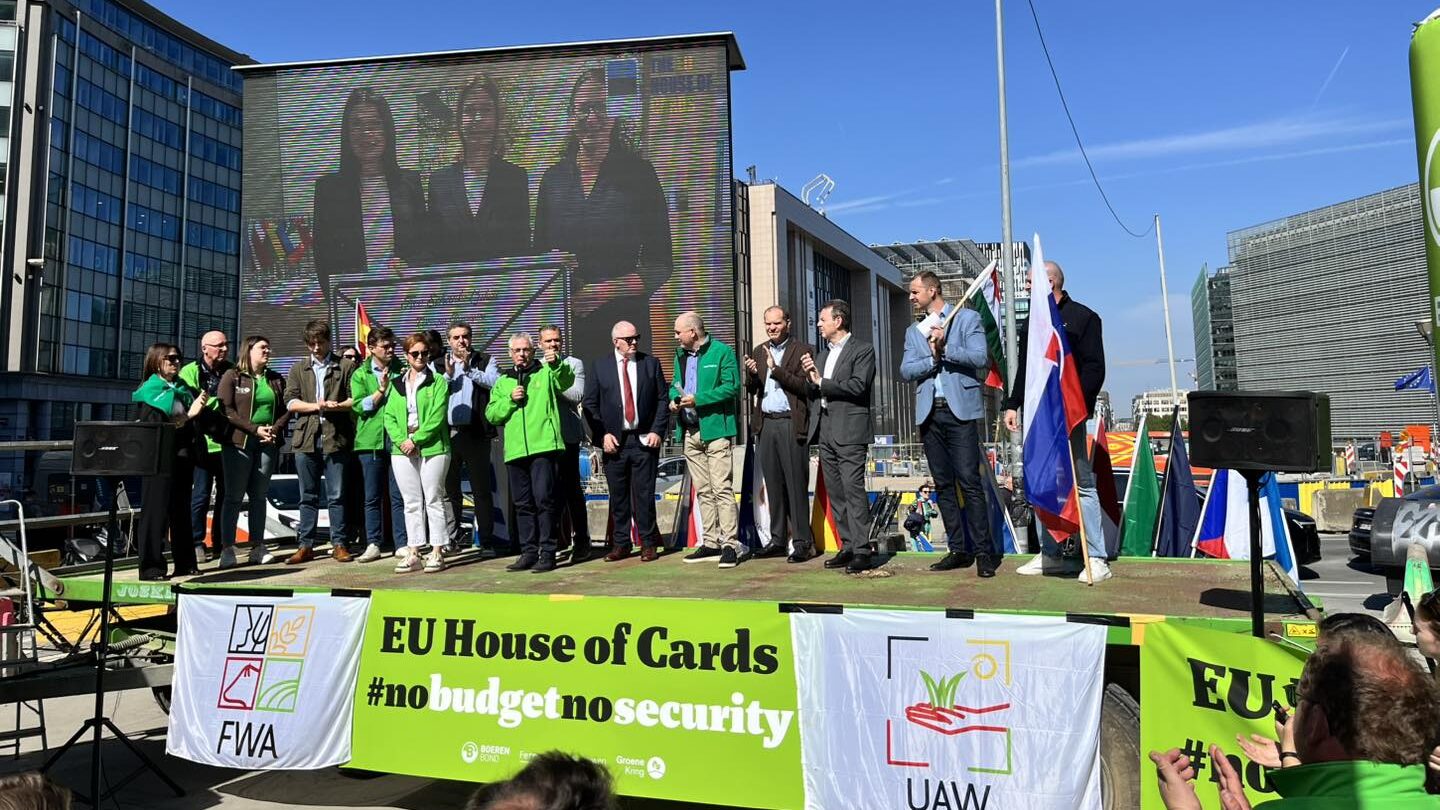
Photo: Fédération Wallonne de l’Agriculture (FWA) on Facebook, 20 May 2025
Belgian and European farmers’ organizations staged yet another protest in front of the European Commission’s Brussels headquarters on Tuesday, May 20th, to demonstrate against the budget cuts and other changes in the planned CAP (Common Agricultural Policy) reforms, set to be officially unveiled in July.
While the protest was peaceful and relatively small this time, the organizers noted that larger demonstrations might follow as the July 16th deadline approaches if European farmers still feel excluded from decisions about their future.
Last year saw a continent-wide series of massive farmer protests, some of which even turned violent, especially in Brussels. Now, an Ipsos poll has found that farmers are ready to mobilize again, with French and Polish organizations leading the charge.
The main reason is that the reforms, first pitched in January, include a major restructuring of the EU budget in the next seven-year financial framework, starting in 2028, diverting valuable grants and subsidies from the CAP to fund other projects, such as rearmament or Ukraine’s reconstruction.
Copa-Cogeca, the EU’s main farmers’ lobby, warned that the complete restructuring of the EU budget—by merging all currently independent instruments into a giant single cash pot to introduce more flexibility to the system at the expense of predictable financing structures—would jeopardize the very essence of the CAP.
Clever way from Belgian farmers in Brussels today to demonstrate why the planned cuts in EU agricultural subsidies can qickly lead to disaster in food security. #CAP #farmersprotest pic.twitter.com/hR8s8O8pye
— Tamás Orbán (@TamasOrbanEC) May 20, 2025
“It’s not just about cuts anymore,” Elli Tsiforou, secretary general of the organization, explained. “What we’re hearing, from behind closed doors where these discussions are happening, is deeply worrying. There are scenarios suggesting we could lose the second pillar of the CAP.”
The second pillar refers to rural development programs—a critical part of the CAP—that fund agri-environmental programs to help farmers conform to the mounting environmental and climate regulations coming out of Brussels, while also investing in small farms and rural community development.
Tsiforou said that Agriculture Commissioner Christophe Hansen seems supportive so far, but the final decision lies with EU Commission chief Ursula von der Leyen and the member states, who will determine where to put their money.
Nonetheless, there were a few conservative MEPs, at least, who appeared at the protest to signal their support. The EU Commission “always has a great ideological plan that is more important than European farmers,” MEP Csaba Dömötör said in a speech on behalf of the Patriots.
He pointed to green regulations suffocating the agricultural sector, rushed anti-Russia sanctions driving up energy prices, and opening the common market to third countries with cheaper produce (like Ukraine or Latin America) with little to no regard to the consequences.
The new plan of merging the CAP with other funds and stealthily reducing subsidies to support “everybody in the rest of the world” before local communities is the worst yet, and needs a proper response, the MEP added.
“As you see, the big plans are theirs. The consequences are yours and ours,” Dömötör said. “The time has come to say it out loud: a red line has been crossed, we must stop this. We need a strong and independent agricultural budget.”