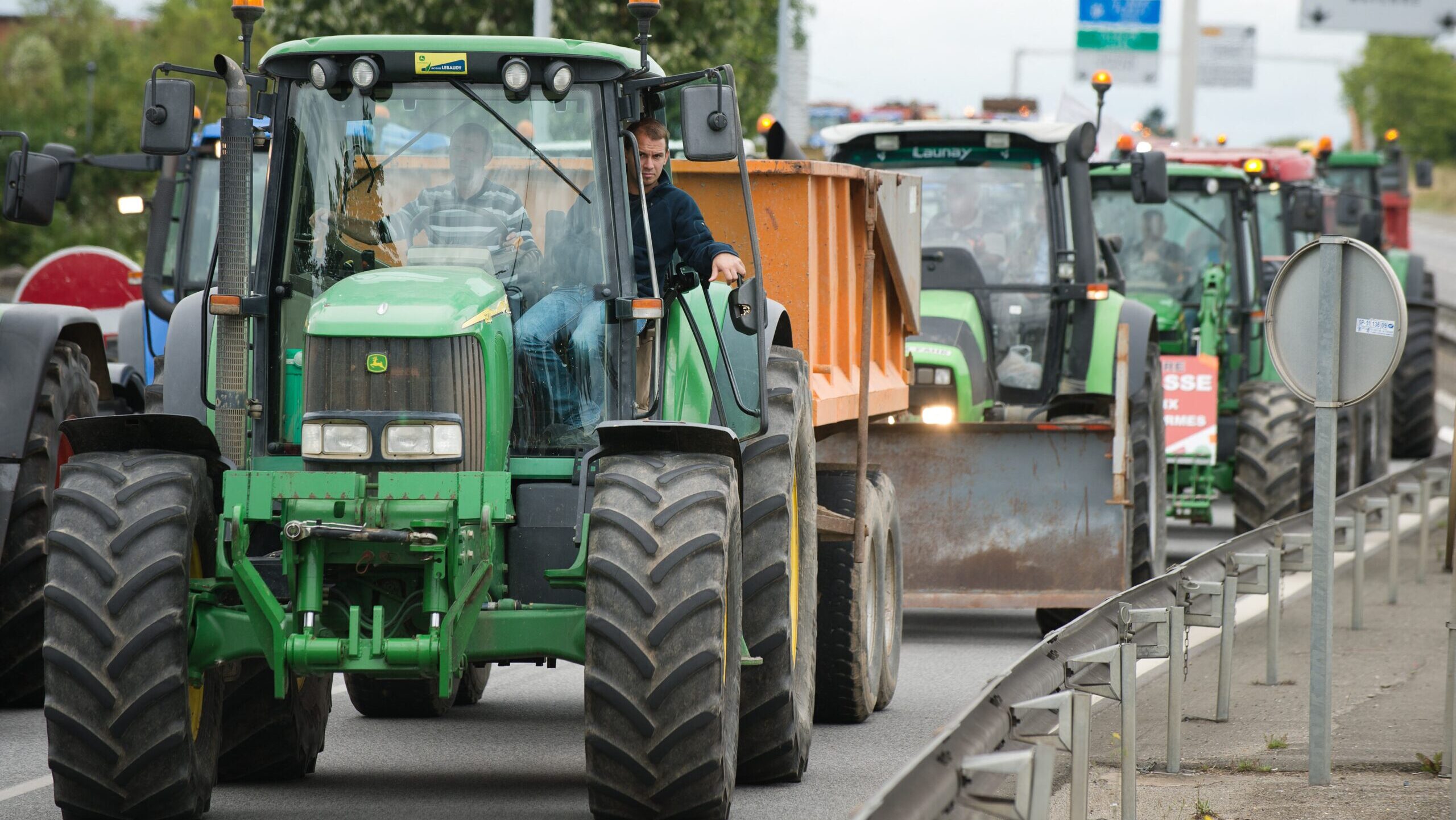
Farmers block roads during price protests in western France, 2015.
JEAN-SEBASTIEN EVRARD / AFP
What looks like a distant trade deal between Europe and South America is fast becoming a problem for Europe’s biggest political party. The Mercosur agreement is forcing the European People’s Party (EPP) to choose between its rural voters and the export interests of its largest economies.
That choice is now playing out inside the EPP itself, as long-stalled EU-Mercosur talks reach a critical moment. The main fault line runs between two delegations with sharply opposing economic and strategic interests: Spain and Germany.
The Spanish EPP delegation arrives under mounting political pressure. Spain is one of the EU’s leading agricultural producers, with farming and livestock sectors particularly vulnerable to cheaper imports. Although the Spanish People’s Party has long supported the EU’s climate and trade policies in Brussels—including measures that have raised costs for farmers—it continues to draw significant backing from rural voters.
That support is now under strain. Against a backdrop of recurring farmers’ protests and upcoming elections, open backing for the Mercosur agreement—widely viewed by producers as a direct threat to domestic agriculture—has become politically risky. As a result, the Spanish delegation has begun to cool its support for a treaty that until recently went largely unchallenged.
The German EPP delegation stands at the opposite end of the spectrum. For Berlin, Mercosur is seen as a major industrial and strategic opportunity. Preferential access to South American markets would boost exports of cars, machinery, and chemical products at a time of economic slowdown and tougher global competition. The negative impact on European agriculture, particularly in southern member states, is seen as an acceptable trade-off.
This confrontation reflects two economic models and two competing ideas of what the EU should be. Endorsing the German position would risk alienating a core rural constituency in favour of a trade deal that mainly benefits large industrial economies. Aligning with the Spanish stance, by contrast, would mean slowing an agreement backed for years by the European Commission and exporters in northern Europe.
The consequences extend beyond Mercosur itself. The decision will test the EPP’s internal cohesion and its credibility as a political force capable of balancing divergent interests without defaulting to technocratic compromise.
These tensions are compounded by recent statements from EPP president Manfred Weber. After years of defending the exclusion of parties to his right and greater centralisation of power in Brussels, Weber now argues that the political centre must move rightward in response to voters. Yet this shift comes with a caveat: that socialists, liberals, and greens adjust accordingly so the system can continue largely unchanged.
This change in tone clashes with the real questions raised by Mercosur. The EU cannot credibly argue for “strategic autonomy” while signing agreements that outsource agricultural production and weaken food self-sufficiency. The EPP’s choice on Mercosur will therefore signal not just a trade choice, but how far its political shift really goes.