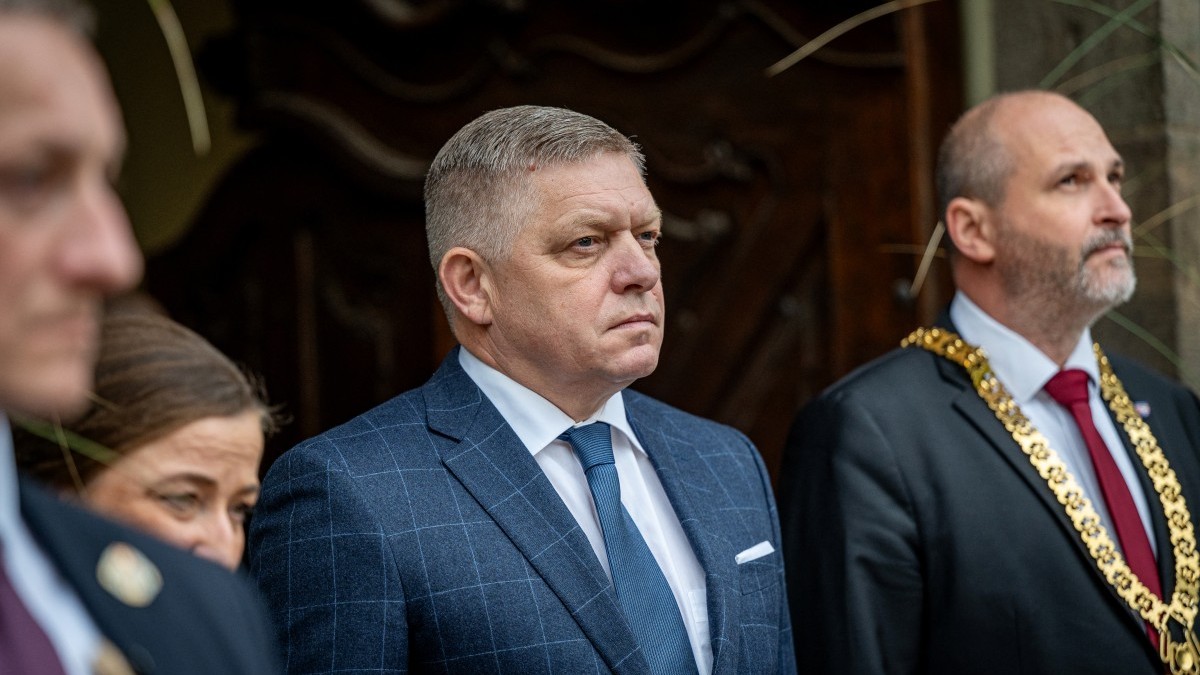
Slovak Prime Minister Robert Fico (C) waits for the arrival of the Ukrainian Prime Minister for their meeting in Košice, Slovakia, on October 17, 2025.
Peter Lazar / AFP
The Slovak prime minister has gotten into letter-writing mode recently. As we reported, the rebellious Robert Fico initiated and co-signed a letter to Ursula von der Leyen the other day, telling her that the Commission should rethink its climate goals so that they don’t cripple the economies of member states, as they currently do. Together with the leaders of Bulgaria, the Czech Republic, Hungary, Italy, and Poland, Fico said the EU must abandon its ideological dogmatism and “pursue its climatic goal in an effective way, while not killing our competitiveness in the meanwhile since there is nothing green in an industrial desert.”
The other letter, dated December 10th and obtained by Politico, is authored solely by the Slovak premier but is equally blunt and straightforward. Addressed to the President of the European Council, António Costa, it starts by nailing down the obvious: that there is no military solution to the Russia-Ukraine conflict. A position long held by the other ’black sheep’ in the EU, Viktor Orbán, and, most recently, also clearly articulated by the Belgian premier, Bart de Wever, and which should not come as a shock to anyone capable of a realistic assessment of the situation.
The Slovak prime minister then makes it clear that he strongly supports President Donald Trump’s peace efforts to “end the unnecessary bloodshed”—something the so-called Coalition of Willing and their allies have been reluctant to do, spurring Kyiv on to fight until the last Ukrainian.
And then comes the coup de grace: he declares that
[A]t the upcoming European Council I am not in the position to support any solution to Ukraine’s financial needs that would include covering Ukraine’s military expenses for the coming years.
It is notable that the Slovak PM felt it was important to clarify that his veto is not centered around legal or fiscal “excuses,” but is rather grounded in the “policy of peace” that he “consistently advocate[s].” He states what should be evident for all: “providing tens of billions of euros for military spending is prolonging the war.” He does note, however, that the (likely illegal) use of frozen Russian assets “could directly jeopardize U.S. peace efforts, which directly count on the use of these resources for the reconstruction of Ukraine.” He also does not fail to make a reference to the corruption scandals engulfing Kyiv, which should make responsible leaders—who are currently hard to find in Europe—rethink their policy of pouring an endless stream of taxpayer euros into the war-torn country’s (corrupt leaders’) coffers.
The letter does not come out of the blue. Fico has always been consistent in his views regarding the war in Ukraine. As he stated in an October speech, he believes the European Union is acting hypocritically and has misplaced its priorities in its approach to ending the Russia-Ukraine war. The Slovak PM argued Brussels is more focused on punishing Moscow than achieving peace.
The sovereigntist Slovak prime minister is one of the few European leaders—alongside Viktor Orbán, Giorgia Meloni, and most recently, the freshly inaugurated Czech PM Andrej Babiš—who is willing to go against the Brussels establishment and many of his European counterparts, advocating for common sense policies, whether it is about EU competitiveness or the war in Ukraine. It remains to be seen whether other EU member states will have the courage and the lucidity needed to break ranks and say no to the endless financing of a war that cannot be won and wholeheartedly endorse the U.S. peace efforts—instead of hindering them.