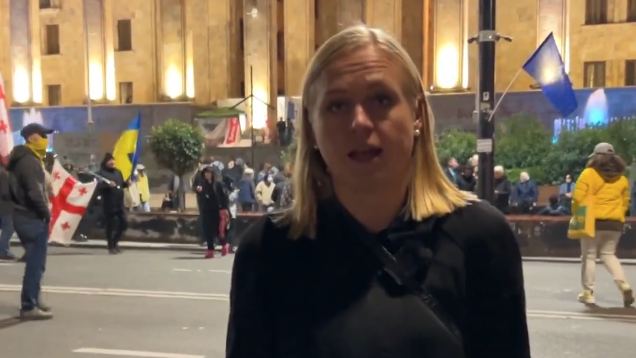
Elina Valtonen, Finland’s foreign minister, in front of the Georgian parliament in Tbilisi.
Screenshot from video posted by @elinavaltonen on X, 14 October 2025.
The recent visit of Finland’s Foreign Minister Elina Valtonen to Georgia has exposed a growing tension between Western ideology and the sovereignty of smaller, conservative nations. Valtonen’s decision to join anti-government demonstrators in Tbilisi and openly declare, “We are here to support them,” raises an unsettling question: how can a foreign minister so openly support protests that challenge another country’s elected government—and still claim to be upholding democratic principles?
The foreign minister shared a video on X denouncing the Georgian government and offering support for the anti-establishment protestors. The video has sparked backlash on the platform.
This controversy does not stand alone. It comes at a moment when the European Union and Western liberal officials are intensifying pressure on Georgia’s conservative government, which recently won parliamentary elections with 54% of the vote. The governing Georgian Dream party, led by Prime Minister Irakli Kobakhidze, defines itself as sovereigntist, socially conservative, and anti-war—positions that have made it deeply unpopular among Brussels elites.
Despite international observers confirming that the elections proceeded peacefully, EU officials and the pro-Brussels opposition have questioned the results, alleging fraud. President Salome Zourabichvili, closely aligned with the opposition, declared, “It was a total fraud,” calling the elections a “Russian special operation.”
Against this backdrop, Valtonen’s appearance at an anti-government rally takes on a far deeper significance. Her words were a public alignment with forces attempting to overturn a legitimate election result and offer support for those who are calling to overthrow a sitting government.
During her visit, Valtonen met with civil society representatives and declared that “the space for civil society and free media in Georgia is shrinking at a worrying pace.” She also announced that the Organization for Security and Co-operation in Europe (OSCE) had “grave concern” about Georgia’s alleged democratic backsliding. Yet these statements, coming immediately after her participation in the rally, reinforced the perception that the OSCE was not a neutral observer but an active participant in Georgia’s internal politics.
The Georgian government’s response was swift. The prime minister canceled his scheduled meeting with Valtonen, citing her participation in an “illegal rally and false statements.” Tbilisi saw her actions as openly endorsing protests against a democratically elected government.
This episode illustrates a broader pattern: when nations in Eastern Europe resist EU ideological conformity, they are increasingly treated as illegitimate. Georgia’s refusal to impose sanctions on Russia, its calls for peace talks in Ukraine, and its conservative social policies have earned it the label of “pro-Russian”—a term now used in Brussels to discredit any government that challenges the EU’s foreign policy or liberal social agenda.
“When liberals win, democracy is upheld; when conservatives win, democracy is questioned,” said Hungarian Prime Minister Viktor Orbán during his visit to Georgia last year. He criticized Brussels and the globalist attack on Georgia, something Hungary also has experience of
Much of Brussels’ criticism does not originate within Georgia itself but flows from a broader web of external propaganda and influence networks. Across Eastern Europe, powerful political forces—often backed by foreign funding—are trying to shape public opinion and steer political outcomes in line with Western agendas. Similar concerns have been raised in Slovakia and Hungary, where leaders have questioned the role of foreign-financed NGOs and media outlets in “distorting the political system.” The systematic attack on conservative governments has been going on in Georgia for some time—but never quite as overtly as with Valtonen’s stunt.