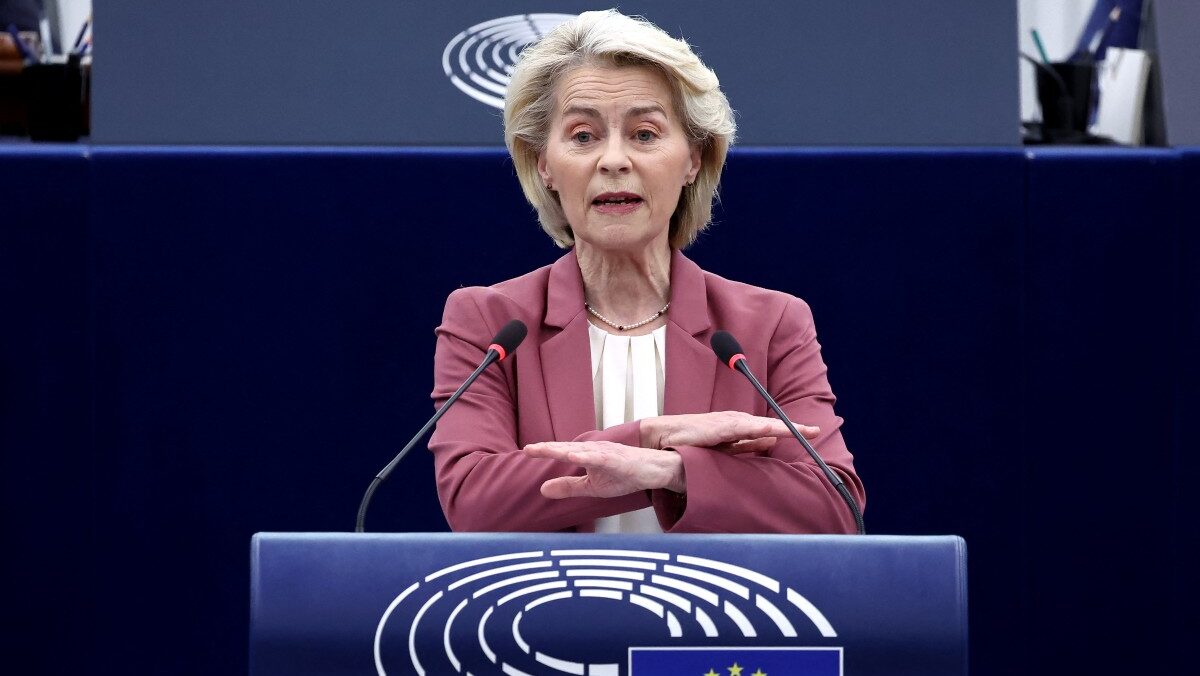
European Commission President Ursula von der Leyen speaks during a joint debate on the preparation of the European Council meeting on March 19 and 20, 2026 and on the US-Israeli war on Iran, at the European Parliament in Strasbourg, eastern France, on March 11, 2026.
FREDERICK FLORIN / AFP
The stance taken by EU Commission president Ursula von der Leyen on the war in Iran is not to everyone’s liking. In an interview with euronews, former French Ambassador to the United States Gérard Araud expressed his disagreement with what he considers to be a clear overstepping of her role.
On Monday, March 9th, speaking before the ambassadors of the member states, von der Leyen advocated for an offensive line, calling for Europe to stop being a spectator of a moribund international order: “Europe can no longer be a custodian for the old-world order, for a world that has gone and will not return,” she explained. But on what grounds can she allow herself to take such bold positions?
Acting like a sovereign head of state—without the authority, mandate, or legitimacy—von der Leyen was the first European leader to adopt the U.S. and Israeli position that regime change in Iran is necessary. In the early hours of the conflict, she announced that she had contacted several Gulf leaders, even though she has no diplomatic authority.
For Gérard Araud, who served as French ambassador to the United States from 2014 to 2019 and is now retired, von der Leyen is clearly overstepping her role with such statements: “The European Union treaties, which form the basis of the EU, do not give it any particular competence in foreign policy,” the ambassador pointed out.
Apart from the posture, there is also a fundamental problem with the content of von der Leyen’s remarks, which are completely at odds with the position that member states are trying to defend regarding Europe’s mission on the international stage. For Araud, this mission today should be to present itself as the ultimate guarantor of international order in a world where the use of force and interference are becoming the norm. It is precisely Europe’s pride to be “the custodian of the old-world order.”
What is more serious is that Ursula von der Leyen’s position is essentially a German position, according to Araud. Indeed, the president’s remarks directly echo the statements made a few days ago by German Chancellor Friedrich Merz, who said that Europeans have no “lessons” to teach their American and Israeli allies in the decision to strike Iran—implying acceptance of their power.
Von der Leyen’s remarks were followed by swift criticism. “A rules-based international order is vital to avoid the anarchy and suffering that would inevitably ensue otherwise,” said the head of European diplomacy, Estonia’s Kaja Kallas. The president of the European Council, António Costa, essentially supported the same line.
Faced with this widespread disapproval, the Commission president had to soften her tone—described as “clumsy” by her deputy, Teresa Ribera—on Wednesday 11th before MEPs in Strasbourg and reaffirm her commitment to international law, recalling that it was one of the foundations of the European Union project: “Our unwavering commitment to peace, the principles of the United Nations Charter and international law is as central today as it was when we were founded,” she argued, in a statement that sounded like a late mea culpa.