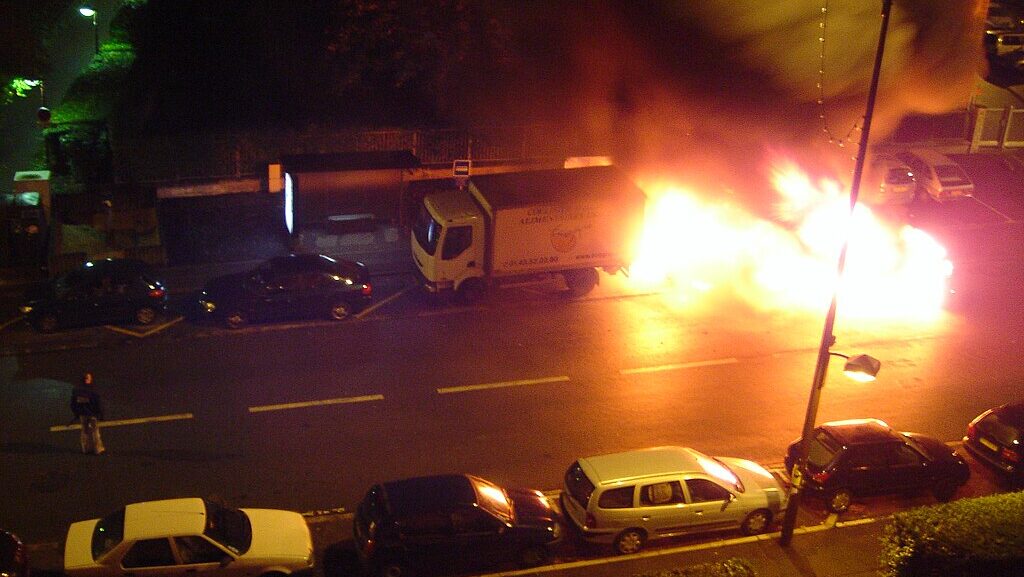
Car on fire in the Grande Rue de Sèvres on November 3, 2005, during the urban riots.
A.J., CC BY-SA 3.0, via Wikimedia Commons
Twenty years ago, in October 2005, two young boys, Zyed and Bouna, sought refuge in an electrical transformer while trying to escape a police check and died there. In response, violent riots broke out in Clichy, in the Paris suburbs, before spreading throughout France and causing chaos for three long weeks. Since then, these events, which were unprecedented at the time, have been repeated and will continue to be repeated: the lessons of this episode have not been learned, condemning France to relive an increasingly intense and violent scenario of urban warfare.
The events took place in Clichy-sous-Bois on October 27th, 2005: two teenagers, Zyed Benna and Bouna Traoré, were electrocuted in an electrical substation while trying to escape a police check.
Three days later, with unrest already breaking out locally in protest, a second event sparked widespread violence: a tear gas grenade was thrown at the entrance to a mosque in Clichy by police officers who had been targeted by projectiles. The riots then spread to the entire department of Seine-Saint-Denis and, two days later, to towns throughout France, to the point that a state of emergency had to be declared on November 8th and then extended for three months. It was not until November 17th that calm returned—after a wave of nearly 3,000 arrests, three French victims, and countless acts of damage to infrastructure and property, particularly burned cars.
In France, these three weeks of riots left a lasting impression because they were the most significant in France since May 1968. They remained unparalleled in Europe until the 2011 riots in England. Today, analysis of the spiral of violence that gripped France shows that the news of the two teenagers’ deaths sparked the unrest but quickly took a back seat. The grenade attack on the mosque in Clichy fuelled the violence, especially after the then-minister of the interior, Nicolas Sarkozy, denied any responsibility or fault on the part of the police.
At the time, the entire political class seized on the case in an attempt to find causes, explanations, and those responsible. The Left developed an offensive discourse of a culture of excuse: the explosion in the suburbs was explained by the resentment of the immigrant populations living there, who were said to suffer daily humiliation, segregation, and contempt from native French people. Socialist Dominique Strauss-Kahn blamed “the reduction in subsidies” and “the dismantling of prevention” in poor neighbourhoods. Lilian Thuram, a member of the 1998 World Cup-winning soccer team and a member of the High Council for Integration, declared on Tuesday, November 8, 2005, that “before talking about insecurity, we should perhaps talk about social justice.” With the force of this argument, the troublemakers become the first victims.
The statements made by the ruling political class—President Jacques Chirac and Prime Minister Dominique de Villepin—reveal the discomfort of leaders who did not assume their role as representatives of state authority. Their statements were mixed with confused arguments about “respect for the law” and “the fight against illegal immigration,” but also the need to develop social housing throughout the country.
The ethnic dimension of the riots sparked heated debate. On the side of the rioters, there was a strong sense of identity, stemming both from their origins and their shared feeling of being “excluded from society.” The foreign press sometimes uses much clearer terms than the French press to describe what is happening: this is indeed an ethnic war that dare not speak its name. The rioters are mainly young people of African origin from the latest waves of immigration to France. While 95% of the rioters arrested are French nationals, the majority are ‘from immigrant backgrounds,’ with just over half coming from North African families. This ethnic dimension, which is quantifiable and real, refutes the discourse of the Left, which sees the inhabitants of the suburbs as nothing more than social outcasts: many pockets of deepest poverty in France can be found in the countryside, not in the neighbourhoods that benefit from “urban policy.” Yet it is never these people who rebel, loot, and destroy.
Twenty years later, the wound has still not healed and the lessons have still not been learned. The riots of June 2023, which followed the death of young Nahel, killed after refusing to comply with a police check, were a repeat of the events of 2005. The spectre of urban warfare is becoming more apparent, but the blame machine—blaming white people, the police, racist France—continues to run at full speed.
But that’s not all. Today in France, everyone knows the names “Zyned” and “Bouna,” just as everyone remembers the death of “Nahel.” But no one remembers Jean-Claude Irvoas, Jean-Jacques Le Chenadec, and Alain Lambert—French victims of the riots whose memory is not worth celebrating. Jean-Claude Irvoas was killed in a lynching in front of his wife and daughter next to a streetlight he was photographing for his work because he was mistaken for a police officer. Jean-Jacques Le Chenadec was also killed in a lynching for trying to put out a fire started by rioters. Alain Lambert died of asphyxiation as a result of a fire caused by these riots.
As MEP Marion Maréchal pointed out, “While these riots are still celebrated today as a ‘social awakening,’ let us remember that they were one of the most violent explosions of anti-French hatred our country has ever known.”
Some right-wing outlets looked into the fate of the third boy involved in the Clichy tragedy, who had also climbed into the transformer but survived. Muhittin Altun has racked up a string of convictions, including two suspended prison sentences for acts of violence and one year in prison for robbery with violence. According to the lawyer of one of his victims, “He thinks he’s an icon; he considers himself untouchable.” There is a kind of symbol in his fate. Meanwhile, consumed by guilt and refusing to call a spade a spade, France continues to fight the wrong battles and is paving the way for a new explosion that will, overnight, set the country ablaze.