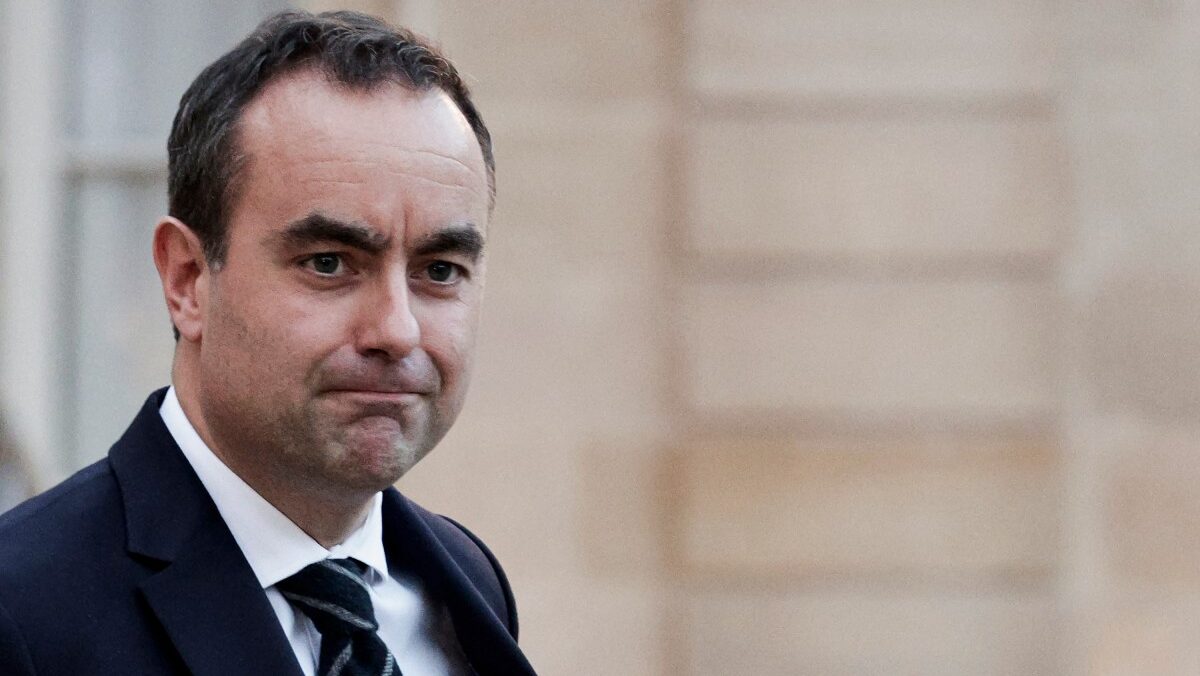
France’s Prime Minister Sebastien Lecornu leaves after the cabinet meeting in Paris on January 19, 2026.
STEPHANE DE SAKUTIN / AFP
After months of fierce debate, French Prime Minister Sébastien Lecornu has decided to go back on his promise and push through the 2026 budget using Article 49.3, which allows him to override opposition from MPs. The National Assembly is in ruins, and the country will end up with a financing plan riddled with concessions to the socialist left.
After failing to build consensus around a budget, Lecornu was left with few options. A cabinet meeting was held on Monday, January 19th, to decide on the constitutional means the prime minister would use to push through his budget. He had the choice between resorting to Article 49.3 of the constitution, combining the forcing through of the bill by MPs with a vote of confidence in his government, and ordinances—that would have spared him this trial by cutting off relations with parliament but would have reinforced the authoritarian dimension of his act. The last option would have been for Lecornu to resign—again.
In the end, what do we find on the final bill? A budget of despair, incapable of charting a future for the country. Pensioners are protected, but business, innovation, families—in short, the future of France—are completely ignored. Young people are supported only through more public assistance.
The latest discussions led by the prime minister and his team will have had a single objective: to ensure that the socialists do not join the motions of no confidence and do not vote against the government when the time comes, when recourse to Article 49.3 becomes inevitable. Concessions to the Left have therefore multiplied in a new list of disjointed measures designed to distribute or take away money according to piecemeal complaints: student meals at €1, an increase in the activity bonus to €50 per month for low-wage earners, and the recruitment of 2,000 new staff in the national education system. The surtax on the profits of large corporations will remain at nearly €8 billion in 2026, instead of being halved. The promised reduction in industry tax has been abandoned.
The minister for public accounts, Amélie de Montchalin, defends her work and praises the merits of the final budget: “We will have a 5% deficit. There are plenty of savings in this budget. Even if I wanted to do more. There are 70 measures for elimination, rationalisation and merger. We are reducing communication and public spending, among other things,” she explained to the press.
Lecornu has therefore gone back on his word not to use the infamous Article 49.3. At least he had the honesty to acknowledge his change of heart and beat his breast: other politicians prefer to deny their U-turns without batting an eyelid. Small consolation. He explained that he was resorting to it with “regret” and “bitterness” because he had failed to build a consensus among MPs. He defends himself by highlighting a “stable” budget, intended to reassure households and businesses alike.
The Rassemblement National (RN) accuses him of lying to the French people and wasting everyone’s time. “We knew all this from the start,” said RN MP Sébastien Chenu. On the Left, La France Insoumise (LFI) believes that the figures don’t add up and that this is an “austerity budget.” Among Les Républicains (LR), former minister Bruno Retailleau severely criticises the budget: “The budget proposed by the government includes all the socialist ingredients that led to France’s decline: more spending and more taxes that weigh down and discourage those who produce. The result is well known: more debt, fewer jobs and the purchasing power of the French people continuing to decline.” However, his party is careful not to draw any conclusions and, like the socialists, will not support the no-confidence motions.
Article 49.3 is set to be triggered on Tuesday, January 20th, on the revenue side of the budget, then used again a few days later on the expenditure side. The budget will then go to the Senate for final approval by the National Assembly one last time via Article 49.3. If the prime minister manages to survive the no confidence votes brought against him, the budget will come into effect in mid-February.
Two motions of no confidence will therefore be put forward once again, by the RN on the Right and by LFI on the Left. Marine Le Pen lambasted Sébastien Lecornu’s “irresponsible announcements” on X, made to “buy” the socialist support “in defiance of the national interest.” The RN’s motion of no confidence aims to “severely punish politicians who choose to ruin our country to save their seats.”
It is conceivable that the LFI’s motion has a slightly better chance of passing than the previous ones—which all failed—although nothing is certain yet. A heavy and oppressive feeling of waste prevails throughout the political class. The previous motion, introduced a few days ago during the debate on the Mercosur deal, failed by only 22 votes.