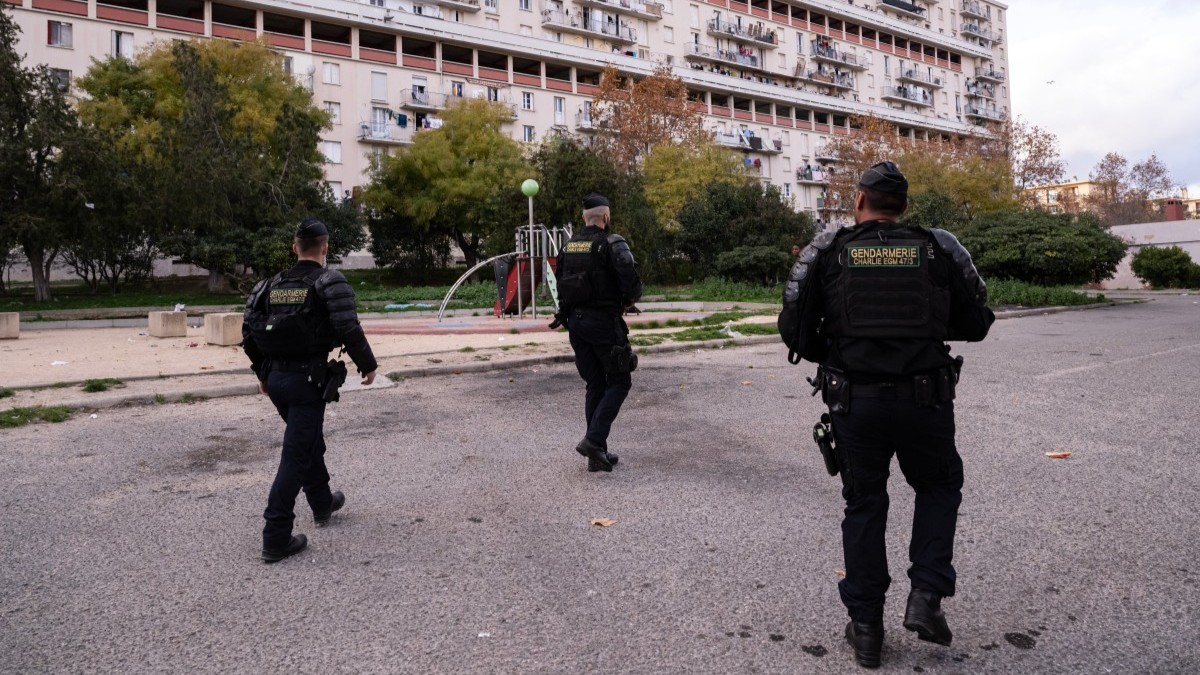
French gendarmes patrol in the Les Rosiers residential complex during a major anti-drug operation in the Sainte Marthe quarter in northern Marseille on December 9, 2025.
Miguel Medina / AFP
France can boast a new and sad record: for the first time, cocaine became the most sold drug on national territory in 2023, ahead of cannabis, ecstasy and other drugs, with an estimated market value of €3.1 billion. The government’s declared war on drugs has proved a cruel failure: the country has never been so contaminated.
The French Drug Observatory (OFDT) released its findings on December 8th: with €3.1 billion compared to €2.7 billion for cannabis, cocaine has become the country’s largest narcotics market. The illicit drug market’s total worth in 2023 is estimated to have been €6.8 billion.
The upward trend in drug consumption and sales in France is now dramatically confirmed. The turnover of the drug market in France increased by 189% between 2010 and 2023, according to the OFDT report. This increase was faster than that of consumption, which rose by ‘only’ 89%—meaning that drugs are selling more, but above all, that they are selling at increasingly higher prices.
In terms of consumption, cocaine and cannabis dominate by a wide margin. In 2023, cannabis and cocaine alone generated nearly 90% of total revenue. While cannabis remains the most widely consumed illicit substance (nearly 400 tonnes in 2023), cocaine has become the drug that generates the most money. The quantities of cocaine sold rose from 15 tonnes in 2010 to 47 tonnes in 2023 (+214%), while the revenue from these sales increased 3.5-fold. Alongside cocaine, the consumption of crack, which is also on the rise, remains poorly identified and poorly quantified. Finally, psychostimulants (ecstasy and amphetamines) are also experiencing spectacular growth. Between 2010 and 2023, the volume of ecstasy consumed increased by 480% while that of amphetamines rose by 600%.
These figures cruelly contradict the government’s supposedly energetic rhetoric on the war on drugs. In recent months, there has been an explosion in the number of murders and gangland killings linked to drug trafficking in France, proving the impotence of the authorities. Seventeen people have died in drug-related violence since January.
On Tuesday, December 16th, President Macron is expected in Marseille, a city particularly affected by drug trafficking. This will be an opportunity for him to take stock of the policies implemented in this city, where bloody gangland killings have made headlines, such as the murder on November 13th of young Mehdi Kessaci, who was killed to silence his brother Amine, an anti-drug activist.
“This is a war we are waging,” explained Interior Minister Laurent Nuñez. “The state will win this new battle,” added Emmanuel Macron, eager to use war metaphors that unfortunately have no effect. In Marseille, an aid plan called ‘Marseille en grand’ has been in place since 2021 to gentrify the city, reducing the divide between neighbourhoods and thus help curb drug trafficking. A year ago, the Court of Auditors denounced the “poor” monitoring and “lack of consistency” of this initiative.
The fight against drug trafficking has been the subject of several parliamentary debates in an attempt to adapt the legislative arsenal to the explosion in drug sales and the violence it generates. A law passed in the spring by a large majority, aimed at combating gangland killings and the laundering of drug trafficking money, is still hardly enforced. But given the scale of the phenomenon, the response cannot be limited to police and security issues, as editorialist Eugénie Bastié points out: “Why, in our Western societies, which have never been so rich and opulent, do so many people take drugs?” The success of cocaine can be explained by the prevailing mindset: “We live in a performance-driven society, so it’s a drug that meets current societal expectations,” explains a researcher at INSERM, the French National Institute of Health and Medical Research.
It is important to examine demand, seeing it not only as a response to supply, but as a symptom of a sick society, lacking structure and meaning.