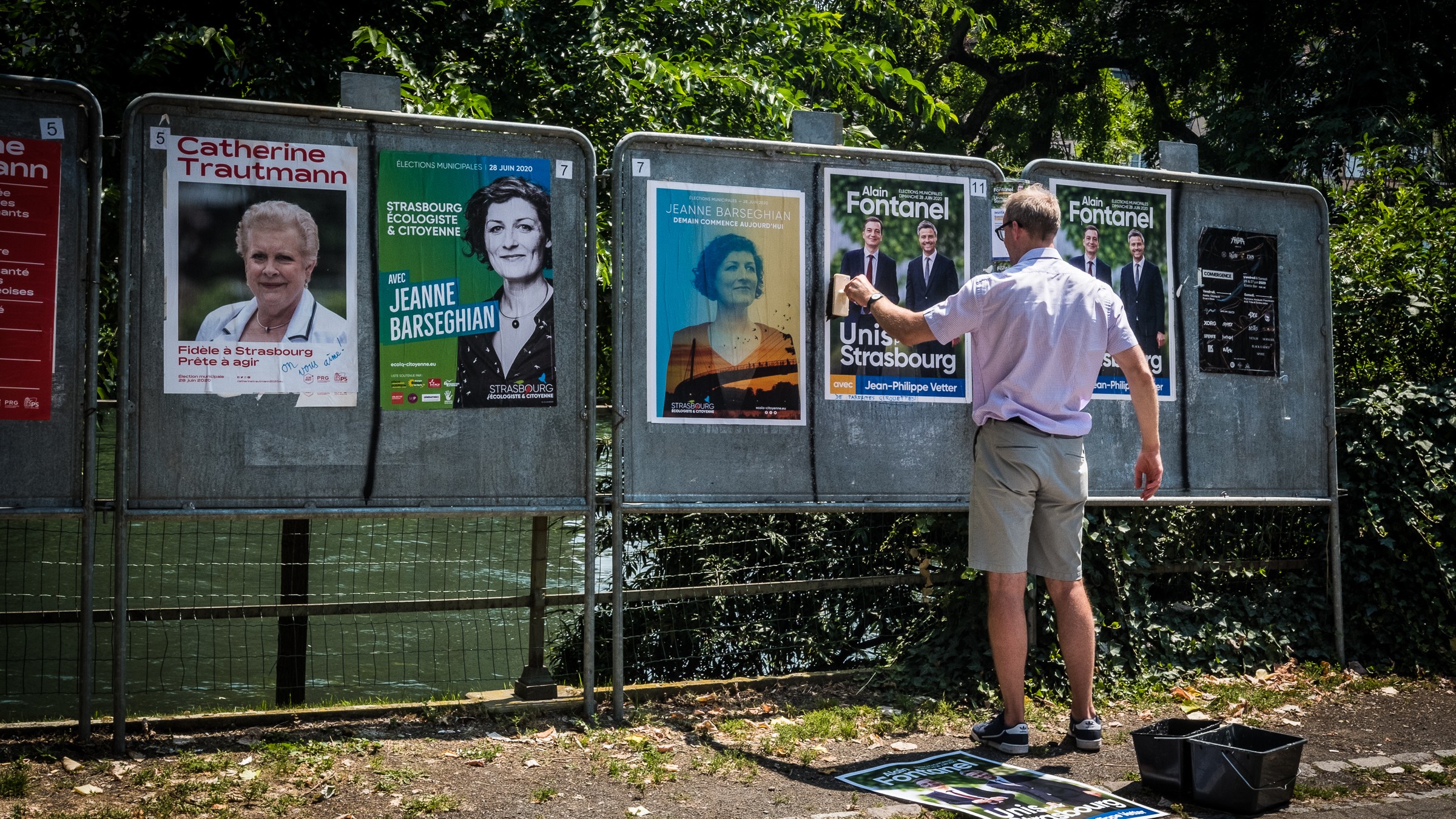
Posters of candidates running in the 2020 Strasbourg municipal elections
By Claude Truong-Ngoc / Wikimedia Commons – cc-by-sa-4.0, CC BY-SA 4.0, https://commons.wikimedia.org/w/index.php?curid=91595404
On February 4th, the French National Assembly’s legal commission adopted a constitutional bill “aimed at granting non-EU foreigners residing in France the right to vote and stand for election in municipal elections.” The bill is scheduled to be debated in plenary session on February 12th.
Pushed by the Left, this constitutional amendment would be a tremendous encouragement for Muslim community voting at the local level. If the process is successful, it will also prove that it is always possible to amend the constitution to maximise the effects of immigration on the country—never the other way around.
The right of foreigners to vote in local elections is a long-standing demand of the Left. Since 1992, European Union nationals residing in a member state of which they are not nationals have been able to vote and stand as candidates in that state in municipal elections and in elections to the European Parliament. But the reform proposed in the initiative would this time apply to foreigners from outside the European Union. It is due to be examined by MPs on February 12th, during the Greens’ parliamentary initiative day.
Six million people would be affected by the reform, who “participate in the daily life of our cities, pay their local taxes, send their children to our schools and contribute to our economy,” according to the arguments put forward by the MPs behind the proposal. The proposal would also grant non-European foreigners the right to be eligible for the position of municipal councillor, although they would still be barred from becoming mayor.
Despite the Left’s initial ‘victory’ following the bill’s approval in committee, the battle is far from over. The assembly is deeply divided on the issue. The right-wing factions and the Rassemblement National are adamantly opposed to moving in this direction. Furthermore, this is a constitutional amendment initiated by parliamentarians, which means that it must be validated by referendum after being adopted by MPs and senators. If the reform were to pass, it would still not apply to the municipal elections scheduled for 15 and 22 March this year. But with the municipal elections approaching, the Left is pushing the symbolic issue to control the agenda.
The government, for its part, is concerned about the rise of “municipal Islam” and the proliferation of community lists. The possibility of granting foreigners the right to vote in local elections provides encouragement to these lists. According to the conservative weekly Valeurs Actuelles, only “a few dozen” towns are under the surveillance of the Interior Ministry, which keeps an eye on explicit community lists but is also wary of entryism strategies, which are more difficult to detect. In Strasbourg, for example, under the guise of multiculturalism, far-left candidate Cem Yoldas, a member of the Jeune Garde Antifasciste (Young Anti-Fascist Guard), printed his leaflets in Turkish and Arabic—a way of addressing “all the people of Strasbourg,” according to him.
On the Right, the proposed constitutional law is causing consternation. The RN has long been calling for fundamental reforms to immigration law and a referendum on migration policy. The universal response from their political opponents and the media is that these areas do not fall within the scope of a referendum. But there are ways to force a referendum, as the Green Party’s proposal proves. For Sarah Knafo, candidate for the Reconquête party in Paris and partner of Éric Zemmour, the left’s strategy is particularly harmful and signals its political failure: “When you can no longer convince voters, you create new ones,” she said on X. She also pointed to the link between control of local voting and the preservation of sovereignty: “City councillors elect senators: giving foreigners the vote gives them influence over our laws. That’s a no-no.”