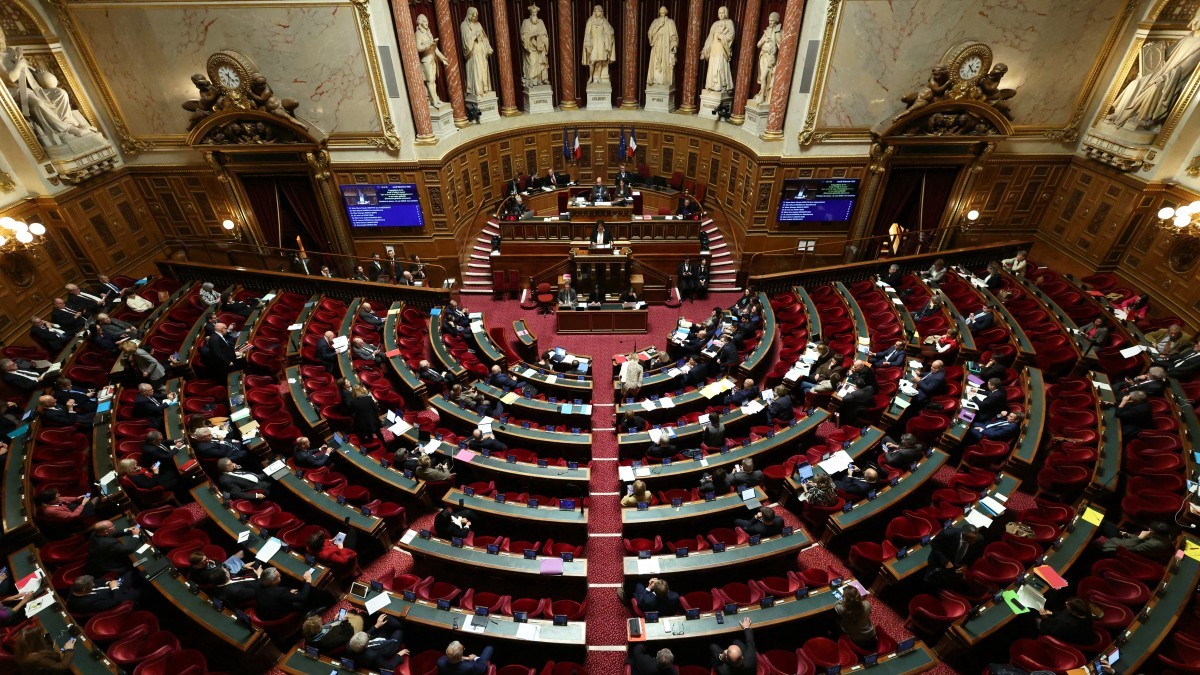
French senators take part in the debate on a bill for the creation of the right to assisted dying at the Senate, in Paris on January 20, 2026.
Alain Jocard / AFP
In a dramatic turn, French senators, in the midst of reviewing the euthanasia bill, radically changed the initial draft to reaffirm the ban on assisted suicide and killing for medical reasons. Will the message thus sent be strong enough to put an end to this disastrous bill?
The turn is quite unexpected: while senators initially seemed to be rushing the vote on the euthanasia bill, the situation was turned on its head at the end of the day on Wednesday, January 21st. On Tuesday, senators adopted Article 1 of the bill, incorporating “medical assistance in dying” into the public health code. But in contradiction to this first ominous vote, they rejected Article 4, which enshrined the principle of euthanasia and assisted suicide for patients “at the end of life,” by 144 votes to 123.
The rebellion came from an alliance between right-wing and centrist senators, who voted to categorically reject the major reform sought by Emmanuel Macron since the beginning of his first term. Senator Stéphane Ravier, a member of the Identity and Freedoms party and close associate of Marion Maréchal, described euthanasia as a “crime against humanity.”
But the final reversal was made possible by votes coming from the left, although from a different stance: in favour of euthanasia, but showing disagreement with a bill they considered too timid in its final provisions, they would have preferred euthanasia and assisted suicide to apply not only to patients “at the end of life” but also to patients “in an advanced stage.”
After the rejection of Article 4, with the initial text thus rendered meaningless, the question arose as to whether there was any point in continuing the debate. The Socialists were particularly disappointed, as they did not think that their angry gesture would have such consequences.
Faced with this unprecedented situation, Health Minister Stéphanie Rist said that there was no choice but to continue the debate. “If I withdrew this text, it would halt the parliamentary process. I do not want that,” she replied.
Later that evening, an amendment proposed by Les Républicains (LR) was adopted, completely rewriting Article 2 of the original bill and making it impossible to introduce euthanasia in France. The article now says
Everyone has the right to the best possible relief from pain and suffering.
Everyone is entitled to this right until their death, without any voluntary intervention intended to cause death.
Anne Chain-Larché, Vice-President of the Senate, who initiated this amendment, defended it by stating that she rejected a society in which the administration of a lethal substance could be considered ‘care.’ She said he proposal “directly addresses the central argument used in favour of assisted dying: the fear of suffering without relief. Whereas the proposed law transforms this fear into a justification for a right to die, the amendment offers a strong, enforceable and legally secure guarantee of relief. It demonstrates that freedom and dignity do not imply the possibility of causing death, but the effective assurance that society will not allow anyone to suffer without response.”
Once this key amendment was adopted, the senators proceeded to methodically rewrite a whole set of provisions in the bill. Aware that the text will be returned to the National Assembly for review, the senators added additional safeguards, such as the collective conscience clause requested by religious institutions. The offence of obstruction of euthanasia (which could have been punishable with up to two years in prison and a hefty fine) was dropped from the bill, despite the government’s support.
As rightly noted by the Family Union, the battle in the Senate proves that, contrary to the narrative peddled in the media, there is no public consensus on euthanasia and assisted suicide. “This lack of consensus reflects the depth of the ethical, medical and social questions raised by these measures,” said the French Society for Support and Palliative Care in a statement.
This night-time episode proves that positions on a subject as essential and divisive as euthanasia are irreconcilable. At this point, it seems difficult to foresee which way the parliamentary process will go. The text will return to the Assembly, where it will probably be completely rewritten—this time in a pro-euthanasia direction, sparking new battles.
Last spring, Macron had already anticipated that such a deadlock might occur, and raised the possibility of a referendum in the event of a “stalemate” in parliament.