Courtesy of La Furia
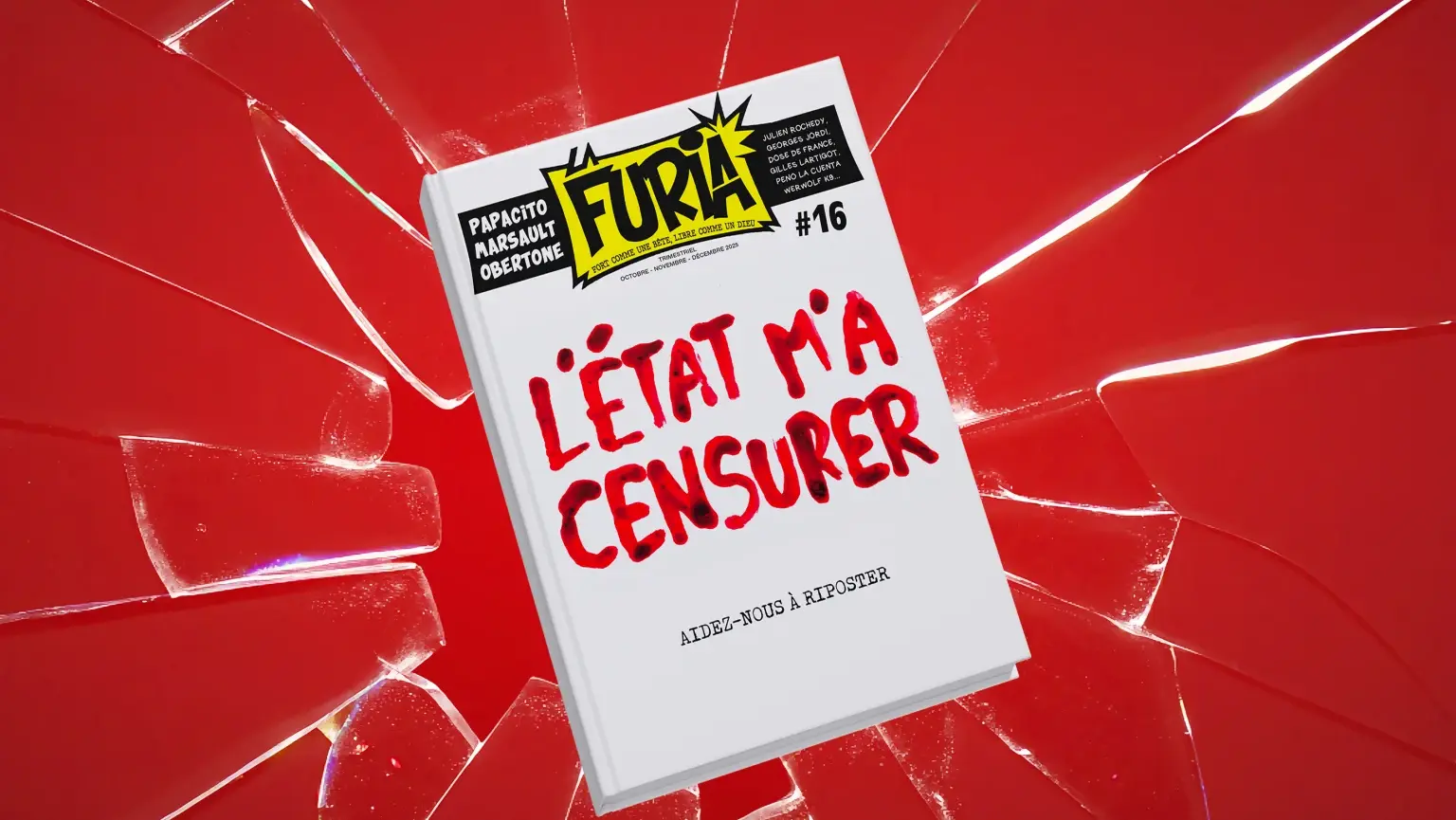
The French state’s censorship offensive—and, through it, that of left-wing organizations—against any form of public expression marked by right-wing views targets not only the audiovisual sector but also the press. After attacks against the conservative channel CNews, which was stripped of its licence to broadcast on digital terrestrial television, it is now the turn of a right-wing satirical magazine, La Furia, to have its print media licence revoked.
La Furia magazine was founded in 2022 by a team of four figures from the French national Right: essayist Laurent Obertone, author of the highly acclaimed essay La France Orange Mécanique (France: A Clockwork Orange) published in 2013; YouTuber Papacito; press cartoonist Marsault; and publisher Laura Magné—known in particular for having published the essay Transmania on the ravages of the transgender lobby.
Its deliberately provocative tone regularly earns it attacks from left-wingers—both associations and anonymous individuals. But for now, all complaints filed against the magazine have been dismissed.
Since its creation, the satirical magazine has been approved by the Joint Press Commission (CPPAP), with approval renewed at the end of 2024.
In France, this accreditation is virtually indispensable for any media outlet that intends to have a national circulation among a wide audience. It offers preferential rates for postal delivery and mandatory placement of the title in newsstands—a guarantee of visibility that otherwise leaves distribution to the ideological discretion of sellers.
Left-wing activist associations SOS Homophobie and SOS Racisme, largely funded by public money, saw fit to report La Furia to the president of the CPPAP, who hastened to withdraw the newspaper’s accreditation.
La Furia was accused of content that was “likely to cause offence,” or “constitute an offence,” or “raise the issue of discrimination,” which cost it its “public interest” status and led to the revocation of its press license.
The decision was made during the summer, but La Furia‘s editors did not communicate this censorship before, hoping to engage in dialogue with the authorities and get them to reverse their decision. In vain. Laurent Obertone published an op-ed in Le Journal du Dimanche this week to draw attention to the ongoing injustice of a “totally unprecedented” decision taken “in the middle of summer. Without any debate, without the slightest warning.”
La Furia does not have to fear the end of public subsidies to the press granted via the CPPAP, as it has always refused them in order to remain free and dependent only on the support of its readers. On the other hand, the end of the obligation to display the magazine is a real blow, as it will lead a considerable number of retailers to voluntarily stop selling La Furia on their shelves. It is the question of the visibility in the public space of an alternative voice to the dominant one that is at stake here, as Obertone explains:
Even if, thanks to the remarkable mobilisation of our readers—or simply defenders of our freedom—La Furia manages to stay afloat, it will gradually lose all contact with the public under pressure from vigilant informers. It will disappear from the landscape and be reduced to clandestinity.
France has returned to the days when newspapers targeted by an official censorship body were printed in Holland and circulated under the counter. Freedom of the press is supposed to be guaranteed by an arsenal of laws passed under the Third Republic, but it is gradually disappearing.
As Obertone points out, absurdity reigns supreme in this case. All complaints against La Furia have been dismissed in the past. The CPPAP justifies its actions by explaining that it does not have to wait for a court decision to take action. But it is taking action on the basis of an offence that only the courts can qualify and which it has never brought against La Furia.
This episode is not anecdotal. The associations behind the complaint are now part of a very official consortium for vigilance against ‘hate speech’ set up by the French government a few months ago with the aim of tracking down any content deemed deviant. Their supposed expertise has been given the seal of public service—with the funding that goes with it.
Erik Tegnér, editor-in-chief of the conservative investigative magazine Frontières, which is itself regularly subject to lawsuits, lent his support to La Furia. He denounces a climate of censorship of which he himself is a victim—including physical attacks—while voices on the Left are calling for Frontières to be stripped of its official accreditation, which grants its journalists press cards—and with them, the rights and protection afforded to members of the press.
What is going on here is a war of attrition: “Of course, justice will prevail in the end. In two years. Enough time to die ten times over,” Obertone storms.
In the meantime, the state will continue its hunt for ‘shocking’ content thanks to generous financial support for its ministers of truth. After all, we must not forget that the country of Charlie Hebdo is also the country of record public spending deficits, and the thought police have always been handsomely fed by public funds.