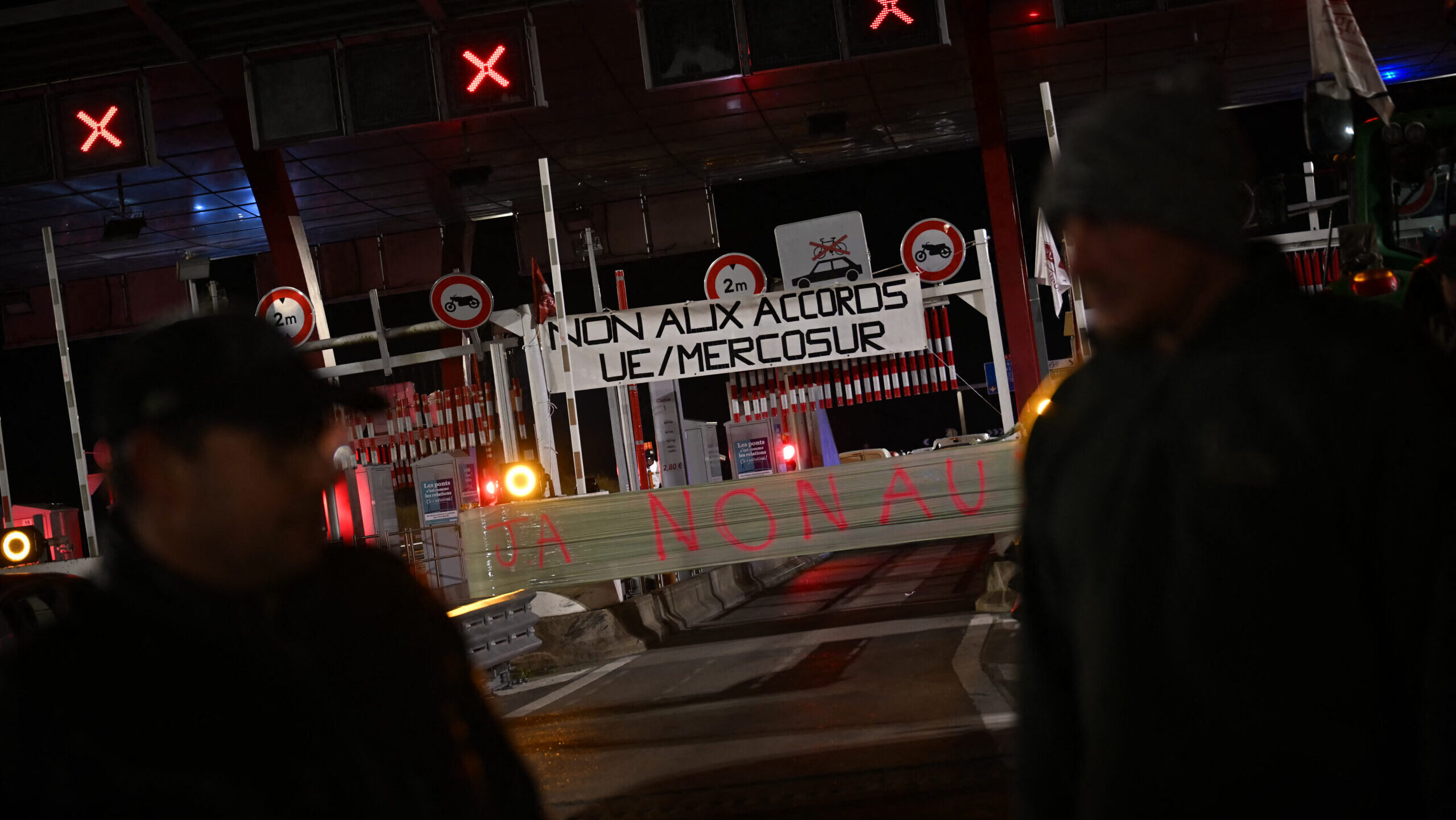
Protesters hold a “No to the EU–Mercosur agreements” placard near the Tancarville Bridge, November 26, 2025.
Lou BENOIST / AFP
France has moved to delay the long-stalled EU-Mercosur trade deal, throwing fresh uncertainty over an agreement years in the making as farmers prepare to protest in Brussels and EU leaders enter a decisive week of negotiations.
The move comes after French prime minister Sébastien Lecornu last weekend urged EU partners to postpone the decision on signing the agreement, which had been scheduled for December 20 during a summit in Brazil, arguing that key conditions—particularly safeguards for European agriculture—had not been met.
In a statement released on Sunday, Lecornu said France would only accept a deal containing “concrete, precise and operational” agricultural safeguards, arguing that current provisions remain incomplete.
The delay is a setback for the European Commission, which had expected to seal the deal before Paraguay—more skeptical of the agreement—assumes the rotating Mercosur presidency.
Domestic pressure also weighs heavily on the French government, which is facing renewed rural unrest amid anger over livestock regulations and rising costs. Farmers argue that the Mercosur agreement would expose them to cheaper South American imports produced under looser standards, a charge that has made any sign of flexibility politically risky for Paris.
On December 18, farmers will once again take to the streets of Brussels. The protest adds to the political sensitivity as EU leaders meet this week to juggle several high-stakes dossiers, including frozen Russian assets and the EU’s next multiannual budget.
The French slowdown comes at a moment of heightened political sensitivity in Brussels, with the European Council forced to juggle multiple high-stakes files this week, from frozen Russian assets to the EU’s long-term budget. Several capitals are attempting to link dossiers in the final phase of talks, turning Mercosur into a potential bargaining chip.
France is not alone in its skepticism. Italy, Poland, Ireland, and Austria have also expressed reservations, while Germany, Spain, Sweden, and other more free-trade-oriented countries argue that Paris has already secured sufficient guarantees, particularly through proposed temporary safeguard measures. The European Parliament will vote this week on a reinforced instrument to shield European farmers from a potential influx of Latin American beef or poultry.