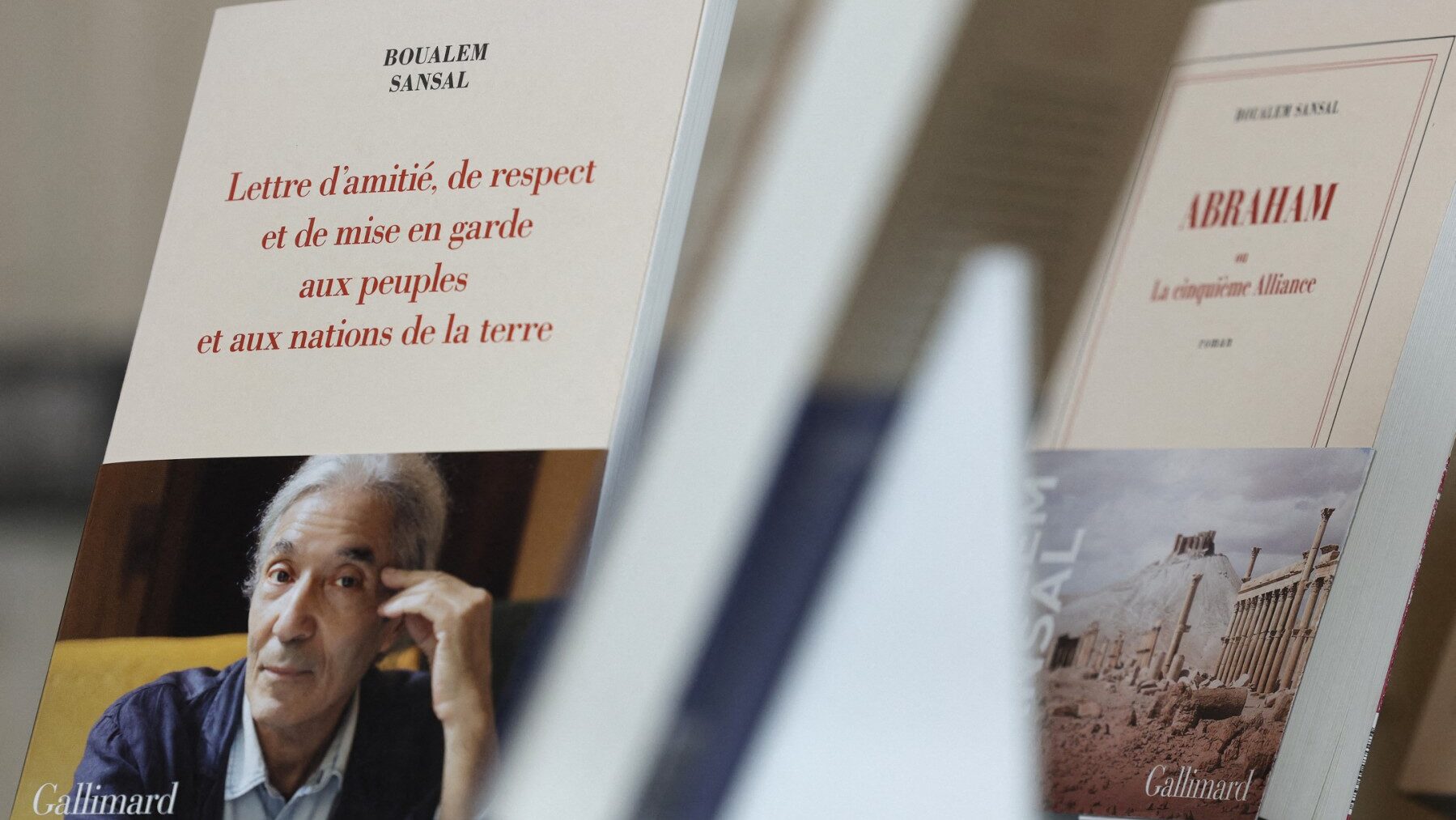
Boualem Sansal’s books displayed during a press conference at the Gallimard publishing house in Paris on December 11, 2024.
GEOFFROY VAN DER HASSELT / AFP
Symbolically, almost a year to the day after his arrest, and on the eve of the tenth anniversary of the Bataclan attacks, the release of Franco-Algerian writer Boualem Sansal was announced, following negotiations between Paris, Berlin, and Algiers. While the end of this political imprisonment is obviously cause for celebration, the circumstances surrounding the writer’s release only serve to highlight, once again, the French president’s impotence in matters of diplomacy.
The writer, known for his criticism of Islamism and of the Algerian regime, was arrested on November 16th, 2024, by the Algerian government during one of his visits to his country of origin. He had since then been sentenced to five years in prison.
Sansal was pardoned on Wednesday, November 12th, by Algerian President Abdelmadjid Tebboune on “humanitarian grounds.” The writer, who has advanced prostate cancer, is seriously ill and was not receiving appropriate care while in detention.
The question of his release has poisoned relations between France and Algeria, which were already seriously strained, for a year. Numerous sources of tension have been building up for months between Algeria and its former colonial power, particularly over France’s expulsion of Algerian nationals, whom Algeria refuses to take back.
The French government has vacillated between several strategies, without ever really giving itself the means to fully implement any of them. The former minister of the interior, Bruno Retailleau, was keen to raise his voice and show firmness in the face of Algerian demands, proposing retaliatory measures—revocation of diplomatic privileges for prominent Algerians and restrictions on the granting of visas to France—but without consistency or convincing results, due to the timidity shown by the president and the foreign minister, who were always reluctant to confront Algeria. In the midst of this battle, the Sansal case was a thorn in the side of the French government, which found itself unable to strike the right tone to achieve its ends and secure his release. Sansal’s family was highly critical of the president and his foreign minister, whom they accused of maintaining a guilty silence. Boualem Sansal’s daughter sent an open letter to Emmanuel Macron last April but received no response. “Neither I, nor our family, nor even the international support committee has received any reply,” she said. “Not a word, not a sign. This silence, coming from the country of human rights, hurts us deeply.”
Although it is difficult for France to admit, the outcome of the Sansal case was only made possible thanks to Germany’s intervention. On Monday, November 10th, the Federal President made a solemn statement calling on Tebboune to release Sansal. He offered to welcome the writer to Germany so that he could continue his medical treatment there. “Such a gesture would be an expression of a humanitarian attitude and a long-term political vision. It would reflect my long-standing personal relationship with President Tebboune and the good relations between our two countries,” the German president explained in a statement, sending a diplomatic snub to Emmanuel Macron, who is unable to maintain ‘good relations’ with Algeria.
Agreeing to Steinmeier’s request allowed the Algerian president to achieve two goals at once: getting rid of a troublesome issue and humiliating France. According to Le Figaro, Tebboune is expected to travel to Germany for an official visit in a few weeks; agreeing to Germany’s request regarding Sansal allows him to present himself in a favourable light. Berlin reportedly insisted several times that the promise be kept before the presidential visit. Algiers explains that it delayed granting the request for release because of attacks from “the French right and far right.”
Last month, lawmakers voted on a motion calling for the repeal of a 1968 Franco-Algerian agreement, proposed by the Rassemblement National and adopted thanks to a union of the Right in the National Assembly. It was accompanied by a wave of criticism from the Left and centre, arguing that the move would be perceived as a provocation that would only further damage relations between France and Algeria and further delay Sansal’s release. The final scenario proves above all that Paris has no authority or credibility whatsoever vis-à-vis Algiers, which is pursuing its own agenda without feeling the slightest pressure.
In Paris, attempts are being made to make the best of a bad situation by welcoming the release of the writer, who has just been awarded the Renaudot Prize, a prestigious literary award, and by emphasising the power of the Franco-German partnership.
A visit by the new French interior minister, Laurent Nuñez, to his Algerian counterpart is reportedly in the works in order to smooth over difficulties on other issues, now that the symbolic obstacle of Sansal’s imprisonment has been removed.