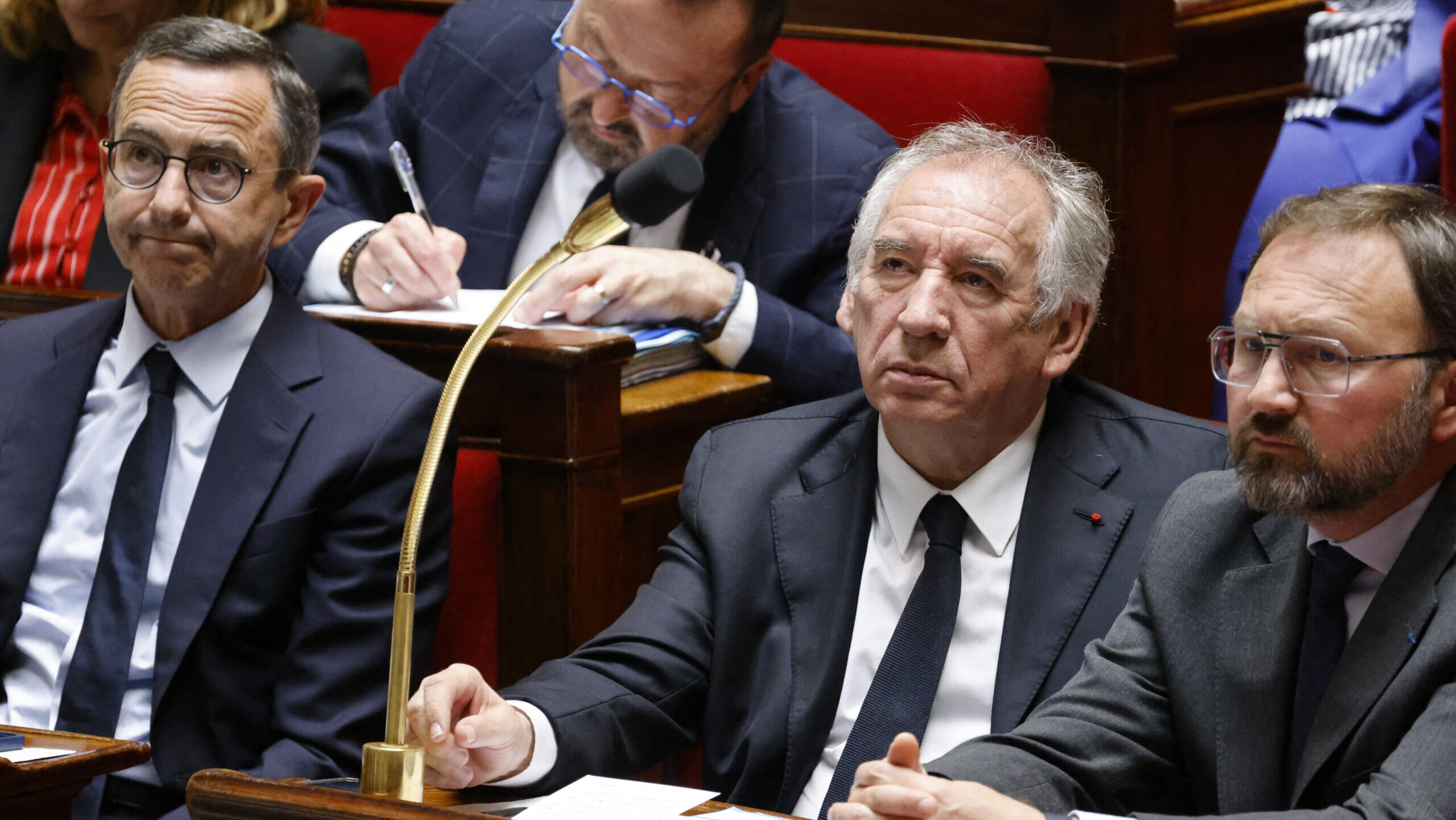
(L to R) French Minister of the Interior Bruno Retailleau, Prime Minister François Bayrou and Delegate Minister for Relations with Parliament Patrick Mignola listen during a session of questions to the government at the French National Assembly in Paris on April 29, 2025.
Photo: Ludovic Marin / AFP
Prime Minister François Bayrou is committed to reforming the voting system for parliamentary elections and wants to introduce proportional representation. Long promised, this reform could come to fruition in the coming months, but Interior Minister Bruno Retailleau is vehemently opposed to it. He has even threatened to resign if the reform goes ahead.
The current French system uses two rounds to elect members of the National Assembly. Each of the country’s 577 constituencies elects one deputy through majority voting. In the first round, a candidate must win more than 50% of the vote and at least 25% of registered voters to secure a seat. If no candidate meets this, a second round of voting is held between candidates that received a minimum of 12.5% of registered voters’ support, and the person who secures the most votes in that run-off is declared the winner. This system tends to distort national vote shares and favor larger parties.
The introduction of full proportional representation in French parliamentary elections is a long-standing wish of Prime Minister François Bayrou, who wants to ensure that the distribution of seats in the National Assembly more accurately reflects the respective weight of the various political parties in the French political landscape. He shares this concern with the Rassemblement National (RN), which has been calling for it for a long time, albeit in a mixed form with a majority bonus.
Upon coming to power in December 2024, Bayrou promised to put the reform on his political agenda. He just began a series of discussions with the various political parties to move forward on the issue.
On Monday, May 2nd, the PM held lengthy talks with Interior Minister Bruno Retailleau, who expressed his “very firm and absolute” opposition to the reform, which he accuses of “unbalancing the institutions of the Fifth Republic.” However, proportional representation was already in force under the Fifth Republic without causing any major political crisis—other than the arrival in the national assembly in 1986 of around 30 deputies from the Front National, the predecessor of the RN. Retailleau has said he is prepared to resign if the reform goes ahead.
Retailleau’s categorical stance is a dangerous choice. He recently established himself as president of the Les Républicains party, with his sights set on the 2027 presidential election, for which he will need to rally broad support beyond his own camp. However, on the Right and beyond, the introduction of proportional representation is a popular idea, particularly among the RN electorate, who believe that their weight in the national assembly does not reflect their real weight in public opinion due to the current voting system. For example, in the last parliamentary elections in July 2024, a proportional representation system would have given the RN a majority and enabled it to form a government.
It is surely for this very reason that Retailleau, who epitomises a government caste reluctant to yield ground to newcomers, is hostile to reform.
Retailleau has put his own resignation on the line, even though he is a very popular minister in the current government. Here too, his position is questionable. At no point has he mentioned resigning over issues that directly concern him and on which he has been unable to achieve consensus or convincing results: relations with Algeria, reform of state medical aid to immigrants, ending the scandal of unfulfilled OQTF (obligation to leave French territory) deportation orders, etc.
In the wake of this debate on proportional representation, Retailleau’s concerns are now clear: by threatening to resign on one issue but not on others, he seems more concerned with preventing the RN from gaining ground in the National Assembly at all costs than with effectively and sustainably resolving problems that are nevertheless his direct responsibility.