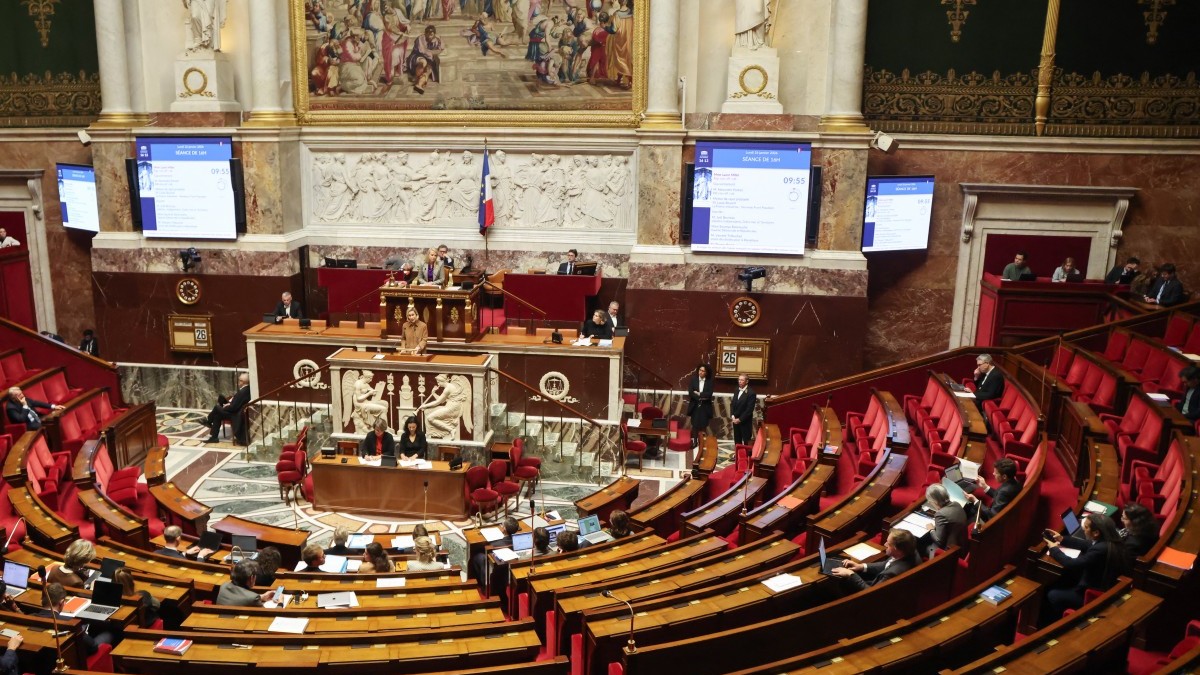
MPs attend a parliamentary debate on banning social media for National Assembly in Paris on January 26, 2026.
Ludovic Marin / AFP
As countries across Europe—and, indeed, much of the rest of the world—consider how to tackle the harms of children’s growing relationships with technology, members of France’s National Assembly on Monday voted by a large margin (116-23) to ban social media access for under-15s.
The proposal is supported by President Emmanuel Macron, who has called for an accelerated legislative process to have it introduced sooner. He said after the vote that “our children’s brains are not for sale. Neither to American platforms nor to Chinese networks,” adding “their dreams cannot be dictated by algorithms” and “we do not want an anxious generation but a generation that believes in France, the Republic, and its values.”
Conservatives are fairly split on the issue. Many on this side accept that social media can be harmful for children, but say that this is merely used as an excuse by establishment types to limit the freedoms of all.
Les Patriotes chief Florian Philippot described the law as “a Trojan horse for digital identity and censorship!” Sovereignist MP and former presidential candidate Nicolas Dupont-Aignan also said that while Macron has “done nothing to protect our youth from screen addiction, ultraviolent video games, the sale and consumption of alcohol and drugs,” he is “suddenly mobilising by targeting only social networks.”
Why such haste as the presidential election approaches? Quite simply to PREPARE THE CENSORSHIP of social networks.
It is of course possible both that the establishment classes are this cynical, and that the harms of social media are enough to warrant a ban. MEP Sarah Knafo, representing the Reconquête party led by Éric Zemmour, who is her partner, noted that she supports children being banned from social media, but that this should be down to “parental authority,” not the “Nanny State.”
In England, where similar proposals are being mulled, Molly Kingsley, executive founder of the child advocacy group UsForThem, conceded in a post earlier this month that “whilst it is categorically not the case that some form of digital ID would be needed for a social media ‘ban,’ it is the case that age assurance will necessarily require some form of data testing. That will inevitably be contentious.”
However, weighed against that is the reality of a vast array of known harms stemming from childhood social media addiction so grave it amounts to a wholesale child safeguarding failure…
That harm is no accident, it is the inevitable consequence of a business model which relies on monetising attention. The libertarian argument that it is in the gift of individual parents to solve the problem—‘parental responsibility, lazy parenting etc’—might be hopeful, but it is also improbably idealistic. It ignores the cohort nature of the problem, it ignores the fact we don’t tend to leave it up to parents to protect children from dangerous-by-design, highly addictive products and services; and it ignores the fact that most parents are as hooked as kids and are therefore ill-equipped to role model more appropriate behaviour.
The French law will now be sent to Parliament’s upper house, the Senate, for approval.