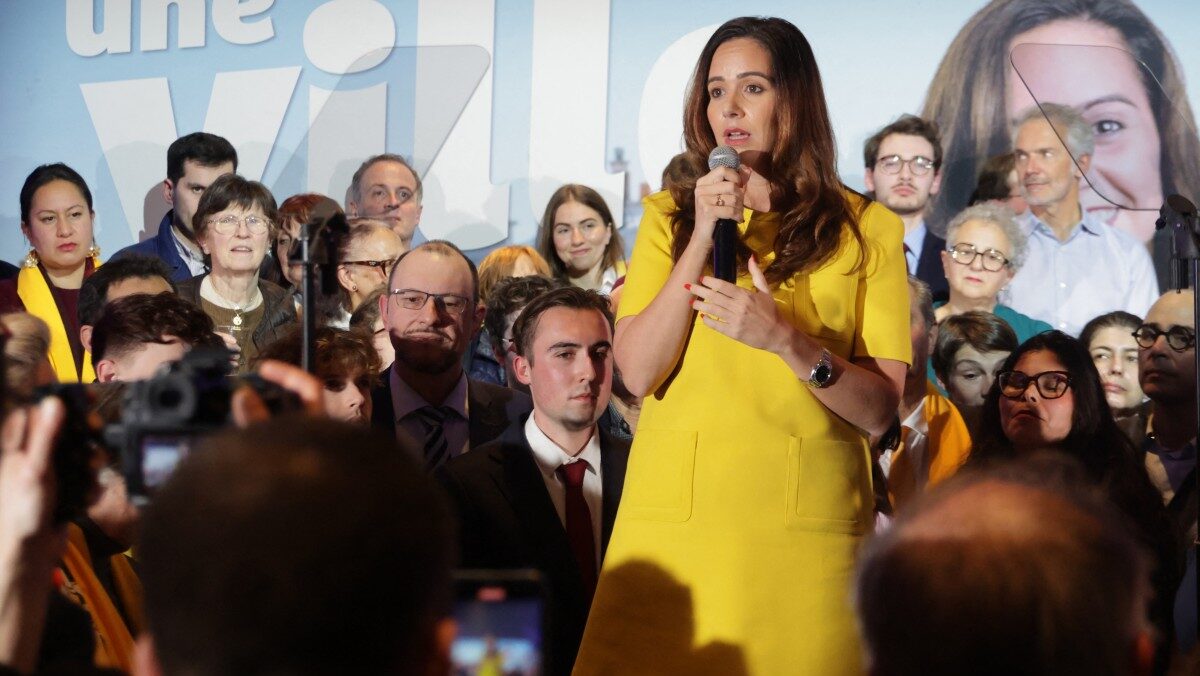
Reconquête party mayoral candidate in Paris, Sarah Knafo (C) addresses supporters following the results of the first round of France’s 2026 municipal elections in Paris on March 15, 2026.
Ludovic MARIN / AFP
Since Sunday evening and the announcement of the first-round results, a race against time has been underway in France’s major cities between municipal lists on both the Right and the Left to forge alliances that will secure victory. Once again, the Right’s self-defeating machine has sadly set itself in motion. While the Left is acting on its reflex to unite at any cost with the far left, the governing right stubbornly refuses any form of rapprochement with the national right and is set to lose in the country’s largest cities.
The outcome is a foregone conclusion, and the 2026 municipal elections are no exception to the rule. In recent months, the excesses of the far-left party La France Insoumise (LFI) may have given the impression that a new cordon sanitaire was being put in place to isolate LFI from the realm of political respectability. This is not the case. As soon as an election looms, despite the denials and bombastic statements made before the cameras, the Left reverts to its instinct for unity, deeply ingrained in its DNA.
As the essayist Ferghane Azihari, who has recently made a name for himself in the French press through his scathing criticism of the archaic practices of the Muslim community, points out, the antisemitism displayed by the far left to court the immigrant electorate should have sparked a clear wave of rejection, as it did in the days of Jean-Marie Le Pen. This is not the case: “The left has turned anti-racism into an adjustment variable that it sacrifices without the slightest scruple whenever such a move is perceived as serving its political interests.”
This is what should enable the Left to win in the city of Marseille, where, nevertheless, the Rassemblement National (RN), represented by Franck Allisio, had a chance. The outgoing Socialist mayor, Benoît Payan, said he would refuse any alliance with the LFI candidate, Sébastien Delogu—but the latter chose to withdraw, without an agreement, even though he had the option of standing in the second round, so that his voters could support the best-placed left-wing candidate and prevent the election of the RN candidate. On the other side, the centre-right candidate, Martine Vassal, for Les Républicains (LR), chose to stand, thereby depriving the city of Marseille of a potential right-wing rallying around a single candidate, Allisio, who enjoyed strong momentum.
On the Right, the absence of even an opportunistic, even minimalist, alliance with the RN remains the absolute rule for LR—a sclerotic party incapable of understanding that it now has no influence in the political arena other than a capacity for disruption and stagnation. On the left, pragmatism prevails. People condemn and take offence at excesses—but they stick together when the decisive moment comes and it is a matter of preventing the ‘fascist threat.’ On the Right, clearly, the Left’s triumph has been internalised and accepted as the lesser evil compared to the prospect of an alliance with the RN. Those who deviate from this line pay a heavy price. Thus, in Reims, the LR candidate formed an alliance with the RN in the hope of defeating the incumbent mayor. He was expelled from his party on the spot.