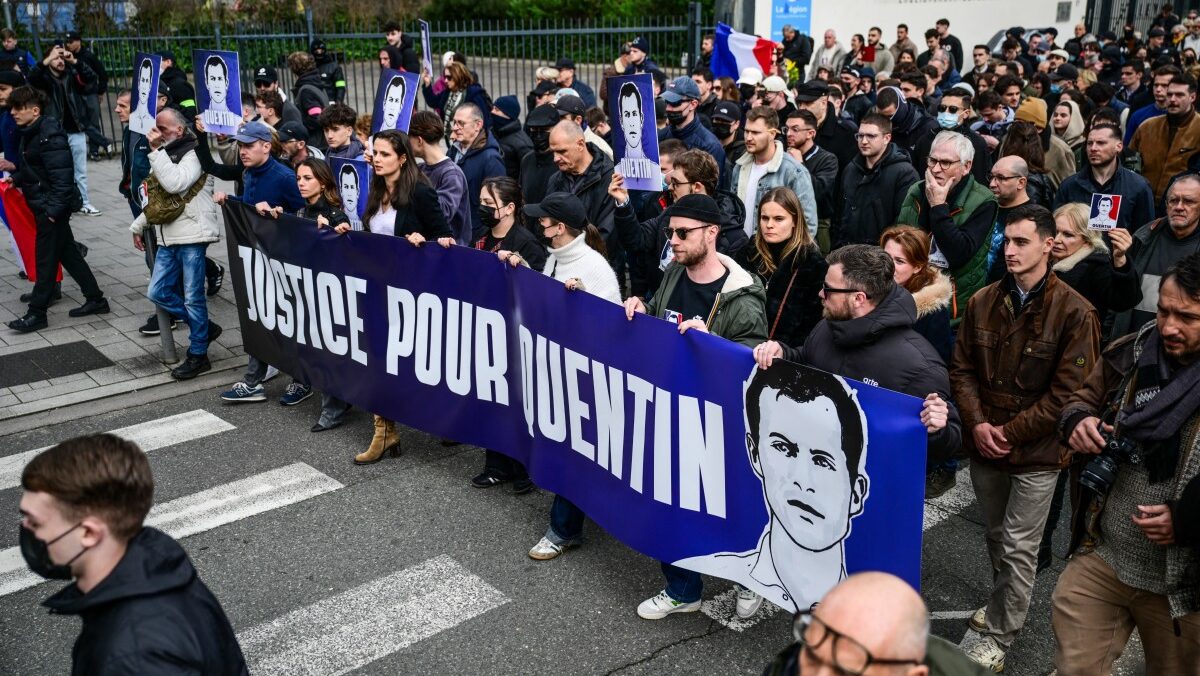
Marchers hold a banner reading “Justice for Quentin” during a march in tribute to Quentin Deranque, who died after being attacked by left-wing activists in Lyon on February 21, 2026.
OLIVIER CHASSIGNOLE / AFP
On Saturday, February 21st, more than 3,000 people gathered in Lyon to commemorate the memory of young Quentin, who was lynched to death by a gang of ‘anti-fascists’ on the sidelines of a conference held by MEP and pro-Palestinian activist Rima Hassan. The movement, impressive in its calm and dignity, continues to make headlines in the media, which stubbornly seeks evidence of ‘neo-Nazism’ without questioning who the real culprits are and why the victim is receiving such massive popular support.
The media outlets that covered the event without trying to impose their own preconceived interpretations—and they are few and far between—described, like Paul Sugy in Le Figaro, a dignified demonstration that brought together a wide variety of people: “a motley crowd gathered for a tribute that was calmer than expected,” reported the journalist, a native of Lyon who was present at the scene.
Nevertheless, the mainstream and left-wing media were on the lookout for the slightest signs to lend credibility to their narrative of a ‘neo-Nazi wave’ that had supposedly swept through Lyon. On RTL radio, LFI MP Manuel Bompard described a “fascist parade,” while the newspaper Le Parisien saw it as a “far-right march.”
The raised arms were systematically interpreted as Nazi salutes, according to a well-known disinformation technique that Elon Musk has already fallen victim to. Demonstrations featuring left-wing activists from La Jeune Garde with raised arms could be subject to the same accusations, but journalists are careful to avoid this.
Comme les salut nazi de la jeune garde 😂😂 pic.twitter.com/YvZIQuFUqF
— B.G 🇫🇷 (@Gigi200lamoroso) February 23, 2026
While it cannot be ruled out that some radical far-right figures may have slipped into the demonstration in honour of Quentin, their presence was marginal—and particularly difficult to document, as most of the journalists’ accounts mentioning them were unable to produce any conclusive videos or recordings to support their claims.
Some did not hesitate to make dishonest misinterpretations, such as those who saw a ‘Nazi symbol’ in the chrisma, a Christological symbol, appearing on one of the banners displayed in memory of the young man, a devout Catholic. Another misunderstanding was the song “La Ligue noire” (The Black League), sung during the march, which was deemed ‘racist,’ when it is in fact a counter-revolutionary song composed in 1793 at a time when mass killings were being perpetrated in the city of Lyon in the name of the Convention.
Alice Cordier, president of the Collectif Némésis, which organised the counter-demonstration that Quentin attended on Thursday, February 12th, told CNews that she was dismayed by the media coverage of the Lyon march:
Because Quentin was right-wing, he wasn’t even given decent media coverage. The public service explained that it was the return of the boots. Meanwhile, on the ground, grandmothers were crying.
Under media pressure, Quentin’s family preferred to distance themselves from the Lyon demonstration and, through their lawyer, reiterated that “Quentin’s memory does not belong to small groups, but to all French people, without exception.”
The majority of the French media therefore devoted more energy to monitoring the supposed traces of far-right violence in the demonstration in tribute to Quentin than to tracing the real culprits behind the explosion of political violence in the streets of France over many months. A genuine “reversal of blame” is at work, in the words of Le Figaro editorialist Guillaume Tabard. However, unlike the demonstrations organised by the far left, where Antifa activists are rampant, there was no material destruction, no injuries, and no assaults, either among the demonstrators or the police. On the channel Public Sénat, MEP Marion Maréchal recalled that the tribute to Nahel, who died during a police arrest in 2023, led to 3,000 arrests, nearly 2,000 convictions and more than 1,000 injuries.
On Monday, February 23rd, Emmanuel Macron organised a meeting on violent movements and the radicalisation of political debate, as demonstrated by the death of young Quentin. Following the deliberations of the presidential council, the dissolution of two right-wing identity groups was requested, while the dissolution of La Jeune Garde, an anti-fascist movement to which most of Quentin’s killers belong, protected by La France Insoumise MP Raphaël Arnault, who is still in office, has not yet been implemented.
Marion Maréchal expressed alarm at the media bias aimed at overemphasising the existence of right-wing political violence:
When it comes to political murders, everyone repeats the figures from LFI and two ‘researchers’ who are themselves linked to the far left.
Europol’s figures are clear: between 2022 and 2024, the agency counted 7 attacks linked to the far right and 71 linked to the far left.
« Sur les meurtres politiques, tout le monde reprend les chiffres de LFI et de deux "chercheurs" eux-mêmes liés à l’extrême gauche.
— Marion Maréchal (@MarionMarechal) February 23, 2026
Des chiffres qui ne comptent pas les assassinats d’Action directe ou omettent l’attaque du conseil municipal de Nanterre (8 morts !) commise par un… pic.twitter.com/Vz0RL26h0e