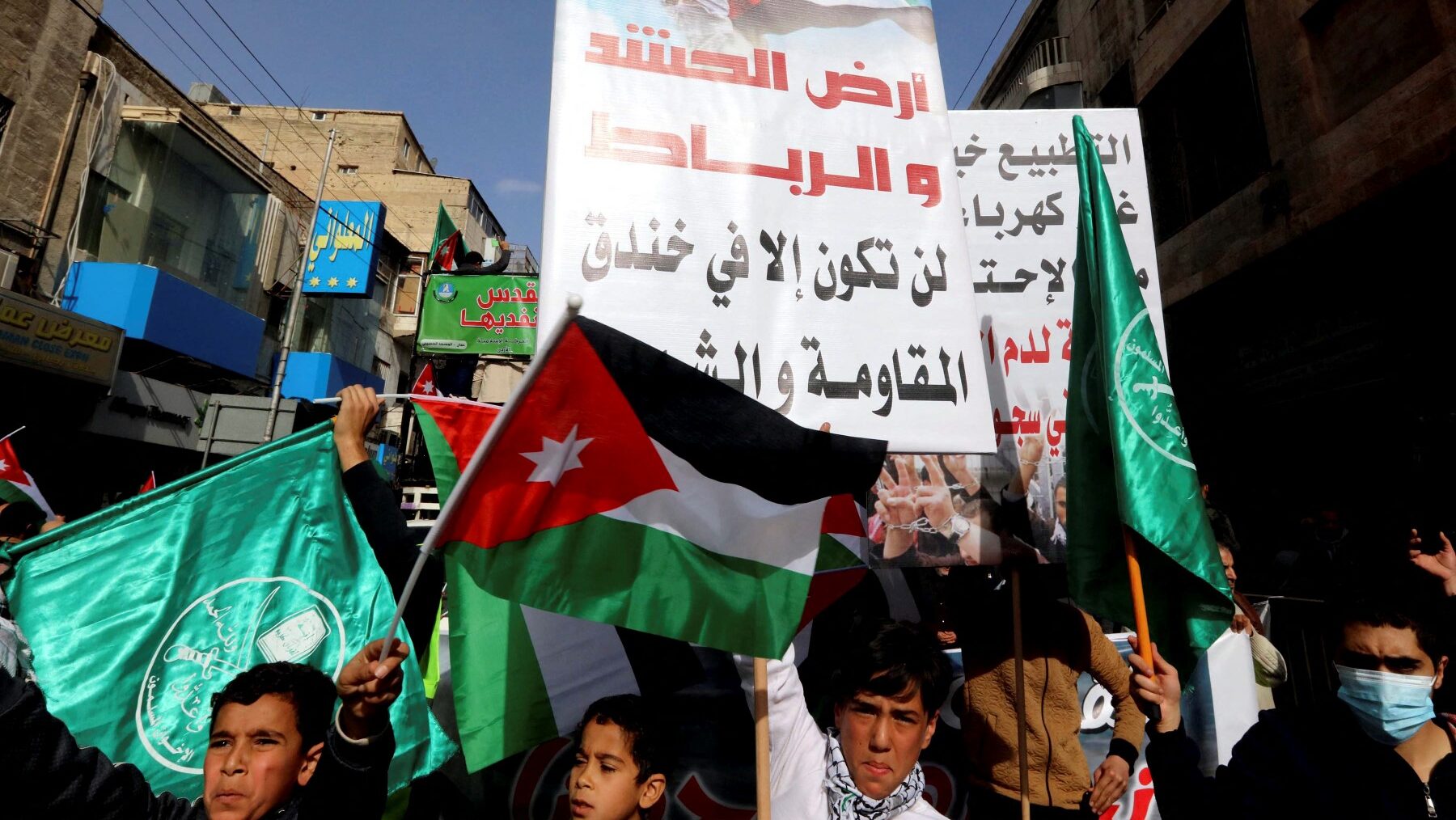
Protesters in the Jordanian capital Amman raise the national flag as well as flags of the Muslim Brotherhood as they rally in support of Palestinians on January 27, 2023.
Khalil MAZRAAWI / AFP
After a heated parliamentary session, French MPs voted in favour of a resolution against the Muslim Brotherhood, classifying it as a terrorist organisation. This decision comes after numerous reports and warnings about the group’s infiltration of and growing influence on French society.
On Thursday, January 22nd, the centre-right Les Républicains (LR) party had control of the parliamentary agenda to submit bills of their choice for consideration by MPs. With 157 votes to 101, they succeeded in passing a resolution to launch a procedure to have the Muslim Brotherhood included in the list of terrorist organisations at the European level.
The non-binding text calls on the European Union to conduct “a legal and factual assessment of the transnational network of the Muslim Brotherhood.”
The rapporteur defended the text against a “political movement” whose aim is to “make Sharia law triumph over the law of the Republic,” arguing that such a classification would make it possible to freeze public funding (for example for schools and mosques) and facilitate the exchange of information between states. Over the last decade, around 10% of mosques that have opened their doors are affiliated with or close to the Muslim Brotherhood.
This resolution is the culmination of many months of alerting French public opinion to the danger posed by the Muslim Brotherhood. In May 2025, an official report highlighted the high degree of infiltration of this radical Islamist movement at all levels of French society. The document has now become a reference point for debates on both the right and the left. For the promoters of the parliamentary resolution, it is time to move beyond ‘denial’ or ‘cowardice’ on the issue.
The resolution was passed with votes from the government, the centre, and centre-right, as well as by the Rassemblement National (RN)—proof that on the issue of the fight against Islamism, a consensus can be reached between parties that struggle to find common ground on other issues. The government issued what is known as a “statement of wisdom”—neither for nor against, in line with the ‘at the same time’ approach so dear to President Macron.
The Left, for its part, almost unanimously rejected the resolution, putting forward well-known arguments about the risk of “stigmatising” French citizens of the Muslim faith or of the right and centre ‘submitting to the RN’s agenda.’
The debate, which lasted five long hours, gave rise to some heated exchanges, such as when MP Laurent Jacobelli, spokesman for the RN, accused the MPs of La France Insoumise (LFI), who were hostile to the texts and accused of suspicious links with the Muslim Brotherhood, of being in favour of stoning homosexuals: “The Muslim Brotherhood wants to stone homosexuals, so if you want to stone homosexuals, vote for LFI,” he said in the chamber. “Conspiracy theorists,” “fascists,” “racists,” “Islamophobes”, “foreign party,” “antisemites,” “Hamas supporters”—a barrage of insults was exchanged by both sides. Another theatrical episode, pitting RN MP and vice president of the National Assembly Sébastien Chaunu against LFI MP Antoine Léaument, almost came to blows.
The vote on this resolution is only a first step. The ball is now in the European Commission’s court. Certain branches of the Muslim Brotherhood are already on the list of terrorist organisations in many countries, such as Austria and the United States.