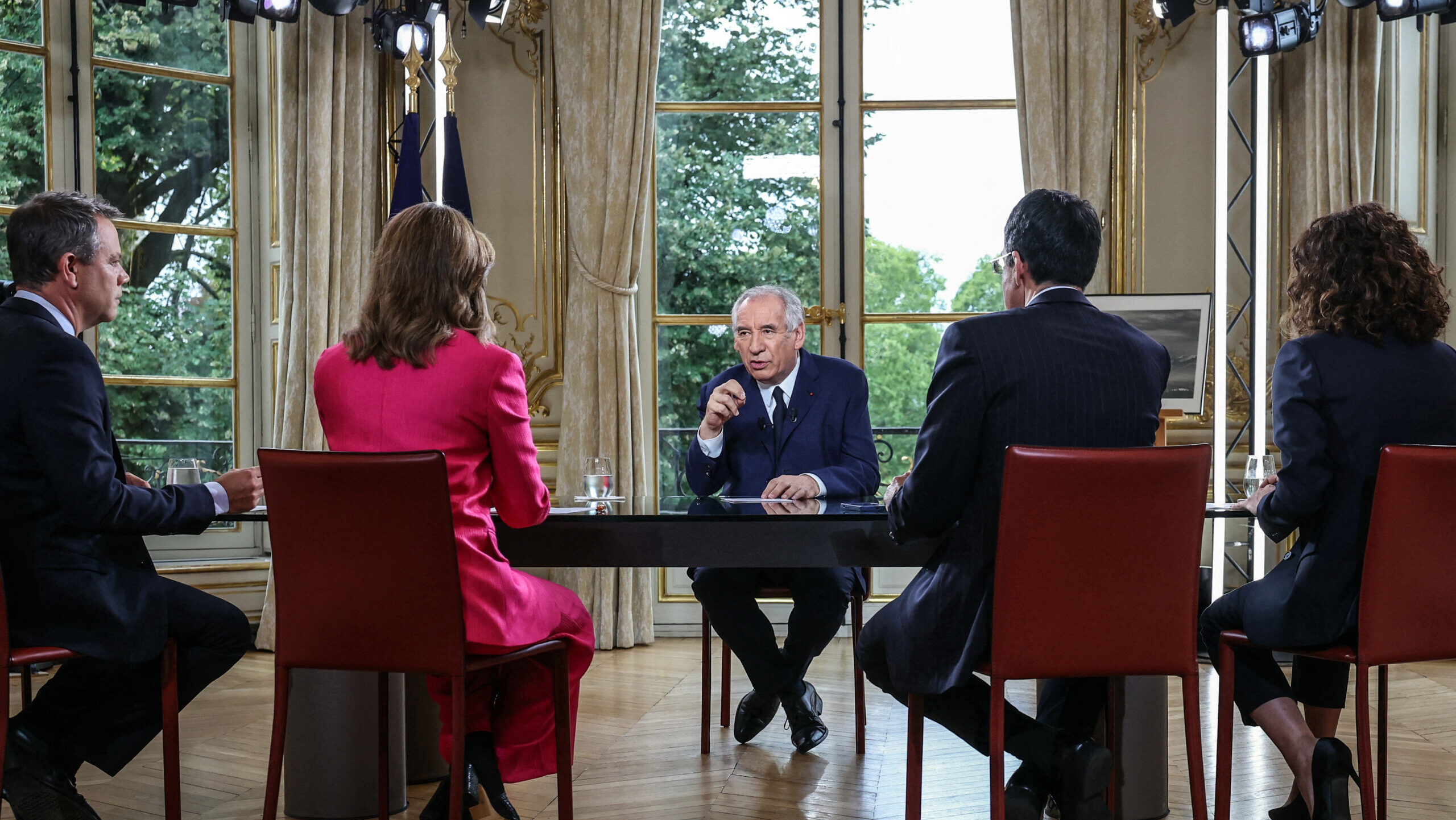
French PM François Bayrou speaks with journalists
ALAIN JOCARD / AFP
French Prime Minister François Bayrou has accused Italy of luring away France’s wealthy taxpayers, prompting a sharp rebuke from Rome just days before a no-confidence vote that could topple his government.
In a televised interview on Sunday evening carried by four news channels, Bayrou accused Giorgia Meloni’s government of pursuing a “tax dumping” policy that, according to him, is driving wealthy taxpayers out of France and weakening the state’s revenues.
“The wealthiest people are leaving. There is a kind of fiscal nomadism. For example, Italy is currently applying a tax dumping policy,” Bayrou stated, as he defended his rejection of the so-called “Zucman tax,” a proposal to levy a 2% charge on assets exceeding €100 million.
The remarks drew an immediate response from Italian prime minister Giorgia Meloni, who wrote a strongly worded statement on her official X account:
The completely unfounded claims by French Prime Minister François Bayrou that Italy is engaging in tax dumping, penalizing France, are astonishing. Italy does not apply unjustified tax advantages to attract European companies.
Stupiscono le affermazioni, totalmente infondate, del primo ministro francese Francois Bayrou, secondo le quali l’Italia starebbe facendo “dumping fiscale”, penalizzando la Francia. L’economia italiana è attrattiva e va meglio di altre grazie alla stabilità e credibilità della…
— Giorgia Meloni (@GiorgiaMeloni) August 31, 2025
Meloni further recalled that her government has tightened the rules for high-income foreigners relocating to Italy, doubling the flat tax regime since 2016. The Italian government argued this showed the country was not acting as a “tax haven.”
The main parties in the governing coalition unanimously backed the response. The Lega party branded Bayrou’s comments a “serious and unacceptable attack against Italy, its entrepreneurs and workers,” while Foreign Minister Antonio Tajani (Forza Italia) declared:
I am astonished. This accusation is the result of completely flawed reasoning. I don’t want to comment on France’s situation, but Italy is not conspiring against anyone. The EU has real tax havens, and we are not among them.
The exchange has once again highlighted long-standing tensions within the European Union over tax competition between member states. EU officials have so far avoided direct comment, but diplomats in Brussels said the dispute is being closely monitored, given the risk of further divisions at a time of economic uncertainty.
Bayrou’s remarks come at an especially delicate moment. On September 8, the National Assembly will vote on the no-confidence motion tabled by the opposition, which could topple his government. Bayrou, who no longer commands a solid majority, needs to secure support from Socialists and independents to reach the 287 votes required.
His economic plan, presented in July, foresees €44 billion in spending cuts, a freeze on expenditures, and reductions in the civil service, including the abolition of two public holidays. With a national debt of €3.3 trillion and a deficit at 5.4% of GDP—well above the 3% threshold set by Brussels—the prime minister defends these measures as essential to “restore France’s credibility.”
Political analysts say his chances of survival depend on winning over wavering Socialist and independent deputies. President Emmanuel Macron has publicly expressed his support, though he has also left open the possibility of dissolving the Assembly if the motion passes. Bayrou’s clash with Italy also comes as he faces strong opposition at home, with unions calling for nationwide strikes against his budget plan.
The dispute has therefore added to the political turmoil in Paris and risks complicating relations with a key EU partner.