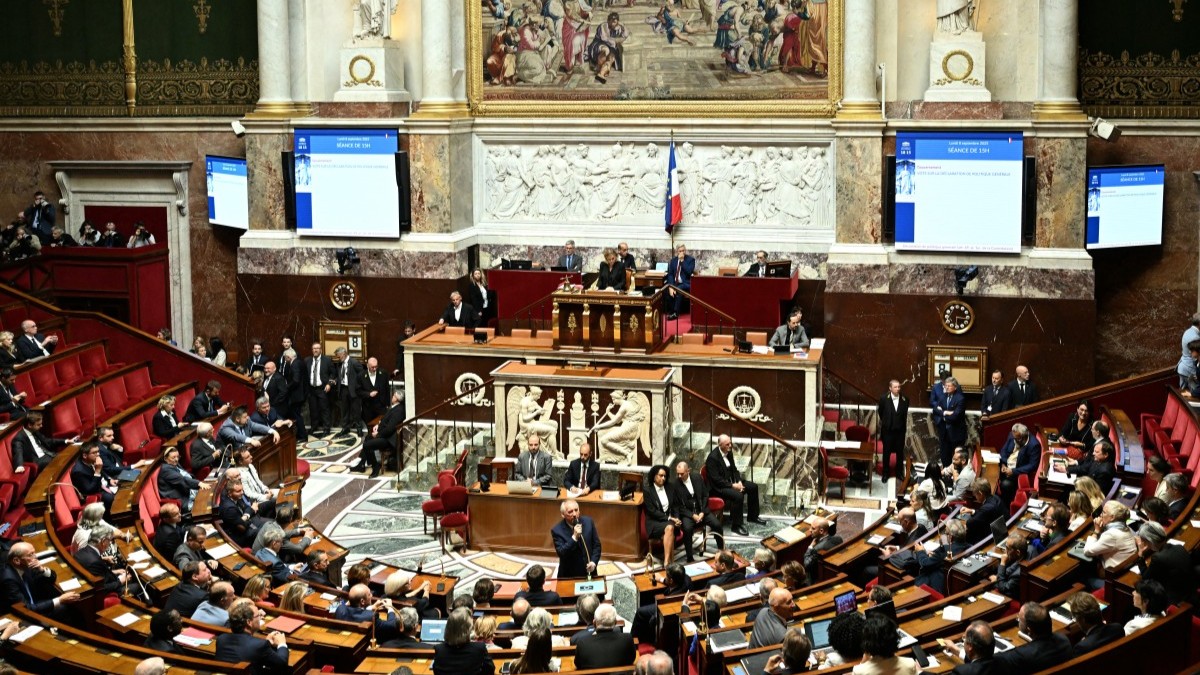
France’s Prime Minister François Bayrou (C) delivers a speech prior to a confidence vote over the government’s austerity budget, at the National Assembly in Paris on September 8, 2025.
Bertrand Guay / AFP
A few weeks ago, when Prime Minister François Bayrou decided to call a vote of confidence in the absence of a parliamentary majority, he was undoubtedly aware that he was signing his own death warrant. And indeed, the day of debates held in the National Assembly on Monday, September 8th sealed his fate, forcing him to resign, as required by the constitution.
The debates opened with a long speech by the head of government, during which he once again attempted to alert MPs to the debt wall looming ever closer on the horizon. But Bayrou’s carefully chosen words were in vain, as the confidence he had come to seek through the vote had long since evaporated. Apart from a residual centrist core, no MP was prepared to grant it to him.
364 denied Bayrou the confidence, 194 voted for him, and 15 abstained. This is the first time in the history of the fifth republic that a prime minister has been denied a vote of confidence and thus been overthrown by a vote of MPs.
While the failed PM’s diagnosis may be correct, the prescription he proposed is completely inappropriate. Bayrou is not solely responsible for France’s current misfortune, the result of decades of mismanagement and wasteful public spending. He deserves credit for denouncing these practices, but despite announcing €44 billion in savings, he has proved incapable of proposing a credible programme that would restore hope to a country that no longer believes in itself and is sinking into stagnation.
The crisis is political before it is financial or economic. By deciding to dissolve the national assembly in July 2024, President Macron has only accelerated the disintegration.
Representatives of the various parliamentary groups took turns at the podium to respond to the prime minister and justify their vote.
The support of the right-wing Les Républicains party for the prime minister was half-hearted, and with MPs free to vote as they wished, they committed to a compromise that lacked ambition and enthusiasm. On the Left, the rejection was unanimous—even if the socialists secretly hoped to be appointed to form a new government.
A few days ago, ahead of the vote, Macron held a private meeting with Gérard Larcher, President of the Senate, a prerequisite in the event of dissolution. Even if everything suggests that Macron will refuse to resort to this expedient again, he may end up doing so, as the situation he himself has created remains inextricable. Names are once again circulating in a flurry to replace Bayrou once he resigns. But the new prime minister will have no more of a majority than his predecessor in the current state of the National Assembly.
This is why the Rassemblement National (RN) is pushing with all its might for the French people to return to the polls: “Dissolution is not an option, but an obligation,” Marine Le Pen explained in her remarks today at the National Assembly.
Bayrou plans to submit his resignation on Tuesday, September 9th at 8 a.m.