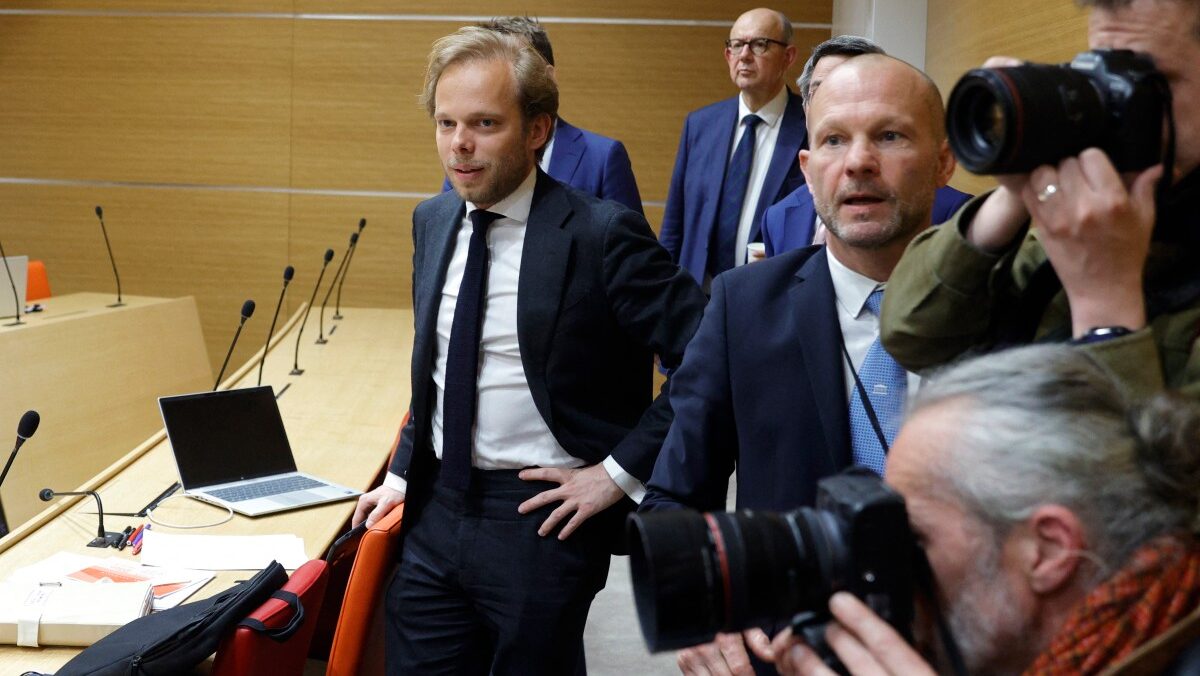
UDR’s MP Charles Alloncle (L), rapporteur of the Commission d’Enquete sur l’Audiovisuel Public (Public broadcasting inquiry commission), looks on prior to France TV CEO and France TV Secretary-General’s hearing by the commission of inquiry into the neutrality, operation and funding of public broadcasting at the National Assembly, France’s lower house parliament, on April 8, 2026.
GEOFFROY VAN DER HASSELT / AFP
The major parliamentary inquiry into French public broadcasting, launched at the initiative of conservative MP Charles Alloncle, has finally got underway. For many long weeks, the MP has doggedly delved into the intricacies of the management of French public television and radio to uncover secrets that everyone suspected but had never been able to prove explicitly: corruption, poor management, and political collusion at the highest level. Now that it is time to draw practical conclusions, the Left is fighting tooth and nail to deny the facts and preserve its privileges.
The parliamentary inquiry originated from a scandal revealed by the conservative magazine L’Incorrect, which had access to a conversation between public service journalists openly admitting to using their airtime and media influence to promote their candidates and their political agenda—a left-wing one. The opportunity was too good to pass up, and the inquiry set out to dig deeper and show that this episode was merely the tip of the iceberg.
Four months of investigation, 67 hearings, 234 witnesses, repeated disruptions during sessions—the parliamentary committee stirred up a storm of emotion. During her final hearing, France Télévisions chairwoman Delphine Ernotte launched into a campaign of blame and accusations to defend her turf: “The questioning, the accusations, the suspicions, have been deeply painful,” she insisted, casting the blame on Charles Alloncle, the rapporteur and director of this commission of inquiry.
Over the weeks, Alloncle has emerged as one of the rising figures of the French conservative Right. Previously little known, this MP—a member of Éric Ciotti’s party, the Union of the Right for the Republic (Union des Droites pour la République, or UDR, allied with the Rassemblement National)—has commanded respect through his tenacity, his resilience in the face of attacks from the Left, and his determination not to waver from the public interest mission he had set himself. The left-wing daily Libération described him as a “cardboard Zola”, in a reverse reference to the novelist who spearheaded the press campaign against the injustice of Dreyfus’ conviction in 1898. Media mogul Xavier Niel, for his part, described him as a “clown” and his committee as “a circus”. The progressive weekly Le Nouvel Obs saw his venture as a dangerous “laboratory for the far right.” Every form of invective was deemed acceptable to destabilise the man who, for the first time, demonstrated an unshakeable determination to take on the impregnable fortress that is the French public media.
On the Right, the emergence of a promising figure is being welcomed, one who combines the combativeness of RN activists with the respectability of the old-school right-wing government establishment.
The inquiry officially came to an end on April 8th. Alloncle must now set about drafting his report. He has around a fortnight to do so. There is no doubt that the conclusions are both eagerly awaited and feared. The MP mentioned the inclusion of a draft bill on public broadcasting on the agenda for the next parliamentary initiative day reserved for his group in the National Assembly, on June 25th. But until then, another deadline is to be watched closely. The 31 MPs who make up the committee are due to vote on April 27th for or against the publication of the report. MPs are under considerable pressure to prevent publication, which could, in the short term, mean the outright destruction of all the work carried out over weeks by Alloncle and his colleagues and all the revelations obtained thanks to his tenacity. But even if the contents of the investigation were to disappear, the essence of the message has got through.
A corner of the veil has been lifted on the opaque management of public institutions—radio and television—where public money flows freely without anyone thinking of being held to account, benefiting sprawling networks of influence through which a handful of magnates and prominent presenters thrive and grow rich—all in the service of an ideological orientation veering ever further to the left, or even the far left. The revelations are spine-chilling. Whilst France Télévisions communicates openly, yet misleadingly, about the balance of its accounts, Alloncle has established that a deficit of €80 million has accumulated since 2017. Other figures, finally brought to the public’s attention, are causing outrage: public broadcasting benefits from an annual budget of over three billion euros, representing more than half of the ministry of culture’s budget, whilst only 4.5% of that same budget is devoted to protecting France’s endangered heritage—a priceless treasure and a source of wealth yet increasingly neglected.
The rapporteur has been accused of having excessively politicised his work—whereas he has specifically sought to show that unilateral politicisation lies with those who constantly profess editorial neutrality. Week after week, the picture is becoming increasingly clear. The ideological bias of public broadcasting has become second nature, and the lack of pluralism a moral obligation for those who see themselves as ‘the side of good.’ The casual manner in which public funding is handled calls for firm action to restore rigour to the accounts. The political conclusion is becoming non-negotiable: those who next come to hold power will have to carry out a thorough reform of public broadcasting in order to redefine or even drastically reduce its scope.