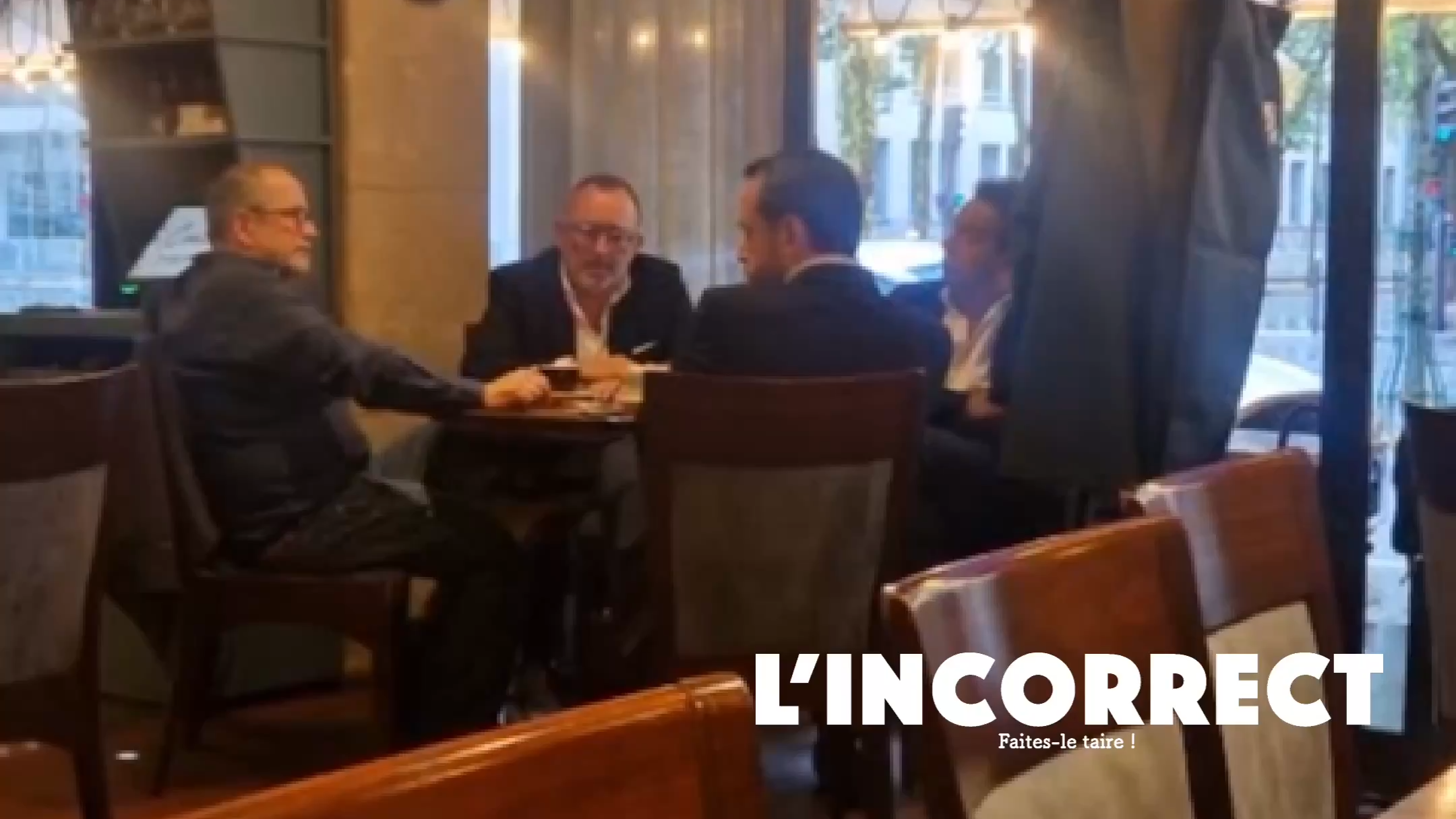
Screenshot of the video recorded in a Paris café, exposing the so-called Legrand Affaire
A scandal is rocking the French press: a conservative magazine has just provided evidence, backed up by recordings, of public service journalists openly using media to support the socialist Left. The Right, which has long denounced the shameless collusion between the mainstream media and the Left, sees its worst suspicions more than confirmed, while those concerned try, in vain, to perpetuate the myth of their ‘neutrality’ and ‘journalistic ethics.’
These revelations, which came to light on the weekend of September 6 and 7—when French news was dominated by the vote of confidence requested by Prime Minister François Bayrou—were made by our friends from the magazine L’Incorrect, which describes itself as “cultural, conservative and corrosive.”
One of L’Incorrect’s journalists witnessed a discussion in a Parisian café between two public service journalists, Thomas Legrand and Patrick Cohen, who work for France Inter radio, and two senior members of the Socialist Party, namely the party’s secretary-general, MEP Pierre Jouvet, and the president of the national council of the party, Luc Broussy. The journalist was able to record a surreal video of this exchange.
The video shows, in no uncertain terms, the high degree of collusion between leading public service journalists and senior members of the left-wing party. The focus is on Rachida Dati, a candidate for mayor of Paris who is determined to oust the Left. She is the prime target for the protagonists in the discussion. During the conversation, Thomas Legrand explains that he will “do what is necessary for Dati.” A little later in the discussion, Legrand, wondering about the electoral choices of the centre-right, congratulates himself on the fact that they listen “en masse” to France Inter—thus providing a prime audience for their propaganda.
As soon as the scoop was released, the journalists in question adopted their favourite defence strategy: to discredit the whistleblower so as not to have to respond to the substance of the accusation. Since the newspaper L’Incorrect is labelled ‘far-right’, no reliable information can come from it. Unsurprisingly, Macron’s supporters defend the Left, as in a post by Valérie Hayer, head of the Macronist party’s list for the European elections, who displays her “total support for public service.”
L’Incorrect’s revelations are deemed null and void because the newspaper is not respectable and its methods are allegedly unfair. Patrick Cohen, the first to be put in the dock, has no trouble denouncing the audacity of L’Incorrect, though a few years ago he vigorously justified the video piracy of a lecture by Laurent Wauquiez, leader of the Les Républicains party, in order to denounce his “nauseating” ideas. At the time, it was not considered an invasion of privacy, but a “perfectly legitimate journalistic endeavour.”
Cohen, cloaked in dignity, announced his intention to file a complaint. Against whom, against what, we wonder. L’Incorrect’s videos were taken in a public place—a café like thousands of others in the capital. Any self-respecting Parisian knows full well that a café is a highly strategic place where anyone can come to fish for information. The complaint will not hold up.
After the initial outrage in the headlines when the revelations came out, embarrassment is beginning to set in, even among Legrand and Cohen’s supporters.
The problem is not so much the left-wing affiliation of these public service journalists. It is a well-known and well-documented fact that the supposed journalistic neutrality of the public service is, in fact, institutionalised ideological bias.
The scandal stems mainly from the deliberate use of a public media outlet—and therefore taxpayers’ money—to convey a specific message and influence the electorate in the run-up to the next elections: the municipal elections in 2026, followed by the presidential elections in 2027.
Faced with the scale of the scandal, France Inter’s editorial team had no choice but to suspend its columnist Thomas Legrand from his duties. A few months ago, another France Inter journalist was thrown to the wolves and dismissed for talking to the president of the National Rally, Jordan Bardella. The public radio station had no choice but to call Legrand to order, lest it further aggravate the legitimate accusations of political bias. “Thomas Legrand’s comments could be misleading and fuel suspicion that our station is being used for partisan purposes,” Adèle Van Reeth, the station’s director, was forced to acknowledge in a message to staff explaining her decision.
It is difficult to then claim to give lessons in good conduct to journalists from the right-wing channel CNews, recently accused by Legrand himself of serving up “lies in the service of ideological warfare” all day long. The difference is significant: CNews is a privately funded channel, which is completely free to broadcast the message of its choice, and which costs the French people nothing.
At a time when the National Assembly is in turmoil over the issue of public deficits, the Legrand-Cohen scandal comes at just the right moment to fuel the debate on the necessary privatisation of public broadcasting, which costs the state budget several billion euros each year.
It remains to be seen whether the controversy will spread beyond the small circle of insiders who closely follow the quarrels that shake the media world. Nevertheless, all the major mainstream media outlets have been forced to report on the facts and comment on them. The affair taps into a widespread feeling among the French public that journalists are sell-outs and that impartiality in news reporting has long since ceased to be a tangible reality.
CNews continues its rise as France’s leading news channel. The channel now dominates the French audiovisual landscape with a 3.8% market share, while the very official and politically correct BFMTV continues to decline. The French have made their choice: they are happy to have partisan news, but not one that is financed by their taxes to spit on them under the guise of objectivity.