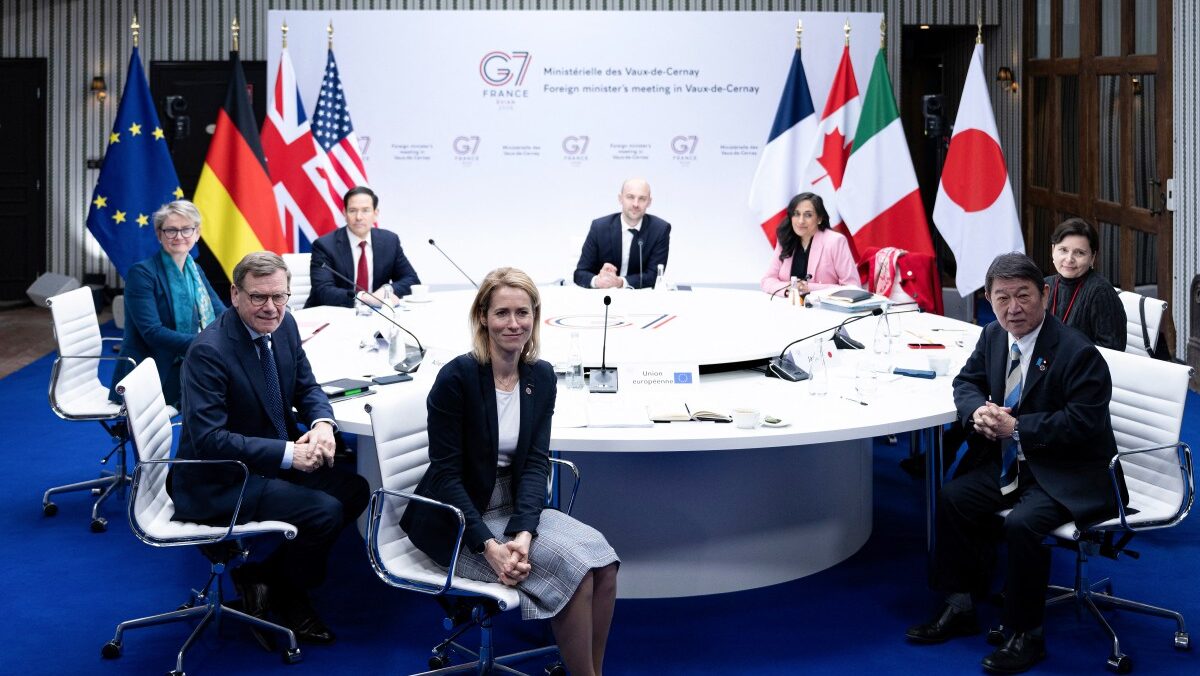
EU High Representative and Vice-President for Foreign Affairs and Security Policy Kaja Kallas (C), Germany’s Foreign Minister Johann Wadephul (2nd L), Britain’s Foreign Secretary Yvette Cooper (L), U.S. Secretary of State Marco Rubio (3rd L), France’s Minister for Europe and Foreign Affairs Jean-Noel Barrot (C-R), Canada’s Foreign Minister Anita Anand, (3rd R) and Japan’s Foreign minister Toshimitsu Motegi (2nd R) attend talks on Peace and Security during a G7 Foreign Ministers’ meeting with Partner Countries at the Vaux-de-Cernay Abbey in Cernay-la-Ville outside Paris, on March 27, 2026.
BRENDAN SMIALOWSKI / POOL / AFP
Meeting under France’s 2026 G7 presidency at a historic abbey outside Paris on March 26–27, foreign ministers from the world’s leading economies issued a joint call for an immediate halt to attacks on civilians as the war in the Middle East intensifies.
Representatives from Canada, France, Germany, Italy, Japan, the United Kingdom, the United States, and the European Union said protecting civilian lives and infrastructure must be a top priority. They also stressed the need to limit the conflict’s ripple effects across the region and to better coordinate humanitarian aid. Deliberate strikes on civilians or diplomatic sites, they said, can never be justified.
The talks also touched on concerns about global trade and energy security, including the danger to critical shipping routes, primarily the Strait of Hormuz, and the broader economic consequences straining energy markets and disrupting supply chains.
German Foreign Minister Johan Wadephul said in a statement before the meeting,
All of us are already feeling the economic impact of the Iranian regime’s blockade of the Strait of Hormuz in our own countries—with long-term impacts on the global economy that are very difficult to predict. This demonstrates once again how closely intertwined security and prosperity are.
U.S. Secretary of State Marco Rubio warned that the U.S. and its allies may struggle to keep the strait open and cautioned that Iran could try to impose a toll on the key waterway, which carries about 20% of the world’s oil. Such a move, he added, could deal a serious economic blow to countries around the globe.
European officials also pressed Washington for more clarity on its approach to Iran, including how it plans to de-escalate tensions and pursue negotiations. In a response to a press question, Rubio said the U.S. would not need ground troops to reach its goals in Iran and that the campaign should end in “weeks, not months.”
Ukraine remained high on the agenda. The group reaffirmed its backing for Kyiv in its ongoing fight against Russia, discussing tougher sanctions—including targeting Russia’s so-called shadow fleet—and long-term support to strengthen Ukraine’s defenses and energy systems.
On the sidelines, France’s foreign minister Jean-Noël Barrot criticized his Russian counterpart Sergey Lavrov, accusing Moscow of violating international law and spreading disinformation. Barrot’s statements came in response to an interview with French television, where Lavrov denounced the U.S.-Israeli strikes and said Russia’s support for Iran was primarily about upholding international law, which he said had been breached by those strikes. The interview itself drew backlash in France with Ukraine’s ambassador to France, Vadym Omelchenko, questioning on X why French television had given a platform to a figure he described as a “war criminal.”
Beyond the major conflicts, ministers also discussed broader challenges, from maritime security and critical minerals to drug trafficking and partnerships with countries in the Global South. Officials from India, South Korea, Brazil, and Saudi Arabia were among those invited to take part in parts of the discussions.
The meeting represented the initial official assembly of foreign ministers during France’s G7 presidency in preparation for the leaders’ summit scheduled for June in Évian-les-Bains.