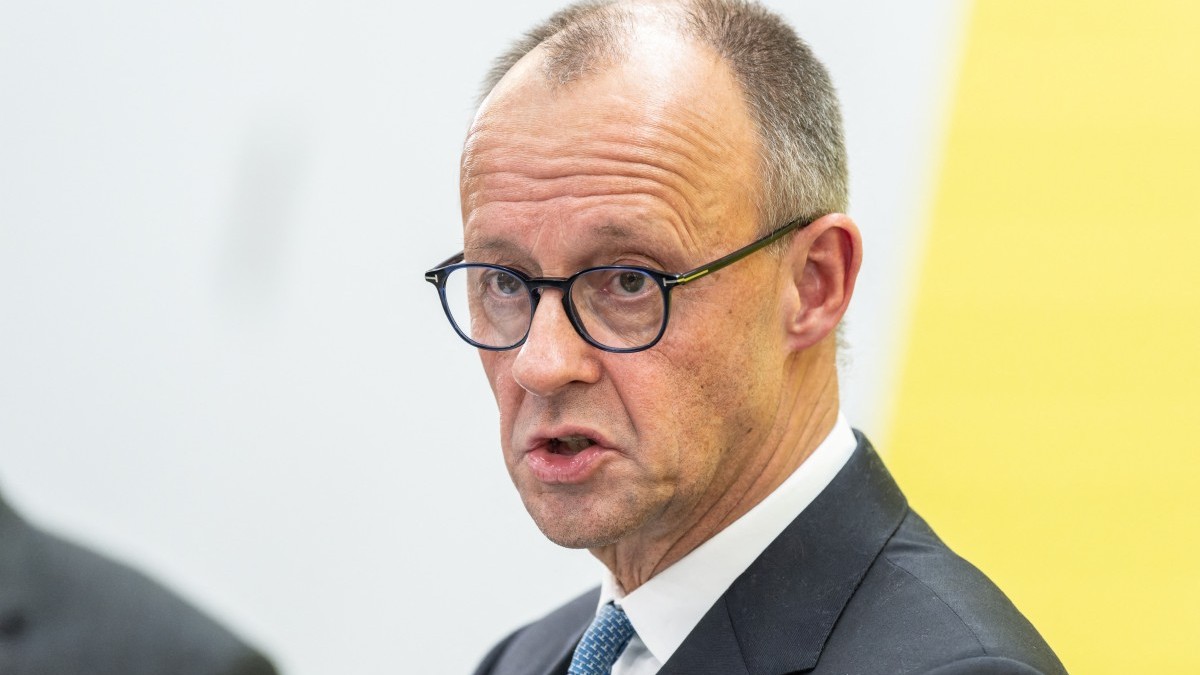
German Chancellor Friedrich Merz
Silas Stein / AFP
German Chancellor Friedrich Merz (CDU) faces one of the most decisive phases of his chancellorship on Thursday, November 27th, as the coalition committee attempts to resolve the escalating pension dispute with SPD leaders Bärbel Bas and Lars Klingbeil, alongside CSU leader Markus Söder. The talks also aim to clarify the government’s stance on the combustion-engine ban.
The planned law, in addition to guaranteeing a minimum pension level, also includes the expansion of the mothers’ pension, which the CSU had promised. The resolution from the Young Group–a grouping of MPs within the CDU/CSU parliamentary faction–states that while they support the coalition agreement to fix the pension replacement rate at 48% until 2031, no stabilization beyond 2031 was agreed upon. According to the draft, the replacement level should be permanently 1% higher than it would be under current law. This would have significant consequences for Germany’s debt. The resolution states that additional costs of more than €115 billion would arise between 2032 and 2040.
The Young Group also sent a backhanded compliment to Merz and his campaign promises. Pascal Reddig, chairman of the Young Group, said:
“The Chancellor emphasized that young people will not be burdened further simply because they are in the minority. We agree.”
The 18 members of parliament, who–together with their supporters–have reportedly grown into a rebel group of almost 50, could now easily block the pension law, which the Chancellor had already approved at the cabinet table. This carries weight because the CDU/CSU–SPD government holds a majority of only twelve seats in the Bundestag.
The SPD has taken a hard line for weeks, stating that it does not want to change anything in the law, referencing their coalition agreement with Merz.
Pascal Reddig, who, together with the head of the Young Union (JU), Johannes Winkel, is leading the pension rebellion, told Der Spiegel:
We cannot agree to the package as it currently stands.
He therefore strongly advises against “going into a vote where we don’t know the outcome.” Reddig warns of the Brosius-Gersdorf debacle, when the vote was abruptly canceled because the Chancellor and his parliamentary group leader, Jens Spahn, could not guarantee a majority within their own party.
Bavaria’s Minister-President Markus Söder (CSU) said “I very much hope that we will find a solution in the end–because neither postponing it nor letting it fail now will provide stability for the social security systems, nor will it signal that we have a strong government.”
Chancellor Merz, however, cannot expect any concessions from the SPD. The Social Democrats warn that if there is no majority for the pension package, there will be no majority at all in the Bundestag.
In fact, the majority of Germans do not believe that the current black-red coalition government will last. 54% of citizens think that Chancellor Friedrich Merz’s term in office will end prematurely, according to a recent survey conducted by the Insa polling institute on behalf of Bild. 29% of those surveyed, however, believe that the government will not collapse; the rest are unsure.
Nearly half of respondents (49%) who expect the CDU/CSU-SPD coalition to end prematurely consider the pension dispute the most important factor. Voters of the far-left Die Linke party are the most convinced of this (58%), closely followed by the right-wing AfD voters (56%). Among CDU/CSU and SPD voters, 50% in each camp believe the pension dispute will lead to the government’s collapse.
On Friday, the Bundestag is also set to vote on the 2026 federal budget–a vote already overshadowed by rumors of a possible coup attempt within the coalition.
Lukács Fux is currently a law student at Pázmány Péter Catholic University in Budapest. He served as an intern during the Hungarian Council Presidency and completed a separate internship in the European Parliament.