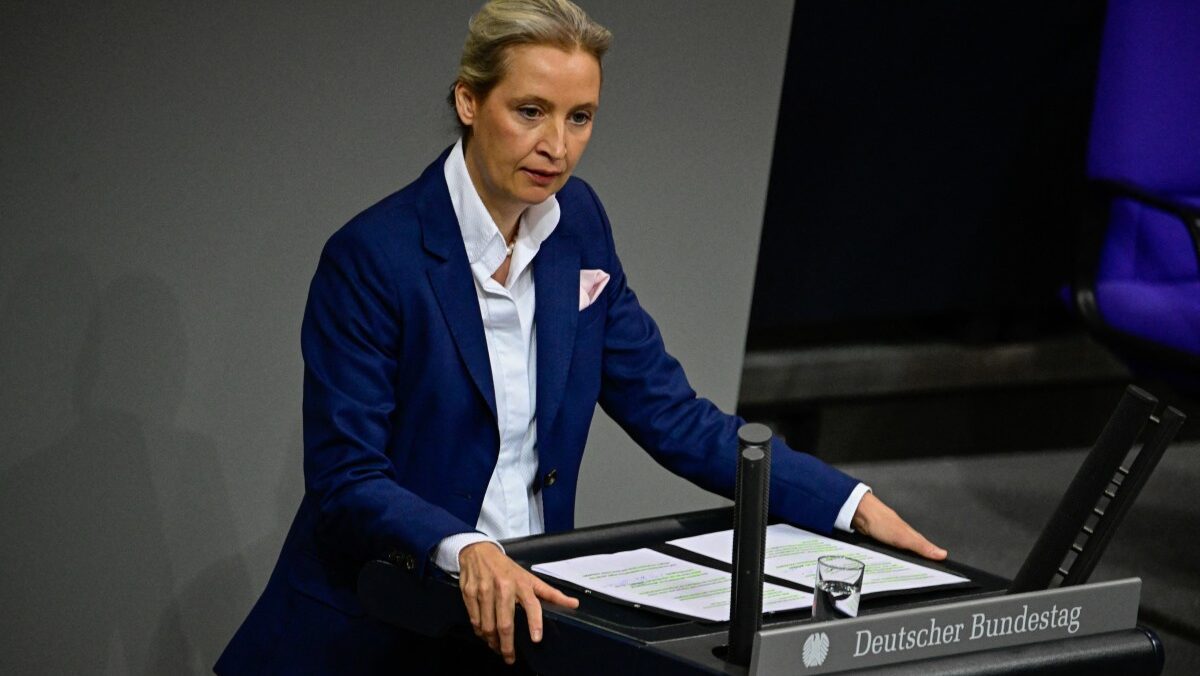
AfD co-leader Alice Weidel speaks at the Bundestag on January 29, 2026 in Berlin.
TOBIAS SCHWARZ / AFP
A court in Cologne has dealt a significant blow to Germany’s domestic intelligence agency, ruling that it may not, for now, classify the opposition Alternative für Deutschland (AfD) as a “confirmed right-wing extremist” organisation.
In a decision published on Thursday, February 26th, the Administrative Court said that the Federal Office for the Protection of the Constitution (BfV) must await the outcome of the main legal proceedings before treating the party as “gesichert rechtsextremistisch”—a designation that would allow expanded surveillance powers and further embolden calls for a party ban.
The court acknowledged that there remains a “strong suspicion” that elements within the AfD pursue anti-constitutional aims. It cited, among other issues, demands to ban Muslim minarets, calls to prayer, and headscarves in public institutions.
However, judges concluded that the party as a whole is not “shaped” by such efforts in a way that would justify characterising it in its entirety as extremist. There was no clear evidence that the AfD’s overall political direction amounted to an “anti-constitutional tendency.”
The dispute dates back to May 2025, when the BfV upgraded the AfD from a “suspected case” to a “confirmed extremist” organisation, alleging that its concept of the German people was rooted in ethnicity and excluded citizens with a migration background, particularly from Muslim-majority countries.
AfD co-leader Alice Weidel welcomed Thursday’s ruling as “a major victory not only for the AfD but also for democracy and the rule of law”. Writing on X, she added that the court had “thrown a spanner in the works” of “ban fanatics” seeking to outlaw the party altogether.
Nicht nur darf der Bundesverfassungsschutz die AfD nicht mehr als "gesichert rechtsextrem" führen, das Verwaltungsgericht Köln schob mit seinem Beschluss auch den Verbotsfanatikern indirekt einen Riegel vor. Ein großer Sieg nicht nur für die AfD, sondern auch für Demokratie und… pic.twitter.com/Ppddsok8go
— Alice Weidel (@Alice_Weidel) February 26, 2026
Critics have long argued that the classification was politically motivated and designed to sideline the government’s most prominent opposition force. The AfD, currently polling as Germany’s most popular party in some surveys, has maintained that its positions on migration, national identity, and Islam fall squarely within protected political speech.
A 17-page excerpt of the BfV’s report, published in May, appeared to reinforce the AfD’s claim that the state’s surveillance apparatus is being used to assemble a political case rather than a legal one.
Among the cited passages were remarks by Alice Weidel on group crime statistics and warnings about “knife migration,” as well as criticism of Germany’s citizenship reforms. Yet none of the quotations amount to a direct assault on the constitutional order; rather, they reflect sharply worded positions within an ongoing political debate on migration, identity, and public safety.