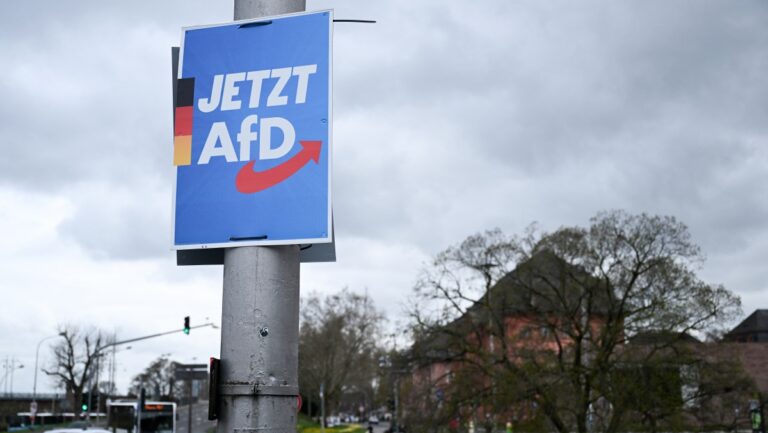
An election poster of the co-leader of Alternative for Germany (AfD) Alice Weidel (R) is seen in front of the headquarters of the Christian Democratic CDU party with a giant picture of Chancellor Friedrich Merz on its facade in Berlin, on February 24, 2025.
Odd ANDERSEN / AFP
Germany is heading into a critical election year in 2026, with five state votes set to challenge Chancellor Friedrich Merz’s centre-right-leftist (CDU-SPD) coalition.
Public dissatisfaction with the government is high, driven by stalled reforms, broken promises, the inability to handle illegal migration, and internal infighting, leaving the right-wing AfD poised to make historic gains.
In the eastern states of Saxony-Anhalt and Mecklenburg-Vorpommern, the party is positioned to dominate local politics unless centrist parties can form broad coalitions. Even in regions where the AfD is not leading, its growth signals a significant shift in voter sentiment, challenging the traditional dominance of the CDU and SPD.
The first vote takes place on March 8 in the western state of Baden-Württemberg, where polls show the AfD could double its share of the votes from 10% to 21%.
Another western state, Rheinland-Pfalz, votes on March 22, where the SPD is lagging behind the CDU and risks losing its prime ministerial post for the first time in decades. Here, the AfD is also set to boost its standing, potentially reaching 23% compared to its 8% in 2021.
The anti-globalist and anti-immigration party is even projected to make gains in the ultra-liberal capital, Berlin—going from 9% to 16%—where elections will be held on September 20.
Though the party is unlikely to challenge power directly in these states, it is more than likely to position itself as the strongest single party in parts of the northeast: citizens in Saxony-Anhalt and Mecklenburg-Vorpommern will vote in September.
The polls put the AfD at roughly 40% in the former and 38% in the latter state—up from 21% and 17%—raising the prospect of the party forming its first-ever government.
With the CDU, SPD, and the liberal FDP losing their majority, only a coalition including the far-left Die Linke could prevent the AfD from assuming power in Saxony-Anhalt. The picture is similar in Mecklenburg-Vorpommern, where the governing SPD and Die Linke would have to band together with the CDU to prevent an AfD-led government from forming.
The prospect of such a scenario has intensified debate over Germany’s political future. Mainstream parties have maintained a cordon sanitaire against the AfD, refusing any coalition talks, while some politicians have suggested banning the party outright—typical of the establishment, which chooses to ignore millions of voters’ preferences.
Instead of allowing democracy to work, CDU politicians are using scaremongering tactics to agitate against the AfD, with CDU’s prime minister in Saxony-Anhalt, Reiner Haseloff, describing the vote as a “system choice” between centrist democratic governance and a radical shift.
However, national opinion surveys suggest a majority of Germans expect the AfD to secure at least one state leadership post by the end of 2026. Confidence in the CDU-SPD coalition is low, with only a third of voters believing it will last until the next federal election in 2029.
Chancellor Friedrich Merz attempted to frame 2026 as a year of opportunity in his New Year’s address, calling for reforms to Germany’s social security systems and measures to boost competitiveness. He insisted that the country’s “hands are not tied” in confronting demographic, economic, and geopolitical pressures.
However, his government has consistently failed to deliver on promises relating to pensions, welfare, and industrial policy. He has failed to push through the promised U-turn on migration, as well as a new energy policy that leaves harmful climate goals behind.
As conservative media outlet Apollo News writes, with “the continuous downward slide of the German economy” and more job cuts expected in 2026, Merz will face a daunting challenge to try and push for far-reaching structural reforms, leaving the CDU vulnerable and contributing to the AfD’s rising support.