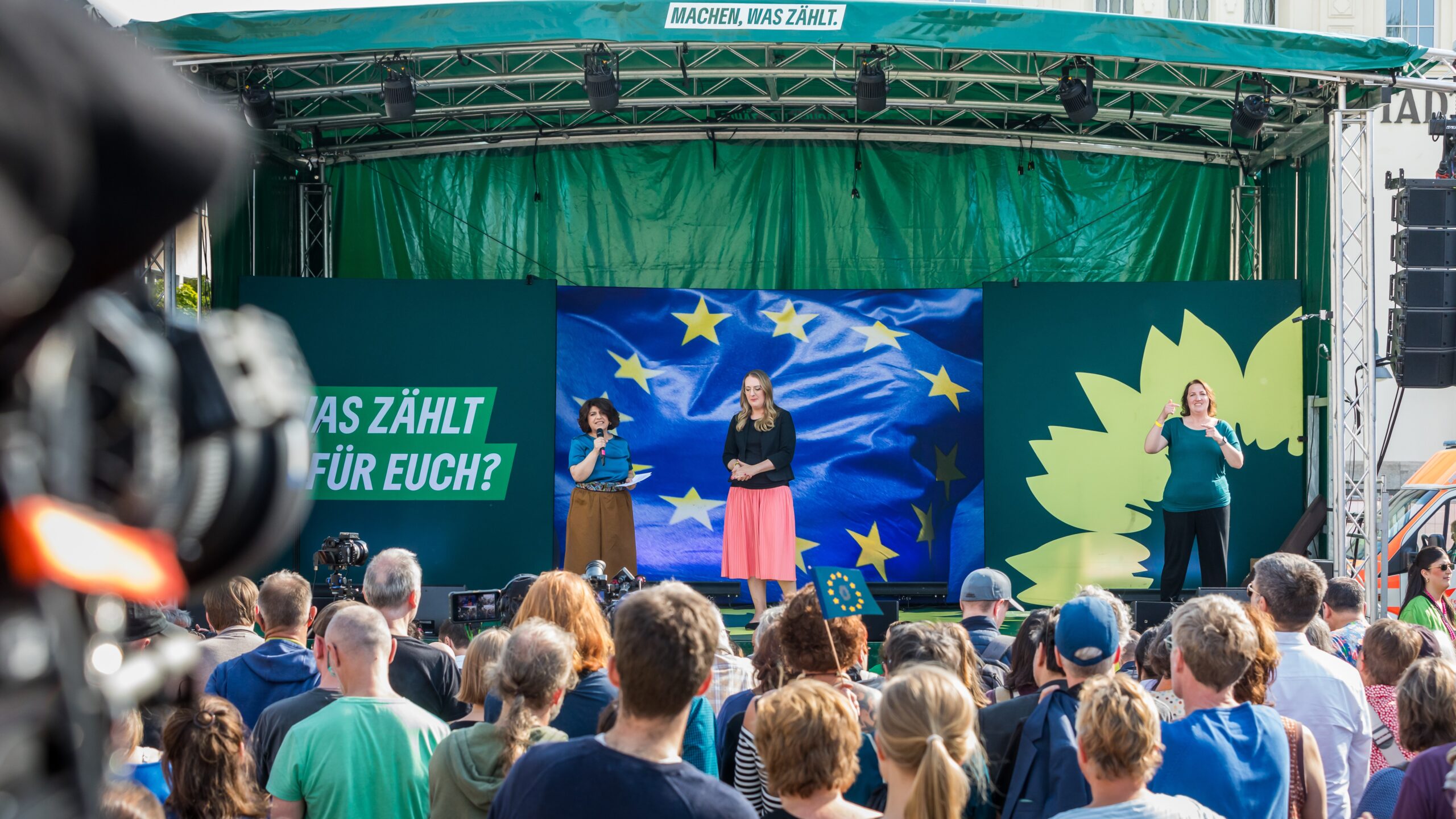
A Green Party rally in Köln-Ehrenfeld during the European parliamentary elections campaign in 2024, with Katharina Dröge standing on the stage (R). The campaign slogan of the party was “Doing what counts.”
By © Raimond Spekking / CC BY-SA 4.0 (via Wikimedia Commons), CC BY-SA 4.0, https://commons.wikimedia.org/w/index.php?curid=149181807
As the Bundestag returns from summer break, establishment MPs aren’t wasting any time before launching the next full-on attack Alternative für Deutschland (AfD), Germany’s largest opposition party. Green Party parliamentary group leaders Britta Haßelmann and Katharina Dröge have invited the leaders of the CDU/CSU, SPD, and Left Party parliamentary groups to a meeting to discuss the possibility of banning the AfD. The Greens argue that such a measure must be examined and potentially implemented “to protect people.”
According to an invitation letter, the meeting should ideally take place in the first week of the parliamentary session following the summer recess, meaning as early as next week. The Greens justified the timing with what they describe as the “growing radicalization” of the AfD. No word on whether the party’s soaring poll numbers have anything to do with the perceived urgency; In Saxony-Anhalt, the party has reached a record high of 39% support in a new poll, up 19 points since February 2022.
“In light of our historical responsibility, the German Bundestag has a legal and political duty to seriously consider initiating party ban proceedings if there is a corresponding reason,” wrote Dröge and Haßelmann. Ban proceedings, they stressed, must be carefully considered and, if necessary, initiated “to protect the people and democracy.”
SPD chairman Lars Klingbeil reiterated his own call for a ban from August 23rd. “The enemies of democracy” must be fought, he said. “We cannot stand by and watch while an obviously right-wing extremist and anti-constitutional party seeks to destroy our democracy and pursues politics with contempt for humanity,” Klingbeil continued.
While Chancellor Merz remarked on May 6th that a decision would only be made after “the most careful examination,” he did not directly rule out a ban. CDU Bundestag member Sascha van Beek went further, openly calling for one.
Meanwhile, the Green Party’s pressure is already having visible effects. Federal Interior Minister Alexander Dobrindt (CSU) has convened federal-state working groups to address how to deal with AfD members this month, even before a court decision on the party’s classification as ‘confirmed right-wing extremist’ has been reached. This marks a reversal of his previous stance in which he insisted discussions would only take place once the classification was legally confirmed.
Green Party parliamentary director Irene Mihalic welcomed the move, saying Dobrindt now recognizes “that we must urgently address the consequences of classifying the AfD as confirmed right-wing extremist.” At the same time, she argued he was “still not up to date” and does not fully acknowledge the “acute danger the AfD poses to our country and the democratic constitutional state.”
Support for Dobrindt’s initiative also came from Saxony, where Interior Minister Armin Schuster (CDU) said he considered nationwide preparations to be sensible. “I welcome the goal, in case the AfD’s classification is confirmed by the courts.” Saxony classified the AfD as “certainly right-wing extremist” already in 2023 and, according to Schuster, has “established legal procedures” that it now intends to bring into the federal-state working group.
The German legal system allows for the banning of parties that are deemed unconstitutional under Article 21 of the Basic Law, which states that parties seeking to undermine or abolish the free democratic order or endanger the existence of the Federal Republic of Germany can be prohibited. Such decisions are made by the Federal Constitutional Court, and the bar for banning a party is high, requiring clear evidence of a threat to the democratic order.
While Germany in the past has banned political parties, multiple attempts to outlaw the NPD—a party with ties to neo-Nazism—have been rejected by the Constitutional Court which ruled that while the party held unconstitutional, extremist views, it lacked sufficient influence to pose a real threat to German democracy.
The AfD has repeatedly declared its full support for the country’s Basic Law, and the report by the Verfassungsschutz (Federal Office for the Protection of the Constitution, BfV) on the party really appeared to be grasping at straws to find anything damning enough to even remotely be used to justify a ban.