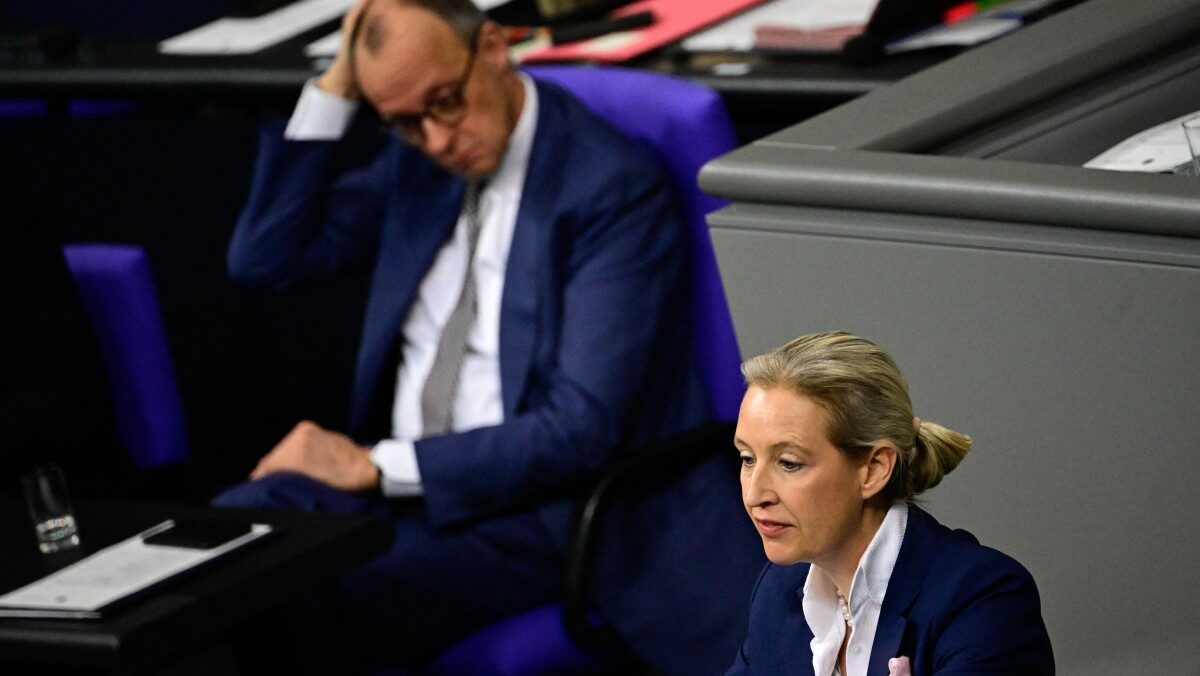
AfD co-leader Alice Weidel speaks as German chancellor Friedrich Merz looks on at the Bundestag
Tobias SCHWARZ / AFP
The German parliament has rejected a proposal by the right-wing AfD to abolish Section 188 of the Criminal Code, a provision that gives public officials special protection from criminal insults, defamation, and slander.
The vote took place on Thursday evening, with all parliamentary groups except the AfD opposing the motion.
The outcome stands in sharp contrast to recent statements by Jens Spahn, a prominent member of the CDU parliamentary group, who said in an interview that the regulation is questionable and that it primarily benefits the “powerful.” Despite those comments, the CDU parliamentary group voted against abolishing the paragraph.
During the parliamentary discussion, CDU/CSU speakers strongly rejected the AfD’s draft law. “Murderous acts followed bloodthirsty words,” Carsten Müller said, linking aggressive rhetoric to acts of political violence. From the SPD benches, Carmen Wegge described the AfD proposal as “an attack on the protection of our democracy.”
While Germany did see an increase in politically motivated violence in 2025, the primary target in reported attacks was the AfD.
The political dispute over Section 188 is not merely theoretical. It is unfolding against the backdrop of a sharp rise in investigations into alleged online insults against politicians. Germany’s Federal Criminal Police Office (BKA) has reported a rapid increase in cases forwarded to prosecutors under this provision.
The figures were released in response to an enquiry from AfD MP Martin Renner and relate to the work of the BKA’s internet reporting office (ZMI), which was set up in February 2022 and tasked with addressing what the government describes as “hate and incitement” online.
According to the data, 468 cases of “politician insults” were forwarded under Section 188 in the first quarter of 2024. By the first quarter of 2025, that number had risen to 1,690 cases, followed by a further 1,528 cases in the second quarter of 2025. In just over a year, quarterly referrals nearly quadrupled. These cases now account for almost half of all reports handled by the system, compared with 16% a year earlier.
Between 2021 and 2025, the vast majority of posts flagged to the ZMI were classified by the system as “right-wing” (22,957 cases), while only 233 were categorized as “left-wing.” Nearly 19,000 cases fell into an “other” category.
Renner said the large disparity between right-wing and left-wing cases does not reflect reality and instead demonstrates deliberate one-sidedness. He also pointed out that two reporting offices dominate the system: HessenGegenHetze, responsible for 45.8% of reports, and REspect!, which accounted for 38.5%.
HessenGegenHetze was also involved in several high-profile cases. It reported a post by pensioner Stefan Niehoff, whose home was searched before he was fined €825 for sharing a meme that labeled then-Economy Minister Robert Habeck a “professional idiot.” The same organization was responsible for reporting right-wing journalist David Bendels, who received a seven-month suspended sentence for mocking former Interior Minister Nancy Faeser. Bendels was later acquitted on appeal, with the judge ruling that the ‘offending’ photomontage was protected by freedom of expression when viewed in context.
In recent years, police crime statistics have also shown a steep overall increase in cases recorded under Section 188: 1,404 cases in 2022, 2,598 in 2023, and 4,439 in 2024, more than tripling within two years.
Against this backdrop, the parliamentary manager of the AfD, Stephan Brandner, sharply criticized the provision during the Bundestag debate, referring to it as a “gag order.” Despite growing controversy and mounting case numbers, the Bundestag majority has made clear that Section 188 will remain part of German criminal law.