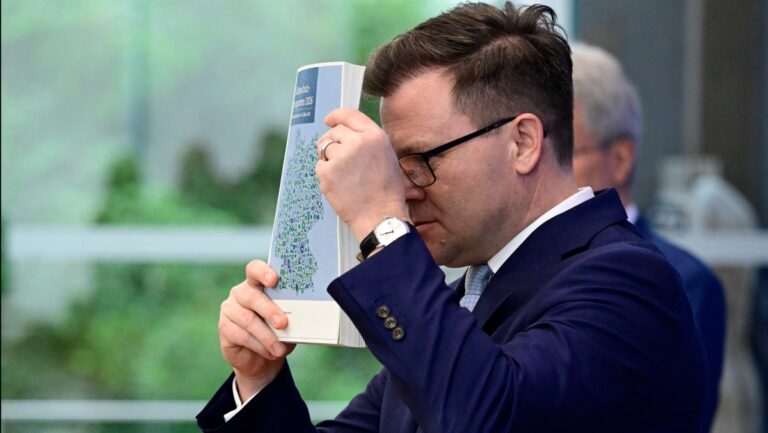
Lars Klingbeil
John MACDOUGALL / AFP
Germany’s ruling Social Democrats (SPD) have caused uproar after posting a bar chart on social justice that showed the right-wing opposition AfD party not by name, but as a pile of faeces.
The image, shared on social media, compared parties on their commitment to “social fairness”—but where other bars were labelled with party names, the AfD bar was replaced by a faeces emoji.
In einer Grafik beschriftet die SPD alle Balken mit den Namen der Parteien – nur bei der AfD ist stattdessen ein Kothaufen zu sehen. Parteichef Klingbeil behauptet, das Diagramm sei gelöscht. Doch das stimmt nicht.https://t.co/ByslGCZNBl
— JUNGE FREIHEIT (@Junge_Freiheit) October 13, 2025
The incident became a talking point on national television when ARD host Caren Miosga confronted SPD leader and Vice-Chancellor Lars Klingbeil. “Is the AfD sh*t—or this marketing idea?” she asked.
Klingbeil replied that he had immediately called his team and said he “did not accept” the post, insisting it had already been removed.
But during the live broadcast, Miosga’s producers checked and found the post was still online on the social media platform Threads. Only after the show ended was it deleted, along with the entire account.
The episode left Klingbeil embarrassed and raised doubts about the SPD’s ability to manage both its message and its response to the growing strength of the AfD. More importantly, it exposed how Germany’s main parties continue to isolate not only the AfD itself but also its millions of voters.
Despite being classified by the domestic intelligence agency as a right-wing extremist party, the AfD has become the most popular force in recent polls. A new INSA survey put the AfD at 26%—ahead of both the centre-right CDU/CSU bloc and its junior coalition partner, the SPD.
Germany, INSA poll:
— Europe Elects (@EuropeElects) October 12, 2025
AfD-ESN: 26%
CDU/CSU-EPP: 24%
SPD-S&D: 14%
GRÜNE-G/EFA: 12% (+1)
LINKE-LEFT: 11%
FDP-RE: 4%
BSW-NI: 4%
+/- vs. 02-06 October 2025
Fieldwork: 06-10 October 2025
Sample size: 1224
➤ https://t.co/obOCVirbpF pic.twitter.com/yH9m1F23R1
Yet instead of trying to understand why so many voters are turning to the AfD—such as the ruling elite’s inability to handle the migration crisis—the major parties have often chosen ridicule or moral condemnation. This approach risks pushing more disillusioned citizens towards the populist camp.Even Klingbeil admitted during the interview that some former SPD voters had switched sides because of poor public services or frustration with government infighting.