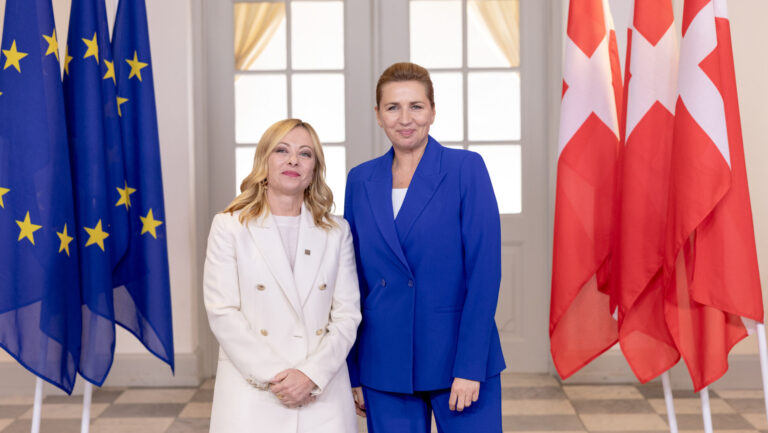
Italy’s conservative prime minister and Denmark’s centre-left leader said tighter returns policies alone are “not enough”, arguing that respect for European laws must go hand in hand with respect for European values.

The Bonn Christmas market in 2021
By Jorge Franganillo – Bonn: Christmas market, CC BY 2.0, https://commons.wikimedia.org/w/index.php?curid=121242561
Several German towns have canceled their traditional Christmas markets this year, pointing to the mounting costs of new security requirements introduced after a series of terror attacks. Local organizers argue that they are unable to comply with the government’s anti-terror measures, such as installing barriers, setting up surveillance systems, and posting additional guards, all of which have become prerequisites for hosting public events.
In Overath, a town of 27,000 in North Rhine-Westphalia, the stalls will remain closed this year. The local festival association says it cannot afford the necessary counter-terrorism measures on its own, yet the local government refuses to contribute financially, according to Rheinische Post. For the past year and a half, the association has been in talks with the town’s administration regarding who will cover the costs of the necessary security measures, the newspaper quotes Andreas Koschmann, chairman of the Overath marketing association.
The situation is very similar in Kerpen—also located in North Rhine-Westphalia—where the traditional Christmas market has also been called off, as reported by the German newspaper Kölner Stadt-Anzeiger.
René Hövel, chairman of the Kolpingstadt Kerpen Action Group (AGK) complained:
We were informed that we would have to cordon off the marketplace from all sides. At the same time, we’re not receiving any financial support from the city and must shoulder all the costs ourselves.
The organizers are now considering turning the Christmas market into a smaller “pleasure market” focused on food and local products, in order to comply with regulations and reduce costs. The move drew sharp criticism from the right-wing Alternative für Deutschland (AfD), saying it represented an unnecessary erosion of Christian traditions.
The debate over security at Christmas markets and other large public events has been simmering for years. Stricter regulations were introduced following the Islamist terrorist attacks on Christmas markets in Berlin in 2016, and in Magdeburg in 2024, which together claimed 19 lives. In addition, during an attack in Solingen during a street festival last year—only about 65 kilometers from Overath and roughly 60 kilometers from Kerpen—a Syrian national killed three people.
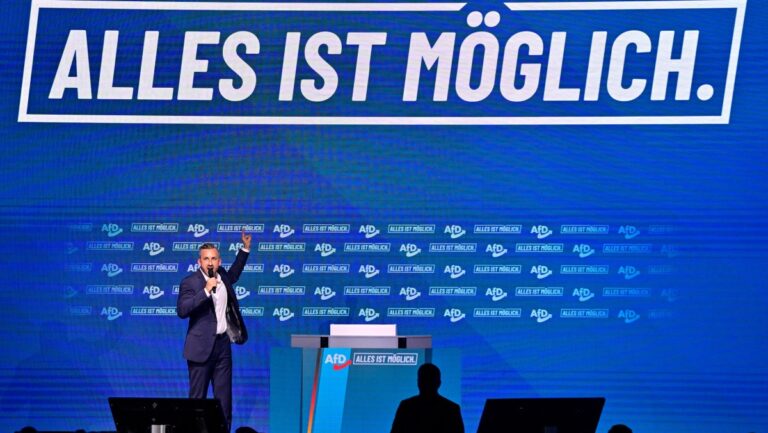
On Tuesday, November 4th, Jörg Urban, AfD parliamentary group leader inSaxony said that the government is standing idly by as Christmas market culture threatens to collapse.
The CDU has long since capitulated to the Islamists.
The politician explained that, in his view, the best solution would be consistent border control and the deportation of all illegal aliens.
In Bonn, the Kessenich Autumn Festival was canceled earlier this year after the city rejected a new security concept intended to protect against vehicle attacks.
The organizers explained the decision on their website:
Despite intensive planning and discussions with the relevant authorities, we were unable to implement a viable security concept that meets current requirements. An autumn market without protective measures against potential dangers, such as uncontrolled vehicles, is not an option for us.
More than 2,000 Christmas markets are held across Germany each year. Some have also been canceled, though for other reasons–for instance, insufficient revenue for stallholders or renovation work at a castle, as in Dortmund.
The cancellations reveal a growing unease in Germany, where mass migration, public safety, and cultural preservation become increasingly incompatible. What used to be cozy symbols of community and tradition are now burdened by fears of violence and by regulations intended to prevent it.
Lukács Fux is currently a law student at Pázmány Péter Catholic University in Budapest. He served as an intern during the Hungarian Council Presidency and completed a separate internship in the European Parliament.