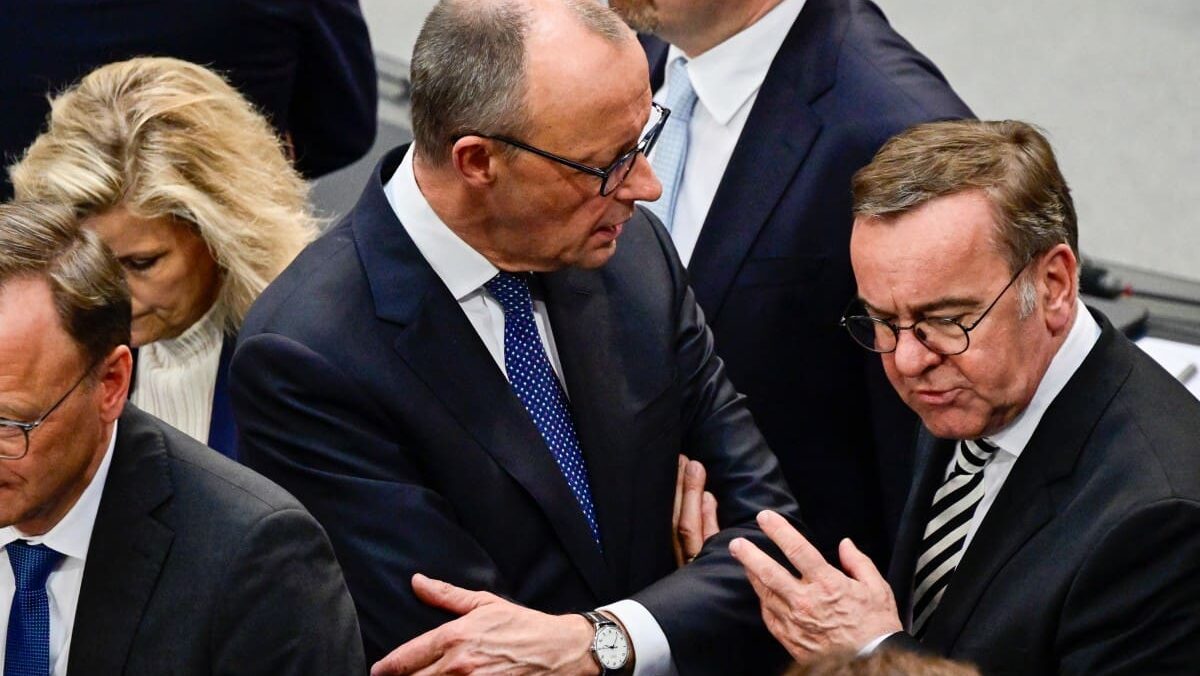
Friedrich Merz, the leader of Germany’s Christian Democratic Union (CDU) speaks with German Defence Minister Boris Pistorius (R) during the constituent session of Germany’s new Bundestag (lower house of parliament) on March 25, 2025 in Berlin.
Photo: John MacDougall / AFP)
Far from leading the way for its European Union neighbours, Germany could well make it more difficult for bloc members to improve their defence capabilities by increasing Eurozone borrowing costs.
Since the Bundesrat last month eased strict borrowing rules to allow for hundreds of billions of euros to be spent on national defence, analysts have pointed to the borrowing costs of other European countries going up as a result.
Indeed, Germany’s position as the EU’s benchmark borrower means that an increase in its own debt is felt elsewhere. This, in turn, could make it harder for some European countries to raise borrowing enough to spend sufficiently on their defence sectors—thus further underlining the improbability of likely incoming chancellor Friedrich Merz’s dream of European “independence” from America.
Welt financial editor Holger Zschäpitz pointed to France, Italy, Greece, Spain, and Portugal as being particularly at risk of becoming more fiscally unstable, because they are already heavily indebted.
#Germany’s new era of big spending is driving up borrowing costs across Europe, sparking fresh concerns about fiscal stability—especially in highly indebted countries like #France, #Italy, #Greece, #Spain, and #Portugal. https://t.co/PXK2yYRtn0 pic.twitter.com/cNvuwMXGzd
— Holger Zschaepitz (@Schuldensuehner) March 21, 2025
Bloomberg also recently noted that these bloc nations are especially vulnerable to higher interest rates. One asset manager told the paper that
Germany stepping on the gas pedal will elevate the entire interest-rate spectrum in Europe.
This sentiment is shared by European hedge fund researcher Sören Radde, who this week told the Financial Times that the Bundesrat’s easing of rules “could eclipse fiscal space for an increase in defence spending outside of Germany.”
At the same time, splits over how to pay for the European Union’s overly ambitious €150 billion rearmament plan are threatening to squash the scheme before it has even got off the ground.