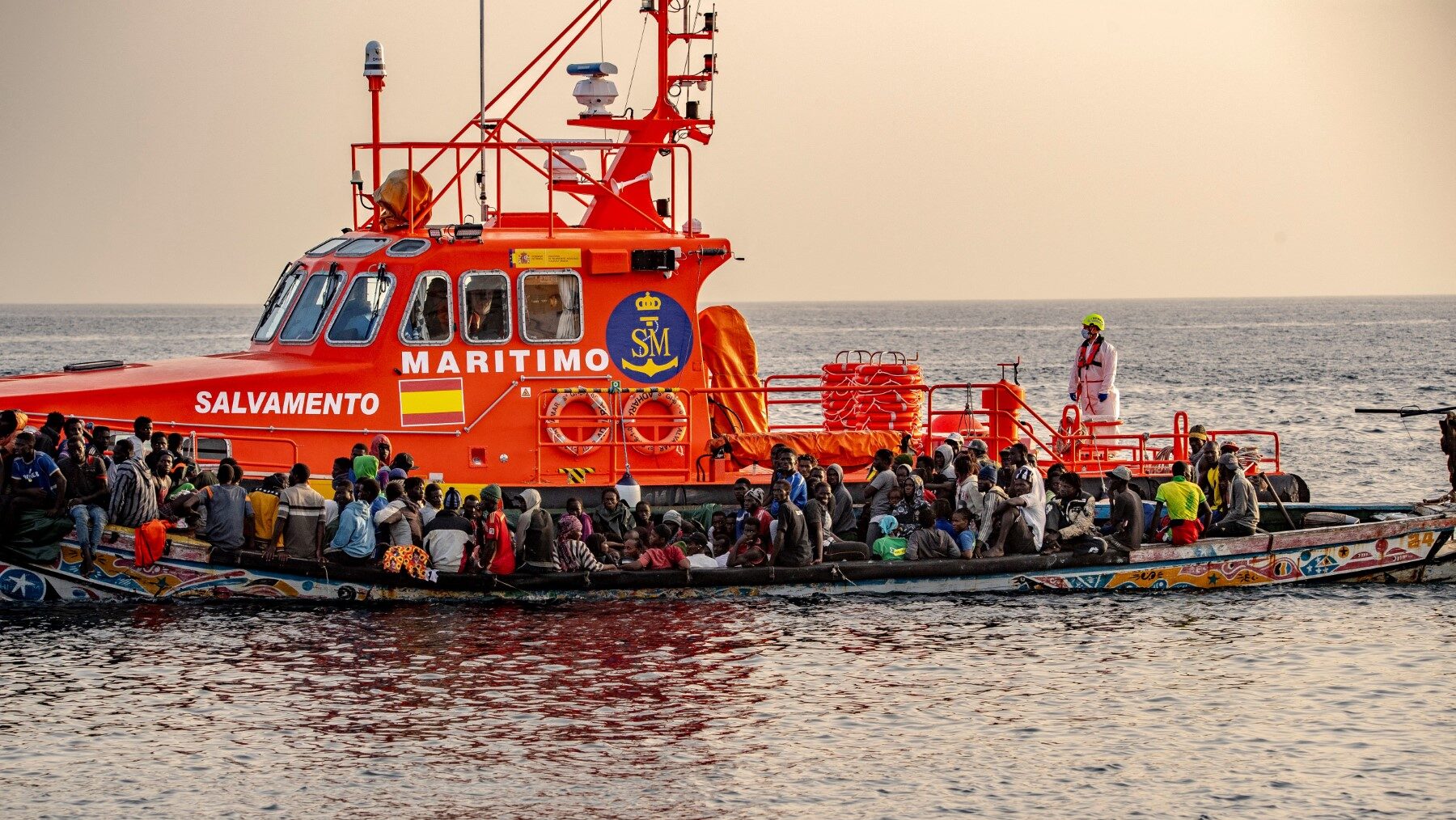
A cayuco carrying 136 migrants arrives in El Hierro, November 28, 2024
Antonio SEMPERE / AFP
Nearly half of the so-called “unaccompanied minors” tested in the Canary Islands were ultimately found to be adults, according to a draft European Parliament report that shows how badly stretched the migration system really is.
The document, prepared after MEPs visited Tenerife and Gran Canaria in September 2025, confirms what local officials have warned for years: child protection centres are overwhelmed, deportations rarely happen, and cases linked to migrant boat arrivals almost never lead to charges.
Although the report is written in careful official language, it makes clear that years of steady migrant arrivals along the Atlantic route have left the islands to deal with the fallout.
One of the most sensitive issues concerns unaccompanied foreign minors.
Prosecutors Teresa Gisbert and María Farnés told the delegation that of roughly 1,500 young people whose age was unclear and who underwent medical testing, around half were ultimately found to be adults. A significant number of those first registered as minors were, after assessment, legally grown men.
The report admits that age checks “are often inaccurate,” meaning adults can temporarily be placed in child protection centres until medical tests confirm their true age. Following the surge in arrivals in 2023 and 2024, those centres were described as “overwhelmed.”
By the end of August 2025, 1,320 unaccompanied minors were registered in the Canary Islands, along with 629 additional cases where age was still in doubt. That makes it harder to plan places in centres, stretches resources, and raises questions about how reliable the checks really are.
The report also highlights the problem of returns.
During meetings with security forces, a representative of Spain’s National Police acknowledged that although returns to Morocco “do take place,” the number of deportations “is very limited.”
In practice, Morocco does not process documents for many of its nationals who arrive without papers and has rejected a formal repatriation agreement with Spain. As a result, only around 8% of Moroccan nationals in Spain illegally are actually sent back. Most deportation cases go nowhere.
Maritime Rescue officials admitted they do not always have the technical capacity to return migrants to the African coast. Even when the departure point is known, those intercepted at sea usually disembark in Spain because of operational limits or because the country of origin refuses to take them back.
EU rules meant to ensure deportations are often not enforced, and removal becomes the exception rather than the rule.
On the judicial side, the President of the High Court of Justice of the Canary Islands provided another striking figure. For each cayuco that arrives, an investigation is opened. But in 97.12% of cases, it is put on hold because no one can be identified. Only 2.88% continue.
Judges cited limited resources and difficulties in identifying boat skippers or members of trafficking networks. The result is that cases linked to the boat arrivals rarely end in charges.
Officials from the Regional Coordination Centre told MEPs that migratory flows cannot be controlled “at the destination” and that real control depends on working with countries of origin and gathering intelligence before boats leave.
The Government of the Canary Islands told the delegation that, despite Spain receiving €560 million in European funds to strengthen its asylum system, the islands themselves had not received any of that money. Meanwhile, the regional government allocated €192 million from its own budget to cover the costs of handling migrant arrivals.
The report describes the islands as carrying an outsized burden, particularly since unaccompanied minors account for 65% of those arriving in Spain via the archipelago.
The delegation also heard concerns from residents in neighbourhoods such as La Isleta, who reported worsening community tensions.
Prosecutors stressed the need to rely on verified facts rather than perceptions. The central government maintained that overall crime rates in the Canary Islands remain below the national average and denied that migration is directly driving crime.
However, the report notes an increase in offences following the arrival of unaccompanied minors, while also clarifying that many of the victims are minors themselves.
In its conclusions, the delegation states that the situation in the Canary Islands reflects wider weaknesses in Europe’s migration framework and that the success of the Migration and Asylum Pact will depend on proper enforcement.
What the parliamentary mission ultimately confirms is that the Atlantic route is no longer a short-term crisis. It has become a permanent pressure point—and a test of whether Europe can enforce its own migration rules.