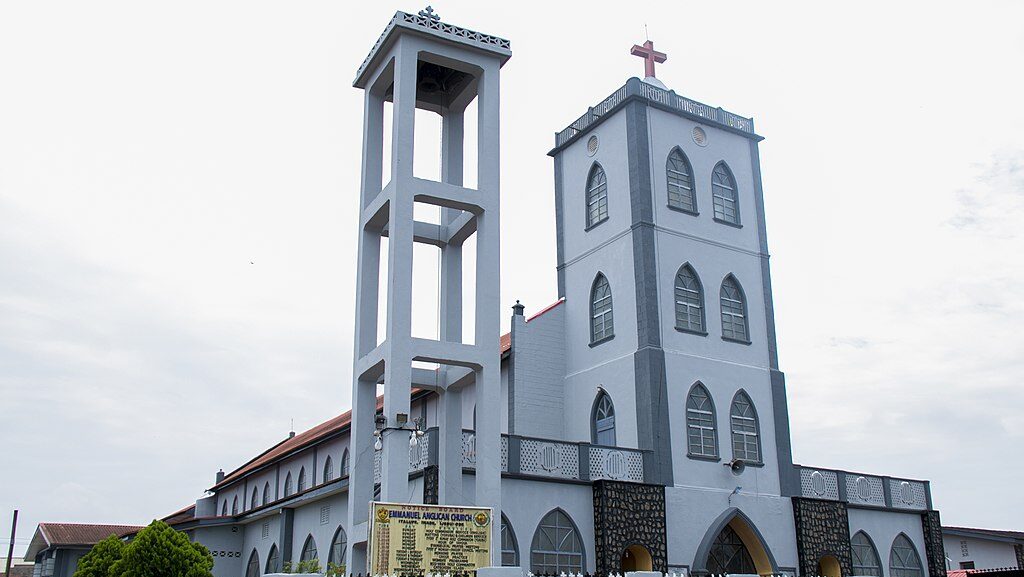
Emmanuel Anglican Church in Ijebu Ode, Ogun State, Nigeria
LensEye Media, CC BY-SA 4.0, via Wikimedia Commons
The Protestant Anglican Communion has witnessed the largest schism in its near five hundred-year history after a body representing between one half and 85% of its total members has broken with the Church of England.
On October 15, the Global Fellowship of Confessing Anglicans (GAFCON) announced that it has severed ties with the Archbishop of Canterbury and formed a new “Global Anglican Communion”. The decision, GAFCON said, was necessary after the Church of England “abandoned the Scriptures” through its endorsement of same-sex blessings and theological revisionism—an accusation marking the most serious rupture in Anglican unity in a century.
The announcement followed days of escalating controversy surrounding the October 3 appointment of Dame Sarah Mullally as Archbishop of Canterbury. Her elevation to the post—the first woman to hold it—antagonised conservative Anglicans who reject the possibility of women’s ordination and episcopal leadership. The move provoked condemnation from clerics such as Archbishop Henry Ndukuba, primate of the (Anglican) Church of Nigeria, which counts some 18 million members.
Ndukuba described the appointment as “devastating,” warning that it ignored the convictions of the majority of Anglicans who reject female episcopal leadership and same-sex marriage. He called Mullally’s selection “a double jeopardy” owing to her promotion of LGBT-friendly initiatives and female leadership as evidence of the Church of England’s “embrace of moral error.” Nigeria’s church is a founding member of GAFCON and one of its most influential voices.
Meeting in Kigali, Rwanda, GAFCON’s primates released a communiqué titled “The Future Has Arrived”, outlining eight resolutions to govern the newly constituted Communion. Signed by Archbishop Laurent Mbanda, primate of the Anglican Church of Rwanda, the statement declared the Bible—“translated, read, preached, taught and obeyed in its plain and canonical sense”—to be the sole authority of the new fellowship.
It rejected the leadership of Canterbury and repudiated four “Instruments of Communion”—the Lambeth Conference, the Anglican Consultative Council (ACC), the Primates’ Meeting, and the Archbishop of Canterbury herself—accusing them of failing to uphold doctrine and discipline.
The new ‘Global Anglican Communion,’ GAFCON stated, will attempt to unite conservative Anglican provinces under a structure modelled on the original 1867 Lambeth framework: autonomous, self-governing churches joined by shared belief rather than hierarchy.
Controversially, member provinces will be instructed to remove references to the See of Canterbury and the Church of England from their constitutions, halt funding to the ACC, and withdraw from meetings convened by Canterbury.
Archbishop Mbanda asserted that GAFCON represents the true continuation of Anglicanism: “We have not left the Anglican Communion; we are the Anglican Communion.”
The fellowship claims to speak for roughly 40 million Anglicans, predominantly in the Global South, including primates from nine recognised provinces—among them Nigeria, Uganda, Kenya, and South Sudan—as well as three non-recognised bodies in North and South America and South Africa.
Tensions have long simmered since the 1994 ordinations of women and recently over the Church of England’s 2023 decision to allow same-sex blessings on a trial basis—a measure that was paused in October amid internal disagreement over how to proceed.
GAFCON condemned the plan as a “revisionist agenda” that violated Scripture and overturned the 1998 Lambeth Conference’s Resolution I.10, defining marriage as between one man and one woman. A prior October 3 GAFCON statement had already argued that the Church of England had “relinquished its authority to lead,” asserting that spiritual oversight now belongs to those who uphold “the truth of the gospel and the authority of Scripture”.
Meanwhile, efforts by English bishops to calm dissent have faltered. On the same day GAFCON issued its declaration, the Church of England’s House of Bishops announced that proposed stand-alone services of blessing for same-sex couples would be delayed until they receive a two-thirds majority from the Church’s synod of bishops, clergy, and laity.
Archbishop Stephen Cottrell, the Church’s second-ranking prelate, said the decision followed “additional legal and theological advice,” conceding it would be “difficult and disappointing” for many. The Church of England Evangelical Council countered that the bishops’ move had “failed to act decisively” and left key questions unresolved.
GAFCON’s roots stretch back to 2003, when the consecration of openly gay Bishop Gene Robinson by the U.S. Episcopal Church ignited deep divisions over biblical authority and sexual ethics.
The Episcopal News Service characterised its latest move as the creation of a “rival network,” while Premier Christian News called it “a major split.” The Religion Media Centre observed that GAFCON’s eleven-member leadership contrasts sharply with the 42 primates of the broader Communion—an imbalance that, given deep financial and institutional ties, may complicate the disentanglement of a now-divided global church.