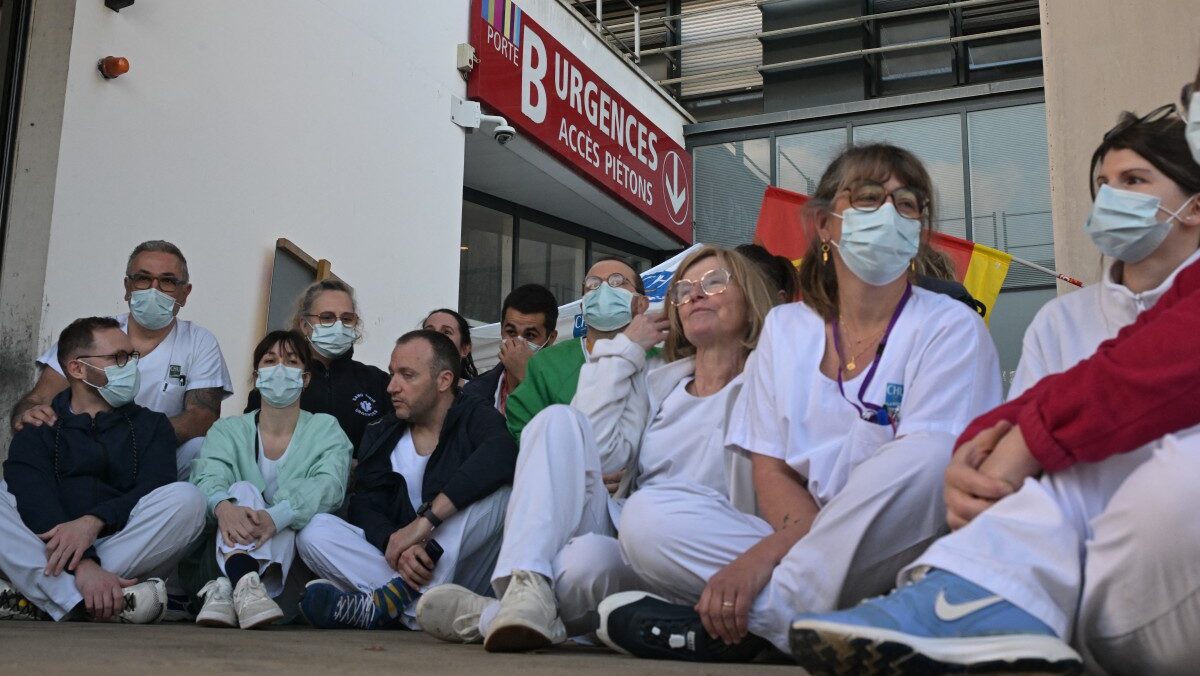
Emergency department medical staff sit at the University hospital in Rennes, western France on January 14, 2026, during a national strike to denounce the nationals politics regarding their sector.
Damien MEYER / AFP
The French Council of State has just handed down a ruling that further strengthens the unreasonable system for receiving foreigners in the country. A migrant who has been granted refugee status in a European Union member state and received medical treatment in that country is now authorised to come to France for medical treatment—all at the expense of the state and therefore the taxpayer. This ill-considered decision can only exacerbate immigration figures, which have been breaking new records since Emmanuel Macron came to power.
The case, revealed by the centre-right magazine Le Point, is set to become a legal precedent: by a decree dated February 2nd, a refugee from the Democratic Republic of Congo, recognised as such by Greece, was able to apply for a residence permit in France on medical grounds and was granted one.
The case is already an old one, dating back to 2023. The man in question was diagnosed with “post-traumatic stress disorder associated with severe depression and suicidal tendencies.” As a refugee in Greece, he should have received medical care in Greece. However, he travelled to France, where he applied for a residence permit in order to obtain medical treatment, which was granted to him, as provided for by French law for illegal migrants suffering from serious illnesses.
In May 2023, the local authorities refused to issue him a visa and imposed an obligation to leave French territory (OQTF) on the pretext that Greece was capable of providing him with the same care as in France. In January 2025, the case was finally referred to the Council of State at the request of Bruno Retailleau, then minister of the interior. A little over a year later, the Council of State ruled that the refugee could legitimately remain in France to receive treatment and that his situation would be reviewed so that he could obtain a valid residence permit. The state was also ordered to reimburse him €3,000 in legal costs.
The announcement of the Council of State’s decision angered many on the Right in France, at a time when the latest official figures show an alarming rise in immigration, with an explosion in applications for asylum on health grounds to the detriment of labour immigration.
Extending access to free healthcare for refugees is a French exception. France is already the only country in Europe—along with Belgium, which has a similar provision—to offer residence permits for healthcare, which allow migrants to be legally admitted when they require medical treatment without which their health would be at critical risk. The term “critical risk” is open to fairly broad interpretation. This system had one limitation: migrants who submitted such a request but were already recognised as refugees in another European Union country were previously rejected on the grounds that the host country could provide them with care, based on the assumption that healthcare systems in Europe are relatively equivalent from one country to another. Following the Council of State’s ruling on February 2nd, this last barrier has now been removed.
This has led to an absurd situation, which is detrimental to European Union citizens themselves and to a form of intra-European solidarity that could be considered legitimate. A refugee who has obtained status in Greece will therefore be able to obtain free healthcare in France, even though a Greek citizen would not be able to do so. Algerians are the leading nationality applying for residence permits for medical treatment, citing mental and behavioural disorders as the reason—with sky-rocketing costs for the health system.
For Nicolas Pouvreau-Monti, director of the Observatory of Immigration and Demography, this is “the endless extension of a principle of free access to healthcare that is already an exception in Europe.” The other incongruity of the decision is that it requires the French administration to be familiar with the specifics of a foreign country’s healthcare system—in this case, Greece—in order to judge whether the care offered is sufficient given the patient’s situation, but the final decision will be made without taking into account the actual state of the French healthcare system and its real capacity to accommodate patients. It is an open secret that French hospitals are currently overwhelmed and that the country lacks doctors due to decades of restrictions on the number of healthcare professionals being trained.
The cost of caring for refugees is currently impossible to assess. At present, the system of residence permits for healthcare is not differentiated in a separate budget line by the social security system—further proof of French mismanagement in terms of social spending.