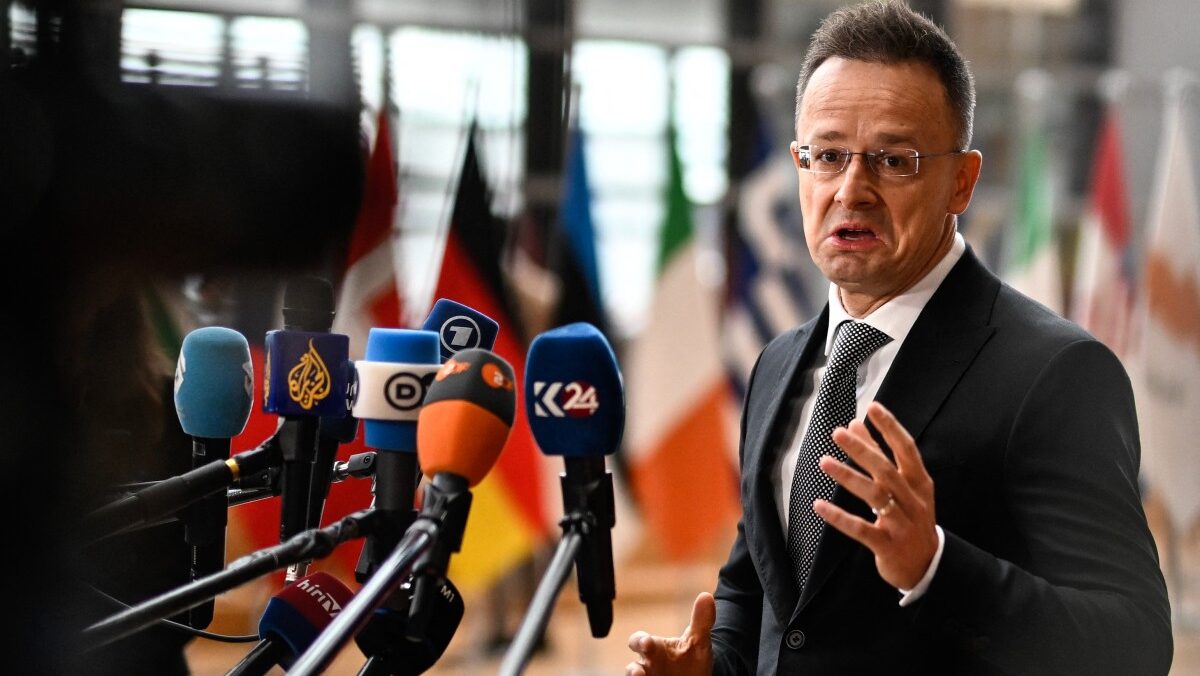
Péter Szijjártó speaks to the press in Brussels, February 23, 2026.
JOHN THYS / AFP
With Hungary’s key national election just two weeks away, attacks on Viktor Orbán’s government are intensifying.
Opponents have latched onto claims that Foreign Minister Péter Szijjártó shared ‘sensitive information’ with his Russian counterpart Sergey Lavrov—allegations previously dismissed as “fake news” and “a desperate reaction to Fidesz gaining momentum in the election campaign.”
Szijjártó rejected the ‘story’ again on Tuesday, saying, “It has long been known that foreign intelligence services … have been intercepting my phone calls. Today they have made a new ‘major discovery’: they proved that I say the same publicly as I do on the phone.”
Balázs Orbán, the prime minister’s political director, added that the media was “sweating again,” and “trying to turn the obvious into an exposé.” He added that it had only ‘revealed’ that Szijjártó “says the same in Brussels, Budapest, and Moscow.”
This is nothing new: for four years, Hungary has been saying that EU sanctions are a failure, causing more harm to the EU than to Russia.
Balázs Orbán noted that the real scandal was that foreign intelligence services wiretapped a foreign minister and turned their findings into a “political operation” just before a major election.
These clarifications have done little to stop fresh attacks on Budapest from Europe’s liberal establishment.
Polish prime minister Donald Tusk said on Tuesday: “Hungary is and will be in the European Union. Viktor Orbán and his foreign minister left Europe long ago.”
Kaja Kallas, Brussels’ top diplomat, added: “European ministers should work for Europe, not Russia.”
Journalist and author Thomas Fazi described the whole saga as “yet another Western intelligence-orchestrated scandal, manufactured to destabilise the Hungarian election.”
Yet another Western intelligence-orchestrated scandal, manufactured to destabilise the Hungarian election. The recordings themselves reveal nothing particularly egregious: routine diplomatic exchanges between representatives of two sovereign states. The real scandal lies… pic.twitter.com/U6EQN5uz4T
— Thomas Fazi (@battleforeurope) March 31, 2026