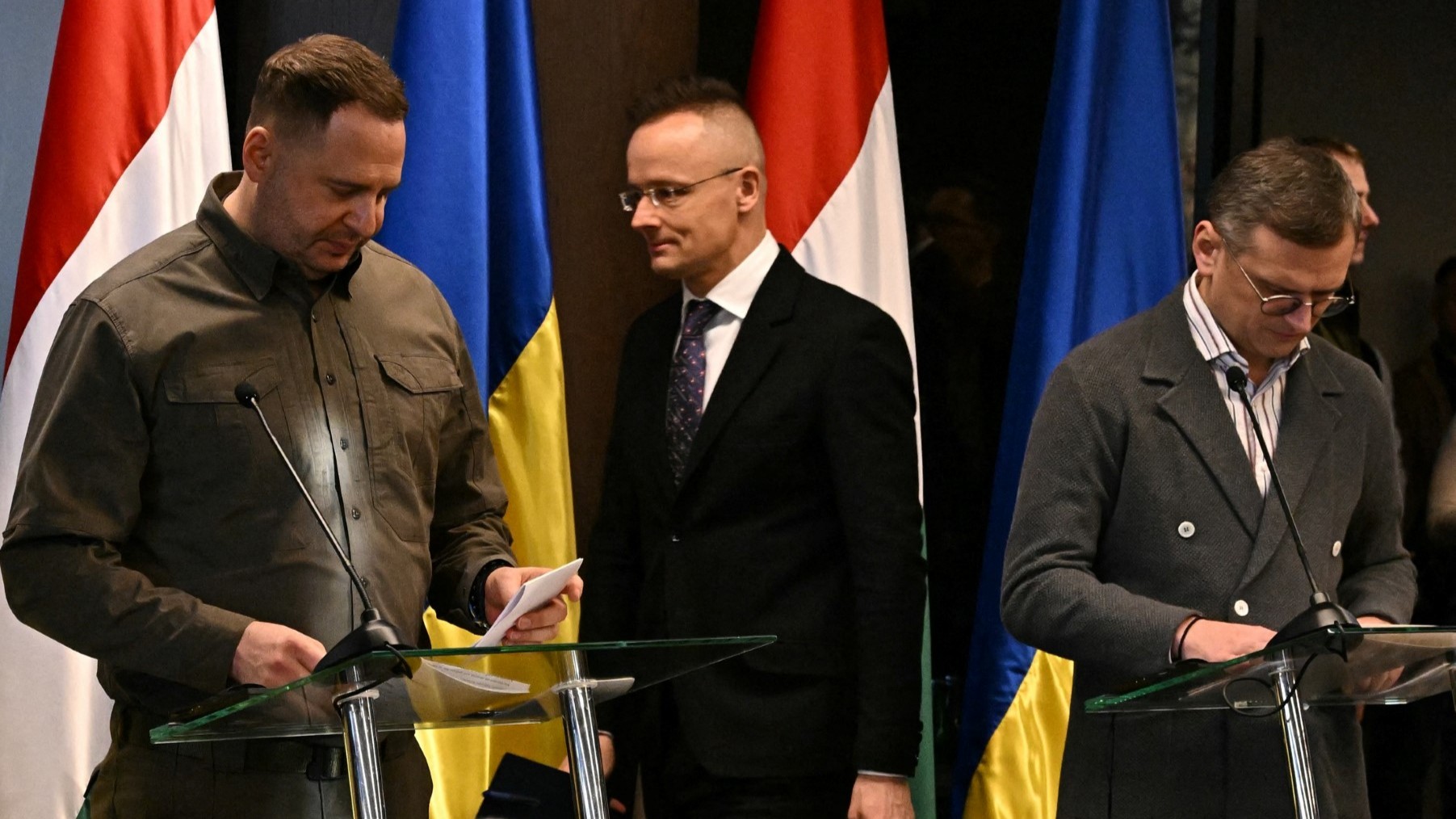
Hungarian Foreign Minister Péter Szijjártó (L) at a press conference with his Ukrainian counterpart Dmytro Kuleba (R) and Ukrainian presidential chief of staff Andriy Jermak (C) in Verkhovyna, on January 29, 2024
ATTILA KISBENEDEK / AFP
Hungary will halt diesel exports to Ukraine until Kyiv restores Russian oil flows through the Druzhba pipeline, Prime Minister Viktor Orbán announced after a cabinet meeting on Wednesday, February 18th. The move, which has sent ripples through Central Europe’s energy sector, comes as Hungary, as a result of the disruption of oil through the pipeline, a critical artery for Hungarian and Slovak energy supplies. Ukraine halted oil deliveries through the Druzhba pipeline (specifically, the southern branch transit carrying Russian crude to Hungary and Slovakia) on January 27, 2026, after claims it had been damaged by a Russian drone attack. Hungarian PM Orbán on Wednesday said the disruption is not due to technical failure, but constitutes a calculated act of coercion by Kyiv.
Secretary of State for International Communication Zoltán Kovács confirmed on X that Hungary’s diesel exports to Ukraine have officially stopped and will not restart until Ukraine restores oil transit.
🚨 BREAKING! Hungary’s diesel exports to Ukraine have stopped – and won’t restart until Ukraine restores oil transit to Hungary.
— Zoltan Kovacs (@zoltanspox) February 18, 2026
🛢️ With a purely political move, Ukraine unilaterally halted shipments on January 27, even though a restart is technically possible.
⚡ Despite the…
The move may represent a major blow for Kyiv, as Hungary plays a vital role in supplying Ukraine with electricity, natural gas, and diesel.
According to Orbán, the shutdown of the Druzhba pipeline is a tool of political leverage aimed at shifting Hungary’s neutral stance regarding the conflict in Ukraine. In a video shared on social media, the prime minister was blunt: “Ukraine is blackmailing Hungary; they stopped the oil on the Druzhba pipeline. We must tap into strategic reserves.”
Orbán further elaborated on the underlying motives, suggesting that Kyiv is attempting to force Hungary into a more aggressive stance. “The goal of Ukrainian blackmail is to force Hungary into the coalition of pro-war European countries,” he stated, adding that “pressure to continue the war in Europe is enormous, and Ukraine specifically wants all of us, every European country and Hungary as well, to enter the war.”
Minister of Foreign Affairs Péter Szijjártó echoed these sentiments, recalling that the transit of Russian oil stopped on January 27th. He dismissed any technical justifications for the outage, labeling it a “purely political decision” made by the Ukrainian leadership.
To mitigate the immediate impact, Hungarian energy giant Mol has already pivoted toward maritime logistics. Szijjártó revealed that 500,000 tons of Russian crude have been ordered for sea transport via Croatia. If European regulations are respected by the Croatian side, these shipments are expected to reach refineries by mid-March, the Hungarian foreign minister said. In a significant diplomatic move, Szijjártó also reported that he, alongside his Slovak counterpart, has demanded EU action regarding Kyiv’s conduct in a formal letter to the European Commission.
Szijjártó emphasized that the planned shift to the Adria pipeline is a matter of legal right rather than a plea for help: “It is not about wanting to restructure the Hungarian energy supply. It is not a favor, not ‛being nice,’ not a humanitarian activity [on the part of Croatia] but the respect of European rules.” Hungary has earlier accused Croatia of refusing to extend the capacity of the Adria pipeline and instead raising transit fees to take advantage of supply difficulties elsewhere.
The crisis has also prompted a coordinated response with Slovakia. Prime Minister Robert Fico announced that the Slovnaft refinery will cease diesel exports to Ukraine, prioritizing domestic needs instead. Slovakia is also releasing 250,000 tons of oil from its state reserves to stabilize the market.
Budapest maintains that, despite the crisis, there is no immediate threat to domestic consumers. “Neither the fuel supply nor the energy supply has been endangered despite the Ukrainian blackmail,” Szijjártó reassured, noting that Hungary possesses over three months’ worth of reserves. He concluded by asserting that “the sovereign decision of the Hungarian people determines Hungary’s future,” rejecting what he described as President Zelensky’s “open intervention” into Hungarian affairs.