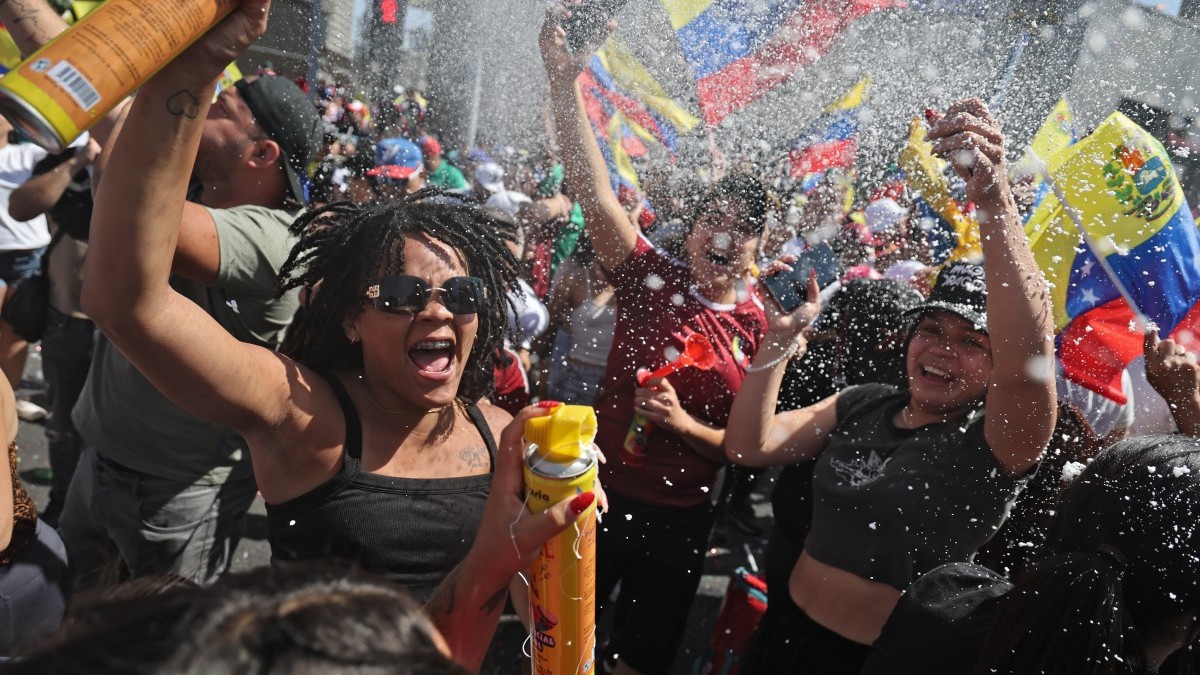
Venezuelans living in Chile celebrate in Santiago on January 3, 2026, after U.S. forces captured Venezuelan leader Nicolás Maduro.
Javier Torres / AFP
Venezuelan President Nicolás Maduro was captured in a U.S. military operation on Saturday, January 3rd, and along with his wife, Cilia Flores, will face charges in a Manhattan federal court, the U.S government said.
U.S. Attorney General Pam Bondi shared on X that Maduro and his wife “have been indicted in the Southern District of New York,” with Maduro having been charged, among other offences, of narco-terrorism conspiracy.
Nicolas Maduro and his wife, Cilia Flores, have been indicted in the Southern District of New York. Nicolas Maduro has been charged with Narco-Terrorism Conspiracy, Cocaine Importation Conspiracy, Possession of Machineguns and Destructive Devices, and Conspiracy to Possess…
— Attorney General Pamela Bondi (@AGPamBondi) January 3, 2026
International reactions vary from forceful condemnations of the U.S. actions and references to international law and national sovereignty to statements that acknowledge the rationale and necessity behind the deposing of Maduro.
Italian Prime Minister Giorgia Meloni essentially endorsed the U.S. action to remove the Venezuelan leader, noting in a statement that her government had never recognised the illegitimate Maduro administration, and has consistently condemned the Venezuelan leader’s repressive regime. She stressed that while Italy holds that “external military action is not the way to end totalitarian regimes,” at the same time Rome “considers defensive intervention legitimate against hybrid attacks on its security, such as in the case of state entities that fuel and facilitate drug trafficking.”
Ho seguito gli sviluppi in Venezuela fin dalle primissime evoluzioni.
— Giorgia Meloni (@GiorgiaMeloni) January 3, 2026
L’Italia, assieme ai principali partner internazionali, non ha mai riconosciuto la auto-proclamata vittoria elettorale di Maduro, condannando gli atti di repressione del regime e ha sempre sostenuto…
France’s President Emmanuel Macron took a similar stance, stressing the importance of the Venezuelan people now being “rid of Nicolás Maduro’s dictatorship.”
The Venezuelan people are today rid of Nicolás Maduro’s dictatorship and can only rejoice.
— Emmanuel Macron (@EmmanuelMacron) January 3, 2026
By seizing power and trampling on fundamental freedoms, Nicolás Maduro gravely undermined the dignity of his own people.
The upcoming transition…
German Chancellor Friedrich Merz reacted in a similar vein, stating that “Nicolás Maduro has led his country into ruin. The most recent election was rigged. Like many other countries, we have therefore not recognized his presidency. Maduro has played a problematic role in the region,” while also stressing that the objective is “an orderly transition to an elected government” in Venezuela.
Also in support of the regime change, Elon Musk announced on his X platform that “Starlink is providing free broadband service to the people of Venezuela through February 3, ensuring continued connectivity.”
British Prime Minister Keir Starmer said on Saturday, January 3rd, that all countries should “uphold international law” following U.S. President Donald Trump’s announcement that American forces had captured Venezuela’s leader, Nicolás Maduro, in a major military operation. Starmer emphasized that the U.K. was not involved and said he wanted to speak to Trump and international allies to clarify the situation.
European leaders have urged de-escalation and stressed the importance of resolving the crisis within international law. European Commission President Ursula von der Leyen said the EU is closely monitoring the situation and ensuring the safety of European citizens in Venezuela.
Marine Le Pen acknowledged that there were many reasons to oppose Nicolás Maduro’s regime but at the same time she denounced the U.S. strike as a violation of Venezuela’s sovereignty. French Rassemblement National president Jordan Bardella, similarly to Le Pen, criticized what he described as interventionism but also condemned Maduro’s regime.
Reform UK leader Nigel Farage acknowledged the operation’s legal ambiguity but suggested it could send a strong message to global powers like China and Russia.
Even Russia’s Ministry of Foreign Affairs, despite being engaged in its own war in Ukraine, condemned the U.S. action. Moscow said the operation constituted “an act of armed aggression against Venezuela” that “gives rise to deep concern and warrants condemnation,” and called the justifications provided by Washington “untenable.” The ministry reaffirmed Russia’s “solidarity with the Venezuelan people.”
The Mexican ministry of foreign affairs reacted in a lengthy statement, saying the U.S. strikes violated Article 2 of the UN charter. The statement calls for the ceasing of “any act of aggression against the Venezuelan government and people,” noting that “any military action seriously jeopardizes regional stability.”