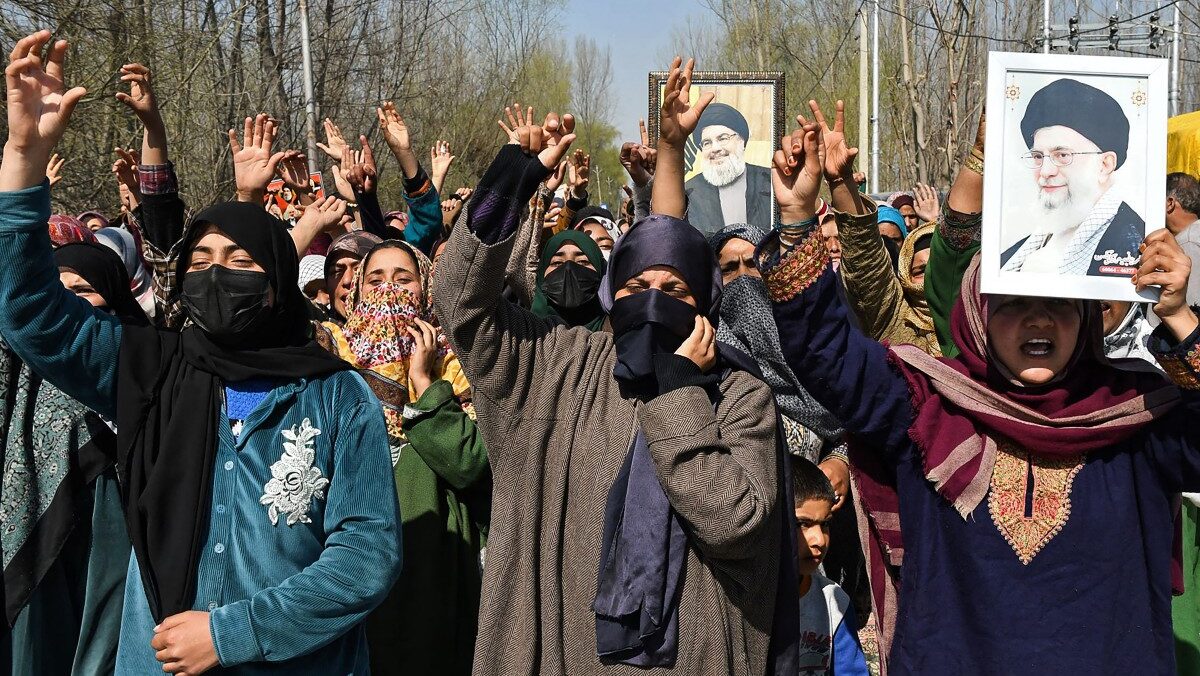
Shia Muslim women hold portraits of Iran’s late supreme leader Ayatollah Ali Khamenei
Habib NAQASH / AFP
Iran has expanded its retaliation across the Middle East, striking embassies, ports, military installations, and threatening global energy routes after the joint U.S.–Israeli operation against Tehran.
A general in Iran’s Revolutionary Guards warned on Monday, March 2, that Iran would “burn any ship” attempting to pass through the Strait of Hormuz, one of the world’s most critical oil and gas chokepoints. He also threatened attacks on oil pipelines and claimed prices could surge to $200 (€170) per barrel in the coming days.
Diplomatic facilities have come under fire. The U.S. embassy in Kuwait was struck by drones, according to diplomatic sources, after smoke was seen rising from the compound. The U.S. embassy in Riyadh also confirmed an attack and announced a temporary closure, urging American citizens to shelter in place. In Australia, Defence Minister Richard Marles confirmed that Al Minhad Air Base in the United Arab Emirates—which hosts Australian personnel—was hit by Iranian drones. All staff were reported safe.
Qatar’s defence ministry said it intercepted and neutralised two ballistic missiles targeting areas within the country. Drone strikes were also reported in Oman, where a fuel tank at a port facility was hit, though authorities said there were no casualties. In northern Iraq, drone strikes blamed on Iran reportedly targeted a camp hosting Iranian Kurdish fighters.
Meanwhile, Lebanon’s government took the unprecedented step of banning Hezbollah’s military and security activities, ordering the Iran-backed group to hand over its weapons. The decision came after Hezbollah launched rockets and drones toward Israel, claiming it was avenging the killing of Iran’s supreme leader. Israel responded with strikes on Hezbollah targets in southern Lebanon, saying dozens of weapons storage facilities and launch sites were hit.
The Israeli military later said it had “completed a broad wave of strikes on Hezbollah terrorist organisation targets in southern Lebanon.”
President Donald Trump warned that the military campaign could extend beyond initial projections. “From the beginning, we projected four to five weeks, but we have capability to go far longer than that,” he said, outlining goals that include destroying Iran’s missile capabilities, dismantling its naval power, preventing it from obtaining a nuclear weapon, and stopping it from arming proxy forces.
Israeli prime minister Benjamin Netanyahu said action was urgent because Iran had been building new underground nuclear and missile sites that would soon be beyond reach. “If no action was taken now, no action could be taken in the future,” he said, adding the conflict would not be “an endless war.”
The escalation follows the joint U.S.–Israeli strikes on Iran and the killing of Supreme Leader Ali Khamenei. In response, Iran launched large-scale missile and drone attacks across the Gulf, targeting military and civilian infrastructure. The International Atomic Energy Agency has convened emergency talks, warning of nuclear safety risks as the confrontation intensifies.