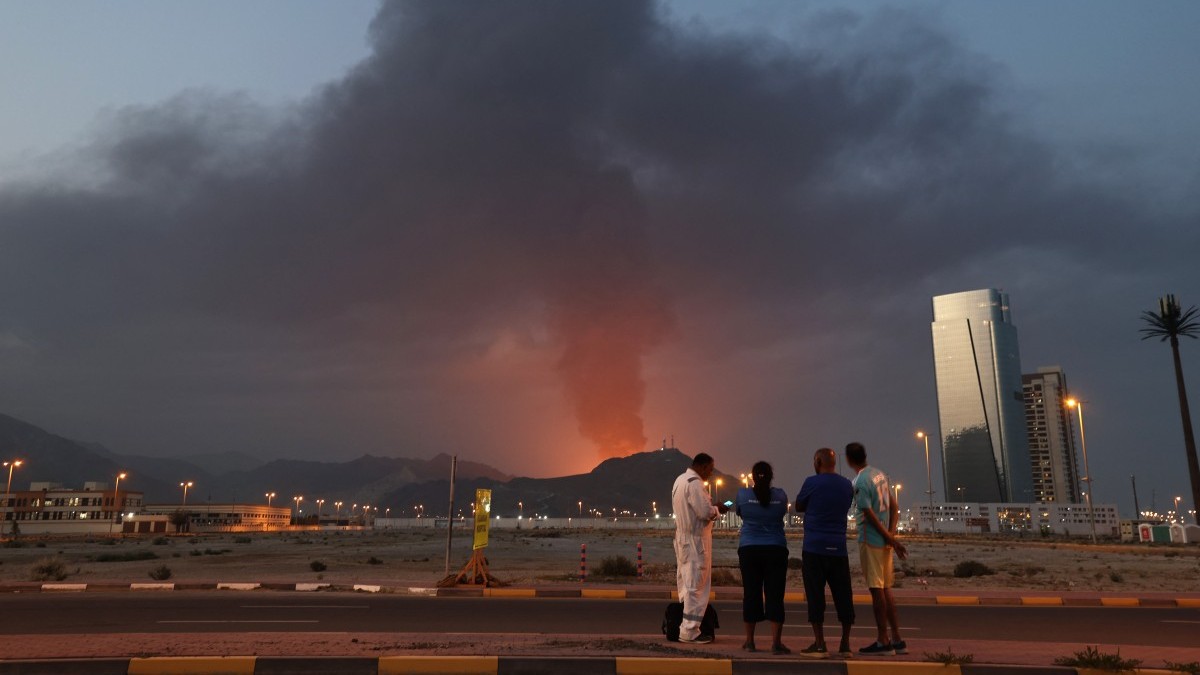
Foreign workers look at a tall plume of black smoke ascend following an explosion in the Fujairah industrial zone in the United Arab Emirates on March 3, 2026.
FADEL SENNA / AFP
Mohammad Mokhber, a senior aide to the late supreme leader, Ayatollah Ali Khamenei stated on state television on Wednesday that Iran has “no trust in the Americans and we have no basis for any negotiations with them,” adding: “We can continue the war as long as we want.”
At the same time, Iran’s defence ministry signaled that the confrontation is far from over. Spokesman Reza Talaei-Nik declared that Iran is prepared for a prolonged conflict and has not yet deployed its most advanced weapons. “We have the capacity to resist and to continue an offensive defence longer than what (the enemy) has planned for this imposed war,” he said, adding: “We do not intend to deploy all our advanced weapons and equipment in the first days.”
The conflict has already spread well beyond Iran’s borders. Loud explosions were reported in Erbil, Iraq near facilities hosting U.S.-led coalition troops. A drone was downed near Baghdad International Airport, which includes a military base hosting a U.S. diplomatic facility. Iraqi authorities have made clear they do not wish to be dragged into a broader war.
Across the Gulf, Iranian missile and drone attacks have triggered air defence interceptions in Doha, Dubai, and Abu Dhabi. Dubai authorities confirmed that explosions heard across the city were caused by “interception operations” by air defence forces.
In Kuwait, falling shrapnel from Iranian strikes killed an 11-year-old girl, according to the health ministry.
Turkey’s top diplomat, Hakan Fidan, criticized Iran’s indiscriminate retaliation across Gulf states. He warned that bombing Arab countries “without making any distinction” significantly increases regional risk and is “an extremely mistaken strategy.”
Meanwhile, Iran’s Revolutionary Guards claim they now have “complete control” of the Strait of Hormuz, a vital artery for global oil and gas supplies. They warned that vessels passing through risk damage from missiles or stray drones.
Inside Iran, succession questions loom. According to reports, Mojtaba Khamenei, the late leader’s son, is considered a frontrunner to replace him. Known for his ties to the brutal Revolutionary Guards, his potential elevation suggests continuity rather than reform.
Farah Pahlavi, widow of the last shah, cautioned that the death of one man does not automatically end a system. “The passing of a man—however central he may be to the architecture of power—does not automatically mean the end of a system,” she said, urging unity around a “peaceful, orderly and sovereign transition.”