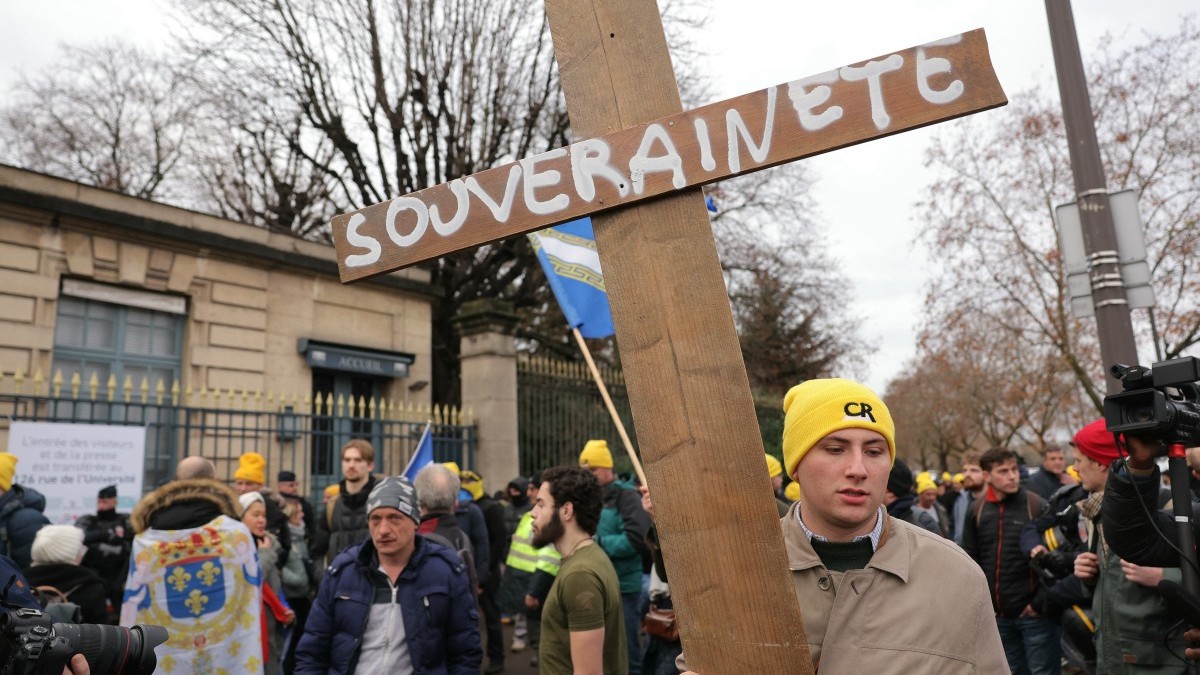
A French farmer holds a mock up cross with a message reading “sovereignty” in front of the National Assembly during a demonstration of Coordination Rurale (CR) as part of a nationwide day of protests to push the French government to block the Mercosur trade deal, on January 8, 2026.
Thomas Samson / AFP
Ireland announced on Thursday, January 8th, that it will vote against the European Union’s trade agreement with the Mercosur bloc, which includes Brazil, Paraguay, Argentina, and Uruguay. The final EU vote on the deal is scheduled for Friday.
Deputy Prime Minister Simon Harris stated, “The government’s position on Mercosur has always been clear: we did not support the deal in the form in which it was presented. We will vote against the agreement.” Harris said that while the European Commission offered concessions to address concerns, they were insufficient to satisfy Irish citizens. Many European farmers fear that cheaper agricultural imports from South America will undercut domestic producers.
Hungary’s foreign minister Péter Szijjártó took to X today to announce Budapest’s veto this morning. He added on Facebook: “Brussels has proved time and again that it is only interested in Ukraine, and it couldn’t care less about the problems of European people.” He described the Mercosur agreement as “another betrayal of farmers… with the agreement allowing South American agricultural products unrestrictedly into the EU, thus endangering the livelihoods of European farmers.”
Hungary will vote against the EU-Mercosur free trade agreement tomorrow.
— Péter Szijjártó (@FM_Szijjarto) January 8, 2026
The @EU_Commission is pushing to adopt and implement a deal that would open Europe to unlimited imports of South American agricultural products at the expense of the livelihoods of Hungarian farmers.
We…
Warsaw confirmed earlier today it remains opposed to the deal. However, Polish agricultural minister Stefan Krajewski said that “given the difficulty in building a blocking minority, we’re working to secure the best possible protections for farmers.”
Farmers across Europe have staged massive protests against the deal, while their governments endorsed it, in what is yet another instance of EU elites snubbing their own citizens’ will.
The EU decision on the deal was delayed in December in the face of opposition from France, Italy, Poland, and Ireland.
Italy, however, appears poised to lift its veto. Prime Minister Giorgia Meloni has reportedly secured additional safeguards and import controls to address domestic concerns. If Italy confirms its support during the ambassadors’ meeting on Friday, Commission President Ursula von der Leyen is expected to travel to Paraguay to sign the agreement on January 12th, as the decision on the matter requires a qualified majority only. As things stand now, a blocking majority, consisting of at least four member states representing 35% of the EU population, cannot be assembled.
France remains firmly opposed, arguing the agreement is “neither fair nor balanced” for European farmers. Paris has even threatened unilateral bans on products treated with pesticides banned in the EU. A massive farmer protest in France today shows that French farmers are ready to resort to all available means to resist the free trade agreement.