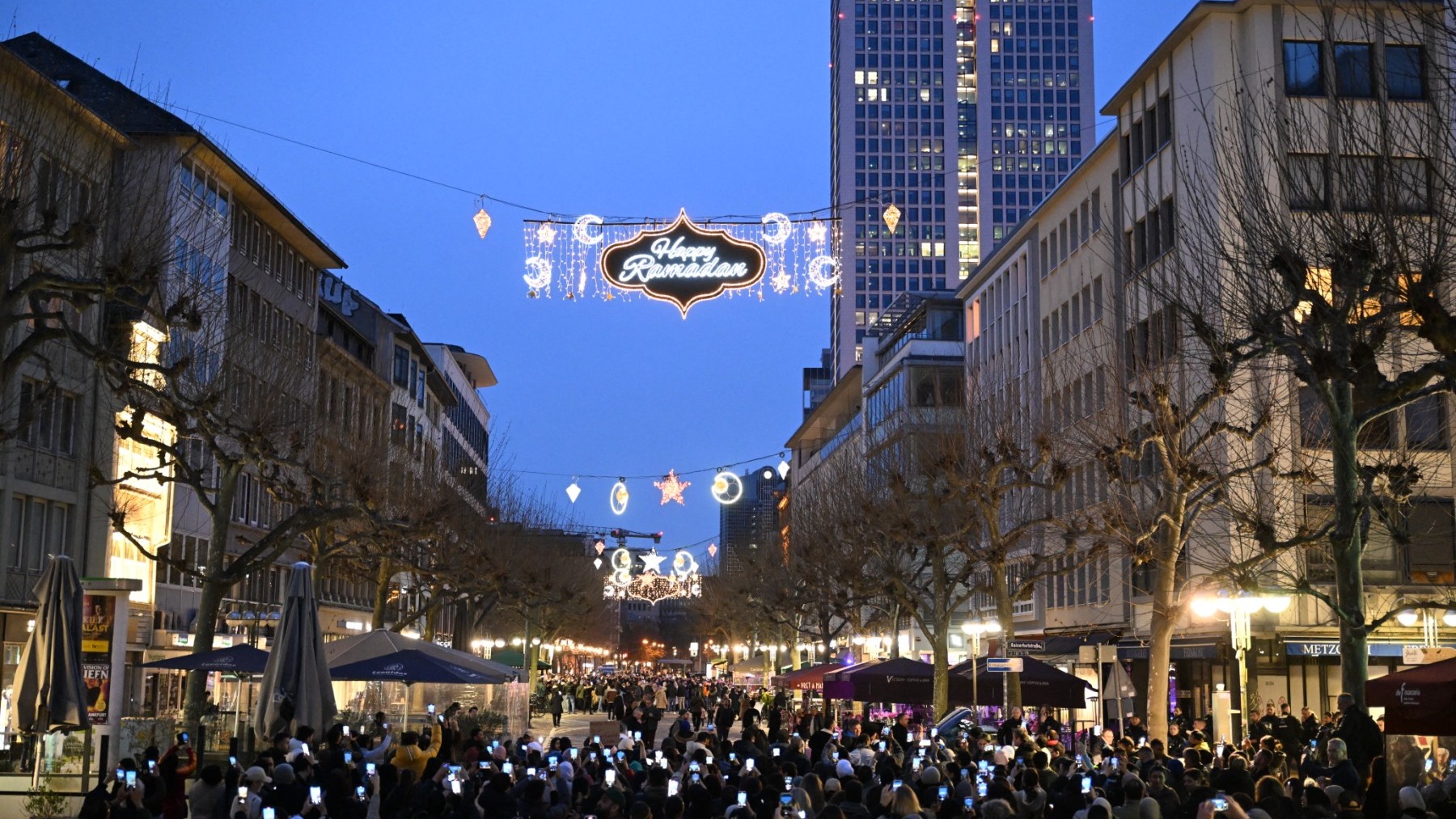
People take pictures with their mobile phones as for the first time in Germany, on March 10, 2024 in Frankfurt, a street is illuminated during the month of Ramadan.
KIRILL KUDRYAVTSEV / AFP
Across Europe, the public celebration of Ramadan has become a focal point for cultural and political tension. From Belgium to Germany, the increasing visibility of Islamic rituals in public spaces, supported by municipal authorities, has led to a series of confrontations.
In Zele, Belgium, the Eyyüp El-Ensari Mosque initiated the hanging of festive Ramadan lights in Zwaanstraat with the approval of the municipality. According to the mosque board, the lighting provides extra connection during Ramadan. The mosque plans to expand the project even further next year.
The move triggered immediate political opposition. The right-wing Vlaams Belang party held an event in Zele, despite a municipal ban on their gathering. The party argued that the “oil slick of Islamization” is spreading, pointing to a perceived double standard where traditional Christmas markets are rebranded as “winter markets”—while Islamic symbols receive official support.
A similar situation has emerged in the Netherlands, where the Utrecht North police faced backlash for soliciting invitations to iftar meals—the evening meals Muslims eat to break their fast during Ramadan—on social media. Journalist Wierd Duk described the police’s attitude as a “mixing of uniform and religion,” stating they are “bending their knees more deeply” every year.
Dutch blogger and columnist Bart Nijman also questioned the institutional focus on Ramadan, comparing it to the little attention paid to Christian festivals. Geert Wilders, leader of the right-wing Party for Freedom (PVV), responded to these developments by stating, “We choose freedom. No Islam.”
In Germany, the debate has extended into the education system. Mouhanad Khorchide, head of the Center for Islamic Theology at the University of Münster, has identified the rise of “religion policemen” in schools. He reports that some male youths use the month of fasting to stage masculinity as a demonstration of physical hardness, endurance, and supposed “religious superiority.” According to Khorchide, classmates who do not fast are put under pressure or confronted with derogatory remarks.
In Frankfurt, the city spent €75,000 on bulbs for Ramadan lights, with the total budget reaching €100,000. Green Mayor Nargess Eskandari-Grünberg defended the move, stating the lighting makes Muslim life a “self-evident part” of Frankfurt.
German Chancellor Friedrich Merz issued a public “Ramadan Mubarak” message on Instagram while failing to issue a similar statement to the country’s 43 million Christians for the beginning of Lent.
The expansion of the religious markers into the streets and classrooms suggests that the “oil slick” of Islamization is no longer a political warning but an accelerating reality across the continent.