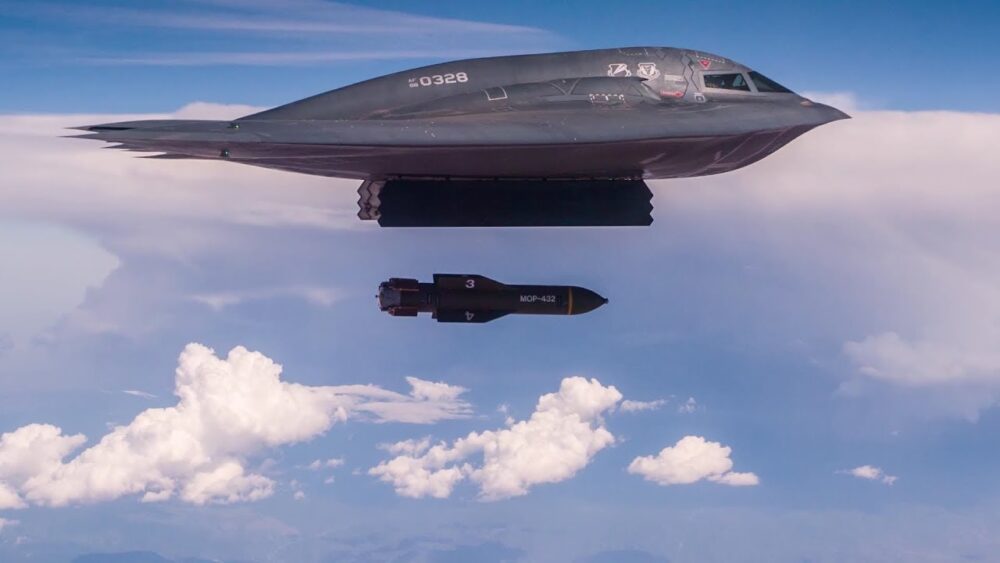
Photo: @diaz_writer on X, 22 June 2025
Mainstream media and doomsday pundits claim that Israel’s military offensive against Iran, and the subsequent U.S. strikes on three nuclear sites over the weekend, failed to achieve anything lasting—barely delaying Tehran’s weapons program and doing little to dent its regional influence. But the truth is completely different, according to two experts from the Israel Defense and Security Forum (ISDF).
Amid a climate of extreme tension in the Middle East, the recent military escalation between Israel and Iran—alongside the unexpected direct intervention of the United States—has changed the rules of the game in the region and beyond. A full week before the world became aware of what was unfolding, on June 13th, Israel had already launched an intensive military campaign targeting key Iranian infrastructure. This meticulously planned preemptive strike triggered a blitz war that culminated in a decisive U.S. bombing of Iranian nuclear sites.
Brigadier General (Res.) Amir Avivi and Elie Pieprz provided exclusive insight into this operation, its geopolitical implications, and Europe’s role in this new landscape. According to IDSF CEO and Chairman Avivi, Israel and the United States successfully destroyed Iran’s nuclear program and severely damaged its ballistic capabilities. This coordinated action is not only a military victory—it could also pave the way for a potential regime change in Tehran.
Pieprz, IDSF Director of International Relations, compared the operation to the Normandy landings in 1944, citing the scale of coordination and risk involved: “Nothing of this magnitude has been seen since. This kind of preparation takes months, even years.” He emphasized that America’s intervention wasn’t an act of solidarity but a strategic move in defense of its own national interest, recognizing that a nuclear Iran would pose a direct threat to global security.
Since June 13th, Israel has carried out sustained, targeted attacks, weakening key nodes in Iran’s military apparatus. Avivi confirmed the total destruction of nuclear sites in Fordow, Natanz, and Isfahan. But beyond the technical achievement, this offensive exposed an uncomfortable truth: the West’s security depends, in no small part, on Israel doing the “dirty work.”

Both experts stressed that Europe should now see things more clearly. “Israel saved the world from a nuclear catastrophe,” Avivi said. “Had Iran succeeded in fitting nuclear warheads onto ballistic missiles, it would not have hesitated to strike Israel—or even European countries.”
The lesson, they argue, is clear: only nations willing to defend themselves can hope to receive American backing. “If Israel hadn’t acted first and proved its effectiveness, the U.S. would never have intervened,” Pieprz added. For Europe, the message is unmistakable: the era of strategic pacifism is over. A new realism must prevail—one based on strength, self-reliance, and cooperation with resilient powers like Israel.
According to both analysts, the European Union has adopted an ambiguous stance, caught between multiculturalist rhetoric and its commercial and energy dependencies on external actors. But this war has forced a recalibration of priorities. “The EU needs Israel more than Israel needs the EU,” Avivi stated. Israeli military and technological know-how is increasingly sought after by EU member states that see it as a shield against radical Islamism and regional instability.
Avivi went further, urging Europe to abandon its ‘end of history’ delusion and acknowledge that we live in a “clash of civilizations,” referencing Samuel Huntington’s thesis that cultural and religious identities would be the main drivers of conflict in the post–Cold War world. He delivered a provocative yet realistic message: “Israel has developed capabilities during this war that defy the laws of physics and chemistry. Anyone who wants to remain relevant must ally with us.”
Though a ceasefire has been reached, both Avivi and Pieprz agree that much work remains. The threat from Iranian proxies such as Hezbollah and the Houthis persists. But Israel has imposed a new set of rules: it will strike when necessary, without the need for formal declarations. According to Avivi, Iran surrendered because it realized the next targets would be the very pillars upholding the regime.
The message from the experts is clear: if Tehran attempts to rebuild its military or fund its proxies, Israel—likely with U.S. support—will not hesitate to act again. Still, both stress that regime change is not an external imposition, but a choice the Iranian people must make themselves.
Out of this war emerges a new geostrategic architecture. Israel not only consolidates its alliance with Washington but also positions itself as a bridge between the West and the moderate Sunni world. “We are building a major alliance that will stretch from Morocco to Indonesia,” Avivi announced. And that’s not all: with ports operated by China, India, and Europe, Israel aims to become a “global Singapore,” a commercial crossroads linking Asia, Africa, and Europe.
This military, political, and diplomatic victory comes as Europe remains bogged down in ideological debates and continues—directly or indirectly—to subsidize movements like the Muslim Brotherhood, whose growth on the continent has been fueled by a naïve Left and EU institutions that are playing with fire.
The full interview will soon be available on our YouTube channel and social media platforms.