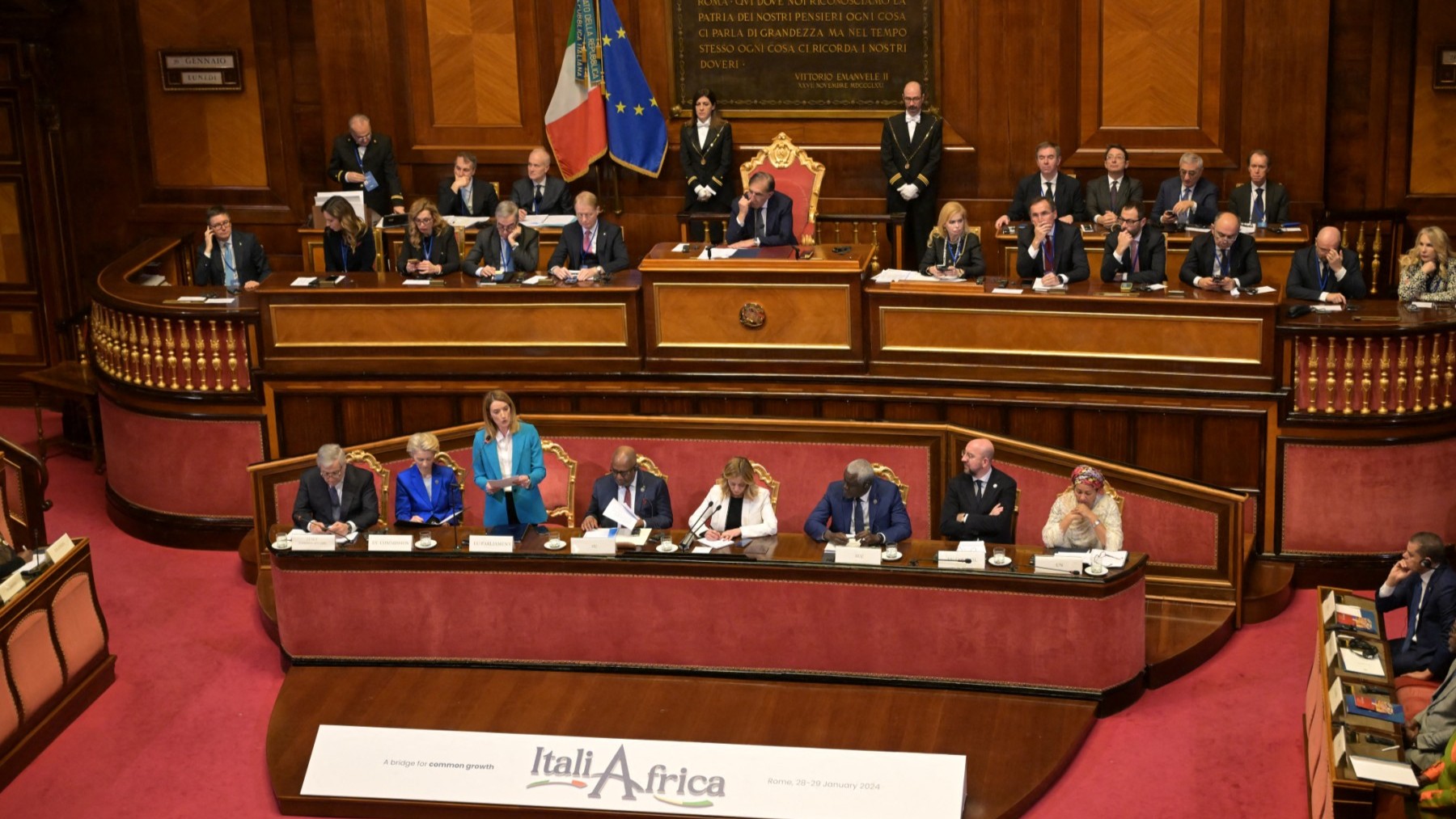
President of the European Parliament Roberta Metsola delivers a speech during the Italy-Africa international conference ‘A bridge for common growth’ at the Italian Senate in Rome on January 29, 2024.
Andreas Solaro / AFP
Italy is threatening to block a key EU plan to speed up migrant deportations, warning it hands too much power to Brussels and risks backfiring on national governments.
The Commission’s new proposal, unveiled in March this year, introduces, among other things, measures to streamline the repatriation of illegal migrants, making procedures more uniform between the various member states, and allowing countries to immediately carry out an expulsion order against a person even when the order was issued by another EU country. Furthermore, the regulation provides for the possibility of transferring migrants awaiting expulsion outside EU territory, having in fact incorporated many of the requests of right-wing governments and parties.
While initially, PM Meloni strongly backed the EU’s proposed return rules, she is now raising objections.
The upheaval started on Tuesday, when the Italian Senate’s European Union Policies Parliamentary Committee discussed the Commission’s new proposal. Marco Scurria of the FdI, acting as rapporteur, criticised the regulation in his speech, making points that essentially echoes those of a 50-page report drawn up by the Italian Ministry of the Interior.
According to the Italian Senate committee, parts of the Commission’s new proposal could create a “procedural burden” heavy enough to undermine the regulation itself, especially regarding the harmonisation of the procedures at the EU level. The Senate is pushing back particularly against the introduction of a European return order, one of the pillars of the newly proposed rules, which would mandate mutual recognition of return decisions among member states.
As Euractiv pointed out, the Italian Senate is now warning that such a move could “obstruct enforcement” and limit national discretion over such key elements as the duration of re-entry bans.
The Senate’s objections have delayed the final vote until June 25.
As is the norm in these cases, the Commission’s proposal for a regulation is sent to the European Parliament and Council after a preliminary assessment by the various national parliaments, which have until June 27th to express any objections. Parliaments must assess whether the regulation respects subsidiarity and proportionality. As none of the parliaments of the member states that have looked at the proposal so far have expressed opposing opinions, if next week the Senate votes to endorse the interior ministry’s reservations, the Italian parliament will be the first to do so. The Commission can reject Italy’s objections or—rarely—revise the regulation.
Italy seems to have become the new enfant terrible of the European Union. Not shying away from raising objections to seemingly incontestable positions, Meloni’s ruling Fratelli d’Italia and their coalition partners often lead the way in resisting the ‘official line’ of the European Commission, most often in matters that concern migration.