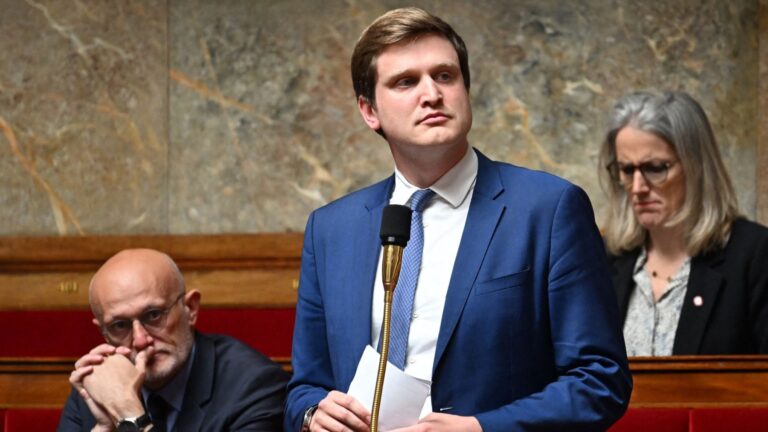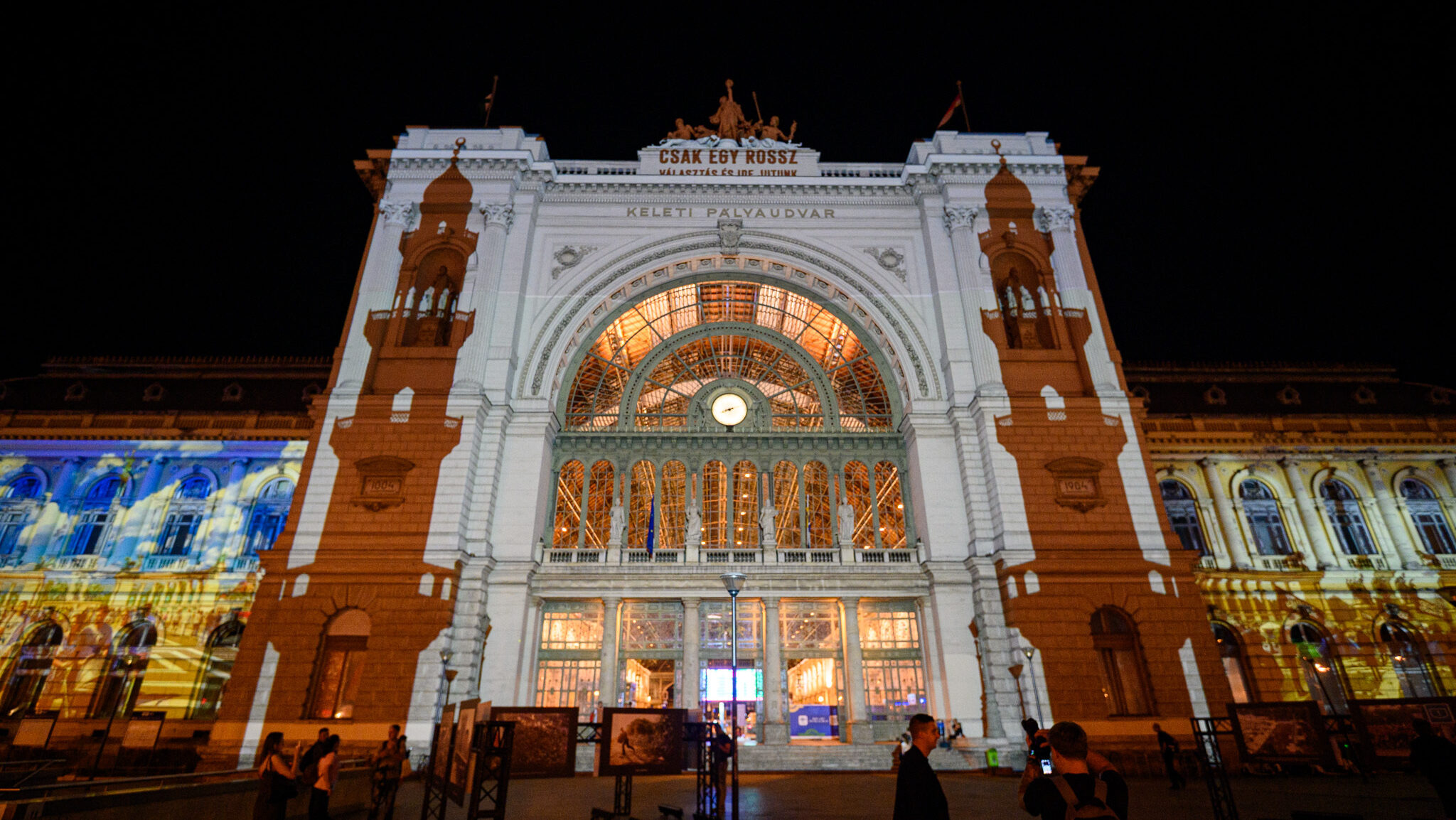
The light display at Budapest’s Keleti station
Attila Gunduz / Center for Fundamental Rights
Budapest’s iconic Keleti railway station was illuminated with a light projection on Monday evening, September 22, warning Hungarians that “just one wrong choice” could turn the country into a “land of migrants.”
A warning ⚠️ in lights at the amous Keleti terminal in Budapest.
— Miklós Szánthó (@MiklosSzantho) September 22, 2025
A single bad choice can lead to mass migration.
We must not allow the muezzin's call to prayer to drown out the Christian church bells. pic.twitter.com/50RHGNm0cR
The display, organised by the conservative think tank Alapjogokért Központ (Center for Fundamental Rights), marked the tenth anniversary of the 2015 migration crisis, when thousands of mainly Middle Eastern and African asylum seekers camped at Keleti as they sought to travel further into Western Europe.
Monday’s event depicted Hungary’s streets and institutions under imagined mass migration, showing what Hungary would look like today if the patriotic government had not made the firm decision to close the country’s borders ten years ago and erect a fence on its southern border.
“Brussels fines us 400 million forints [1 million euros] every day because we refuse to let strangers in,” declared one of the slogans—referring to the fine imposed by the EU—while another accused opposition leader Péter Magyar and his Tisza Party of being ready to bow to Brussels’ will.
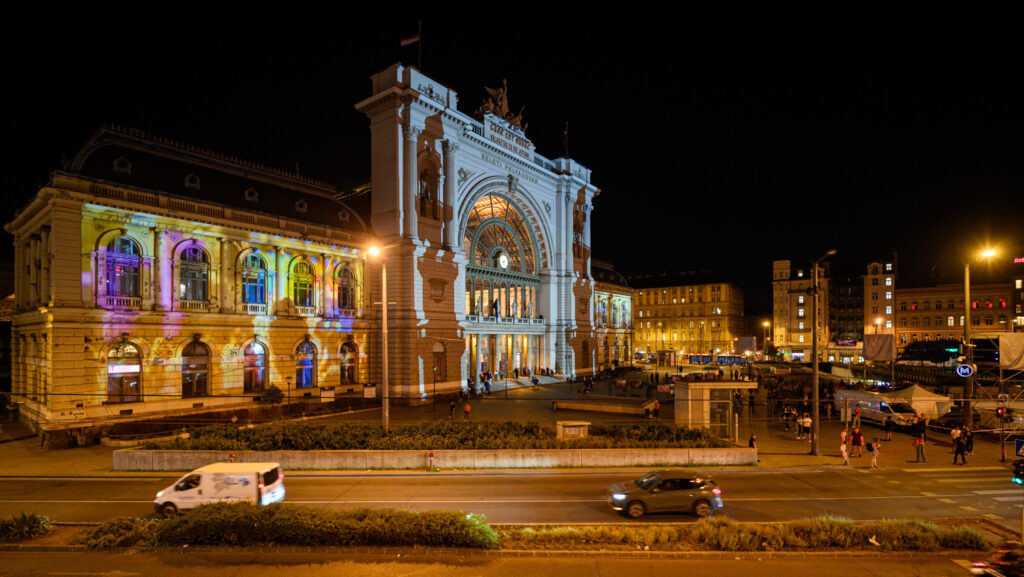
Miklós Szánthó, director general of the Alapjogokért Központ, shared a video of the light show on X, warning “we must not allow the muezzin’s call to prayer to drown out the Christian church bells.”
The campaign coincided with conservative Prime Minister Viktor Orbán’s speech opening the autumn session of parliament. Orbán hailed Hungary as “an island of peace and security,” insisting that the country has zero illegal migration and no migration-related crime. He reiterated his rejection of the EU’s migration pact, due to be implemented in 2027, saying: “Because we refuse, Hungary is fined €1 million each day. Shame on Brussels.”
As long as Hungary has a national, not a Brussels-led government, the southern fence will stand, there will be no migration pact, and thus no migrant ghettos and no migrant crime either.
Orbán later reinforced his message on social media, accusing Brussels of blackmail and contrasting Hungary’s safety record with what he called “crime, chaos, and bombings” in Western cities.
💶 Brussels fines Hungary €1M every day for defending our borders.
— Orbán Viktor (@PM_ViktorOrban) September 23, 2025
0️⃣ For 10 years we’ve kept illegal migration at zero.
🌍 While Western cities face crime, chaos, and bombings, Hungary remains an island of peace & security.
🇭🇺 Brussels can blackmail us all it wants, we will not… pic.twitter.com/4nsApVYC84
The government’s claims are backed by crime statistics showing Budapest to be among Europe’s safest capitals, with no fatalities linked to gang-related shootings this year. By contrast, cities such as Brussels, Stockholm, and Marseille continue to grapple with gun violence tied to organised crime.
Migration is the greatest challenge of the 21st century—yet the mainstream media calls it “propaganda” when someone dares to say it out loud.
In just ten years, 10 million migrants have arrived in Europe. According to leading experts and newspapers, Germany may become Muslim-majority by 2050; in London, 40% of the population already has a migrant background, and in several major European cities, Mohammed is the most common name for newborn boys.
This shows that a single wrong political decision can fundamentally change the fate of a country.
The lesson is clear: Europe made the wrong decision on migration—Hungary cannot afford to make the same mistake.