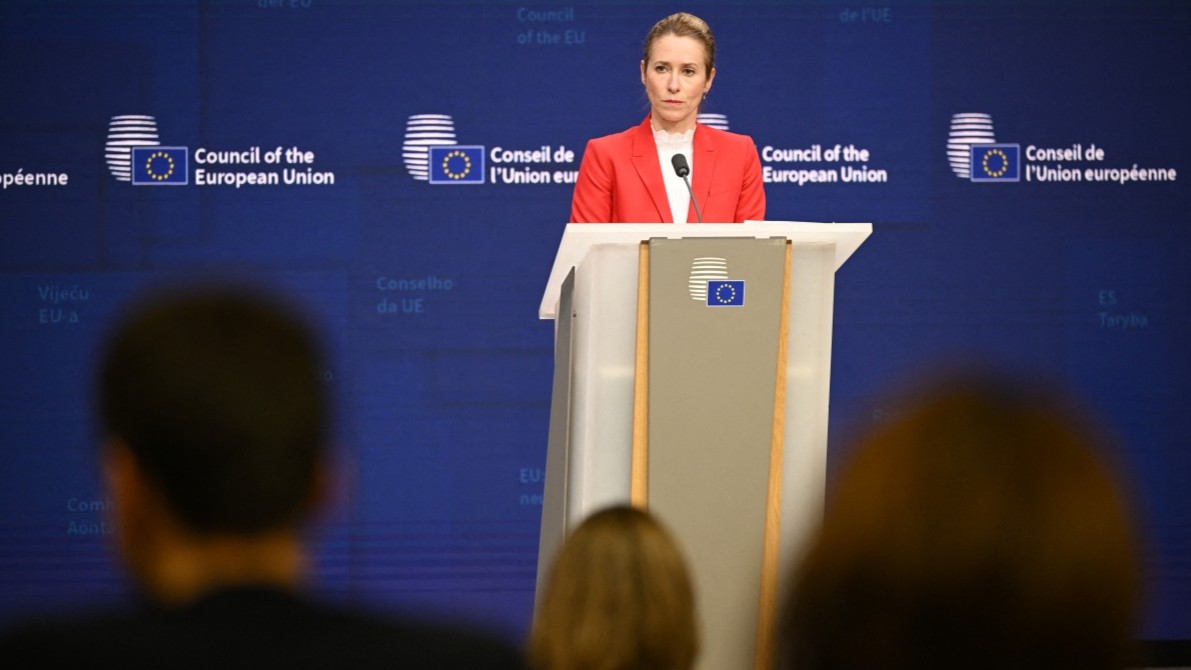
EU Vice-President and High Representative for Foreign Affairs and Security Policy Kaja Kallas addresses a press confrence in Brussels on November 26, 2025.
Nicolas Tucat / AFP
Kaja Kallas, the European Union’s top diplomat, started Monday’s meeting of the bloc’s foreign ministers by rejecting reported aspects of Donald Trump’s Ukraine peace plan and hailing the reaching of a goal that will enable the fighting to go on for longer.
Starting with the latter, the Estonian politician told reporters that Brussels’ target of sending two million rounds of large-calibre ammunition to Ukraine in 2025 has been fulfilled on time, which will surely add to Trump’s view that Europe is keen to prolong the war against Russia.
On this front, the ‘diplomat’ added that Europe has a “break-or-take”—meaning “make-or-break”—week ahead of itself in terms of financing Ukraine, with a decision supposed to be being made on, for example, the confiscation of frozen Russian assets.
The Donbas isn’t Putin’s end game.
— Kaja Kallas (@kajakallas) December 15, 2025
If he gets it, he will demand more.
We know this from history and we should learn from history.
My doorstep ahead of today’s Foreign Affairs Council ↓ pic.twitter.com/g2q7wEwDCh
She appeared to suggest that the conflict really ought to continue—which will, of course, require plenty of funding—until a better peace proposal is on the table that sees Ukraine keep the Donbas, because:
Donbas is not [Vladimir] Putin’s endgame. If he gets Donbas then the fortress is down and then they definitely move on with taking the whole of Ukraine. And if Ukraine goes then other regions are also in danger. [Emphasis added.]
On the contrary, Hungarian Foreign Minister Péter Szijjártó said on Monday that Brussels was the one increasing the likelihood of a wider conflict—in particular, by pushing for the use of Russian assets. He described this as “a war provocation of an unprecedented scale,” adding:
Therefore, at today’s Foreign Affairs Council, I will make it clear that for Hungary, the risk of further escalation is unacceptable. Simply because if a war were to break out between Europe and Russia, Europe would not survive it.
Prime Minister Viktor Orbán also said ahead of the launch of the council that “all” Europe needs to do to help secure peace is “support” America, adding: “Unfortunately, the signs point in the opposite direction.”
This week will be shaped by the #EUCO in Brussels. We are preparing as well. The Hungarian Parliament’s Consultative Body on EU Affairs will meet shortly.
— Orbán Viktor (@PM_ViktorOrban) December 15, 2025
The stakes are clear: war or peace. Never have we been this close to ending the Russia–Ukraine war. Europe stands at the… pic.twitter.com/wFLRny0pW1