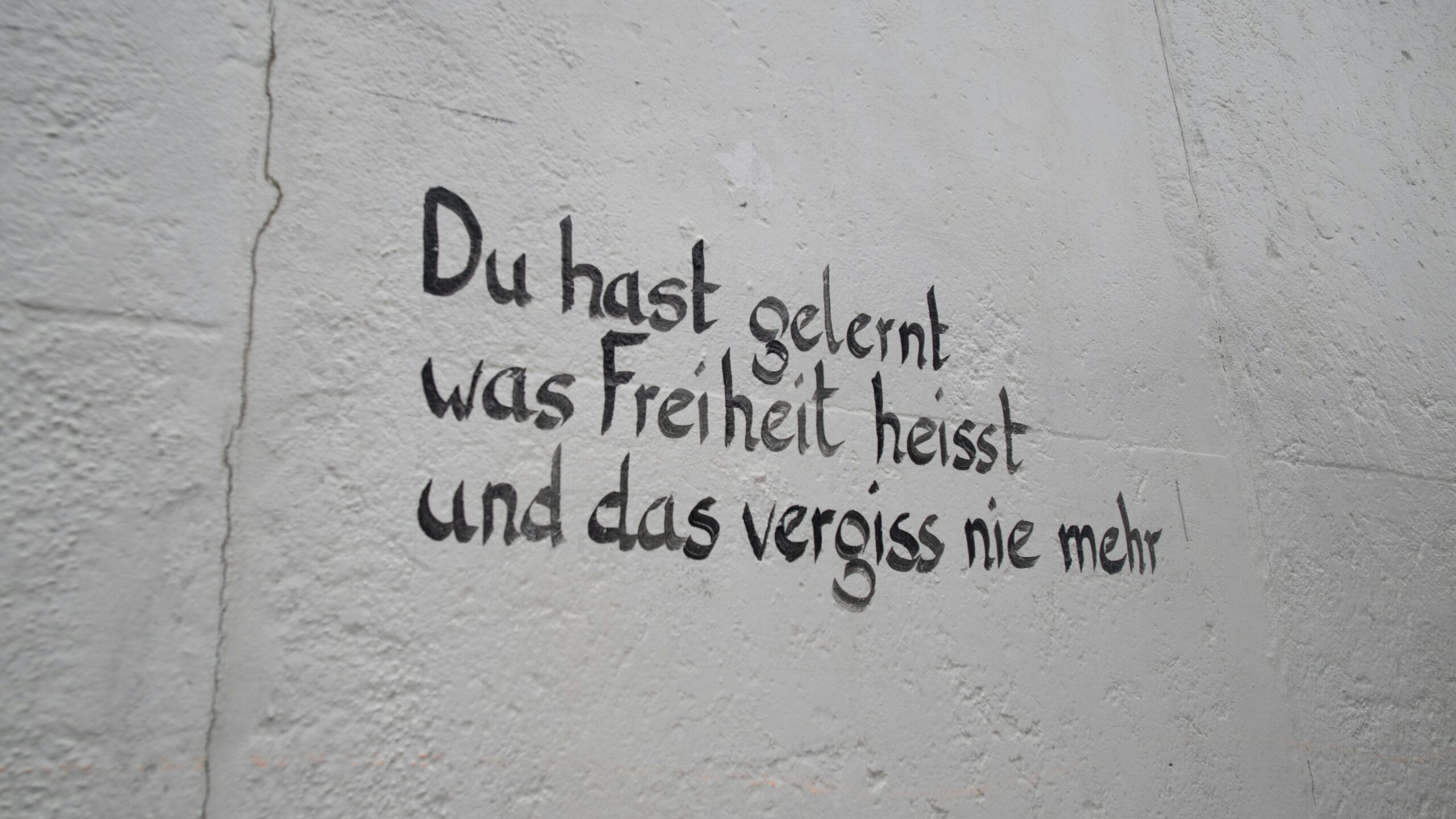
The Freedom Graffiti on the remnants of the Berlin Wall reads “You have learnt what freedom means and never forget it”.
As Hungary approaches its parliamentary elections on April 12th, the debate over media freedom and democracy has once again come into focus. Yet, contrary to the dominant liberal narrative in Western Europe, journalist Boris Kálnoky presents a very different picture.
Kálnoky, a former correspondent for Die Welt and Die Presse who now teaches journalism at the Mathias Corvinus Collegium (MCC) in Budapest, firmly rejects the claim that Hungary lacks independent media.
He argues that government-critical voices are not only present but dominant in the online space, which today plays the most significant role in shaping public discourse. Social media platforms and YouTube channels, in particular, have become powerful arenas for criticism of the government.
According to Kálnoky, the Hungarian media landscape has undergone a profound transformation since 2010. While some outlets disappeared or changed ownership, many new ones were established. More importantly, the overall balance has shifted. Before 2010, approximately 85% of the media represented a left-liberal viewpoint. Today, however, the ratio is closer to 50-50.
This shift did not happen by accident. The Hungarian government, he explains, intervened indirectly in the media market to create what he calls an “even playing field.” While such actions may be considered taboo in the West, Kálnoky raises a fundamental democratic question: what happens when large segments of society are not represented in the media at all? In Hungary’s case, the answer was to restore balance and ensure that previously marginalized viewpoints could be heard.
Perhaps the most striking claim made by Kálnoky concerns freedom of expression. He states that Hungary offers greater freedom of speech than Germany. In Hungary, he notes, individuals can criticize politicians on social media without fear of legal consequences. There is no equivalent to the kind of prosecutorial action seen in Germany when public figures are insulted.
While freedom of expression is never absolute, Kálnoky insists that Hungary remains a functioning democracy where the government can be voted out and where diverse opinions are openly expressed.
The contrast with Western Europe is sharp. Kálnoky points to a growing culture of conformity in countries like Germany and Austria, where journalists risk professional backlash if they deviate from dominant liberal narratives. Even stating that Prime Minister Viktor Orbán is not racist, antisemitic, or autocratic can result in being labeled as a ‘propagandist.’
As Kálnoky puts it, the upcoming election is not merely about party politics, but about whether Hungary will retain its independence and freedom of manoeuvre within the European Union—or become “a country like any other” that follows Brussels without question.