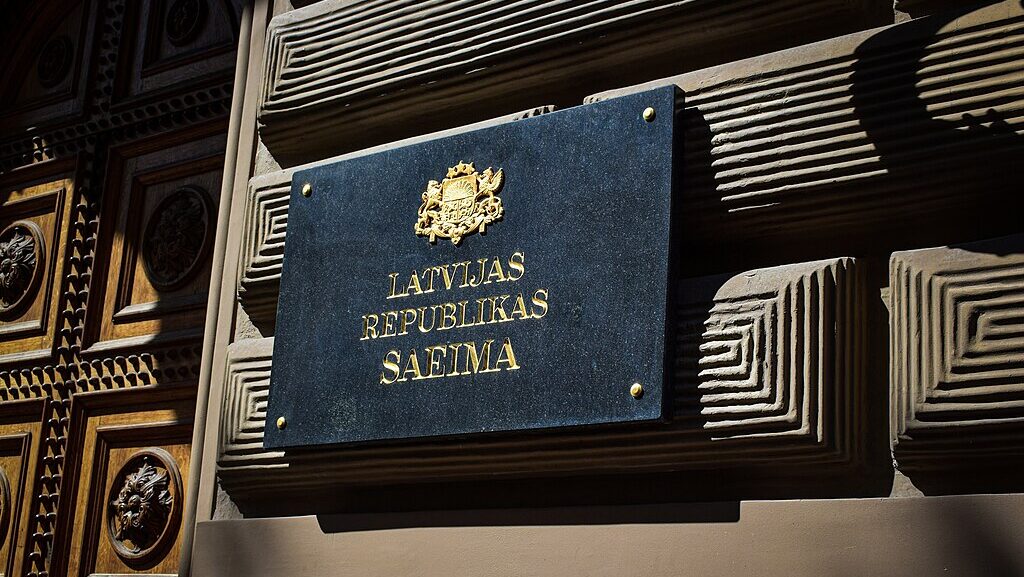
Plaque outside the Latvian parliament
PROP1001, CC BY-SA 4.0, via Wikimedia Commons
On Thursday, October 30, Latvia’s parliament voted to withdraw the Baltic country from the treaty on preventing violence against women, saying that it promotes “gender theories.” The vote would make Latvia the first European Union country to quit the Istanbul Convention.
The Council of Europe convention requires signatory parties to develop laws and policies aimed at ending violence against women and domestic physical abuse. The Council of Europe has repeatedly rejected allegations that the treaty imposes gender theories, notably stating in 2022 that the Istanbul Convention “does not establish any new norms on gender identity or sexual orientation.” However, a closer examination of the treaty reveals provisions that go beyond the simple aim of protecting women. It states that protection applies to all victims, regardless of their biological sex or gender identity. Critics argue that this wording blurs the distinction between biological and social sex and introduces the idea that there are more than two genders.
Hungary, Slovakia, and Bulgaria have previously called the treaty unacceptable and completely incompatible with their national traditions and have refrained from ratifying the document. However, the issue caused a huge dilemma in the UK, Poland, Czechia, Lithuania, and Turkey, which became the first country to withdraw from the convention.
Ladislav Ilčić, former Croatian conservative MEP, previously claimed the treaty “has not proven effective” in reducing violence against women in any ratified countries.
The Istanbul Convention’s explicit definition of gender as separate from biological sex undermines the genuine protection of women and prioritises ideology over facts.
Right-wing opposition parties voted to quit the treaty, while the governing coalition led by centre-right Prime Minister Evika Siliņa was split, with representatives of the Union of Greens and Farmers voting to leave the treaty and the other parties voting to stay. The prime minister voiced her disagreement on X:
Those who have been brave enough to seek help are now witnessing their experiences being used for political battles. It is cruel.
Ramona Petraviča, MP of the right-wing LPV, spoke on behalf of her faction, calling for the problem of violence to be addressed by strengthening Latvian laws.
The liberal camp tends to divert attention from the fact that the Istanbul Convention provides for the introduction of social gender. Anyone who opposes the convention is labelled a Putinist.
Svetlana Čulkova, MP of the centrist ST party, also expressed her conviction that the convention is not necessary to combat violence.
We can already combat violence with existing laws. We have the services and everything else we need to protect every person in Latvia. The Istanbul Convention does not protect women; it protects ideology.
However, women’s rights groups have organised several demonstrations in Riga in recent weeks. On Wednesday, October 29, for example, a group of nearly 5,000 people demonstrated in front of the parliament building.
The MARTA Center, which advocates for the rights of women and migrants, argued that the ratification of the Istanbul Convention in Latvia has produced significant results, which are not just words on paper but represent lives saved.
The motion must now be signed by President Edgars Rinkēvičs, who has indicated he is not in favour but has also hinted that he might not override the parliamentary decision. Rinkēvičs now has several options, including sending the law back for parliamentary review or—under certain circumstances—calling for a referendum.
Lukács Fux is currently a law student at Pázmány Péter Catholic University in Budapest. He served as an intern during the Hungarian Council Presidency and completed a separate internship in the European Parliament.